
When you decide to buy Retatrutide Canada, the supplier you choose is not a minor logistical detail. It is a variable that sits inside every data point your lab will produce with that compound. Retatrutide is a synthetic triple agonist targeting GLP-1, GIP, and glucagon receptors, and its complexity makes it unusually sensitive to synthesis quality and storage handling. A peptide with even modest impurity variation across batches can produce inconsistent receptor-binding kinetics in vitro, turning months of work into a reproducibility problem with no clean explanation. This checklist gives researchers a structured, non-negotiable set of criteria for evaluating any Canadian research peptide supplier before placing an order.
Table of Contents
- Quick Takeaways
- Why Retatrutide Purity Is Non-Negotiable
- The Certificate of Analysis: What It Must Contain
- Third-Party Verification: The Only Standard That Matters
- Chain of Custody and Batch Traceability
- Lyophilization Quality and Shipping
- Supplier Evaluation Comparison
- Red Flags That Disqualify a Supplier Immediately
- Frequently Asked Questions
- References
Quick Takeaways
Key Insight | Explanation |
|---|---|
99%+ purity is the research threshold for Retatrutide | Lower purity introduces unknown impurities that confound receptor-binding assays and dose-response curves. |
Batch-specific COAs are mandatory, not optional | A "representative sample" COA covering multiple lots is insufficient. Every batch must carry its own documented analytical results. |
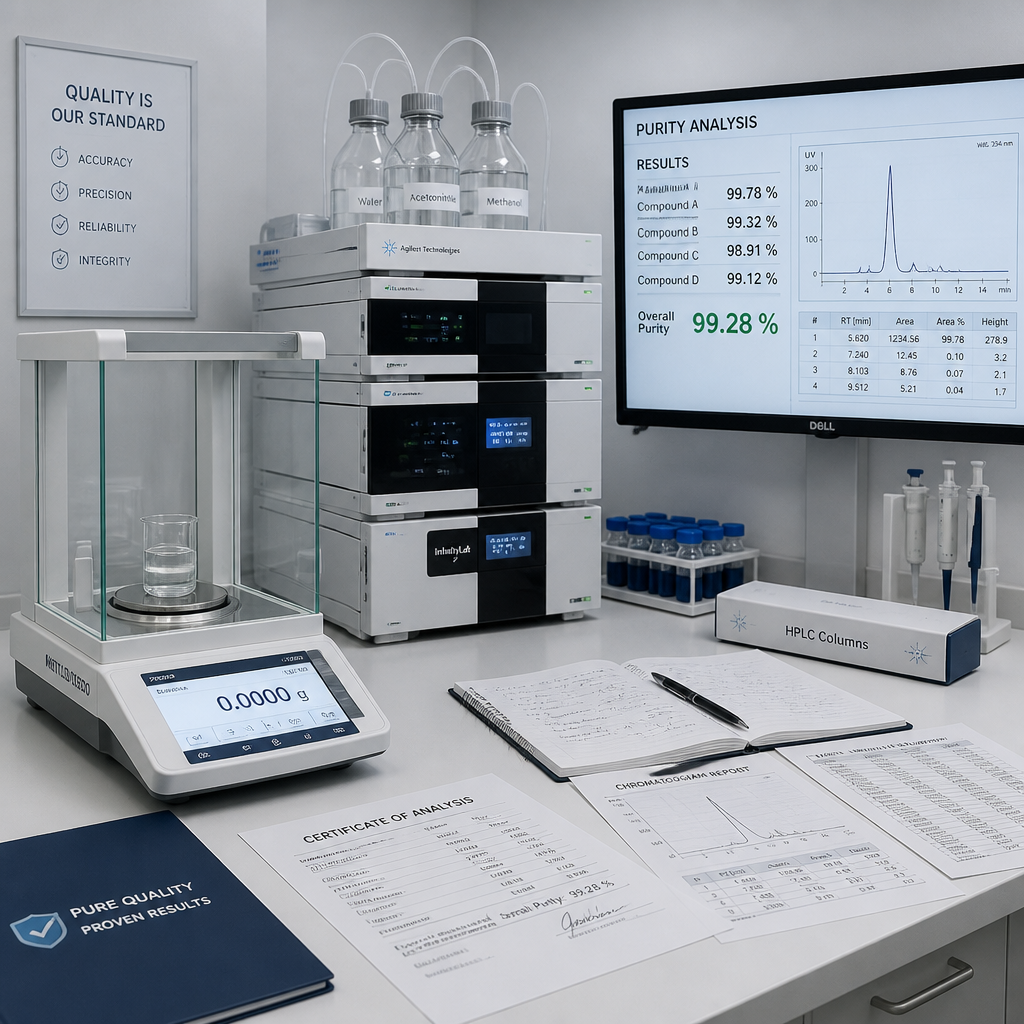
HPLC alone is not enough. Require mass spectrometry confirmation such as LC-MS/MS (Pepura Labs' standard) | HPLC quantifies purity by peak area; mass spectrometry confirms the correct peptide sequence and molecular weight. Or, LC-MS/MS which includes mass spectometry. |
Third-party Canadian lab verification signals real accountability | In-house testing by the supplier is unverified. Independent lab results from a named, traceable Canadian laboratory carry far more weight. |
Chain of Custody documentation protects your research integrity | Full Chain of Custody connects raw material origin, synthesis batch, testing results, and delivery condition into one auditable record. |
Lyophilized format with proper cold-chain shipping preserves stability | Retatrutide in lyophilized form has better shelf stability, but only if the cold-chain is maintained from synthesis through Xpresspost delivery. |
Supplier transparency on reorder consistency is a direct quality signal | If a supplier cannot confirm lot-to-lot purity consistency across multiple orders, reproducibility across your experiments is at risk. |
Why Retatrutide Purity Is Non-Negotiable
Retatrutide is structurally more complex than earlier single-agonist GLP-1 peptides. Its activity at three distinct receptor systems, GLP-1, GIP, and glucagon receptors, means that any synthesis truncation or side-chain modification creates a compound that behaves differently at each target. In practice, a batch at 95% purity versus one at 99%+ purity is not just a 4% quality difference. It is a compound that may carry uncharacterized fragments with partial agonist or antagonist activity at one or more of those three receptors.
For in vitro research, this matters immediately. Receptor selectivity assays, dose-response experiments, and downstream signaling studies all depend on the assumption that the compound introduced is the compound described. When purity is uncertain, that assumption collapses and so does your data's interpretability.
Research-grade suppliers who understand the compound position 99%+ purity as a floor, not a selling point. Suppliers who advertise purity without specifying the method used to measure it, or who list purity as a range rather than a batch-specific figure, are telling you something important about how seriously they approach quality control.
The Certificate of Analysis: What It Must Contain
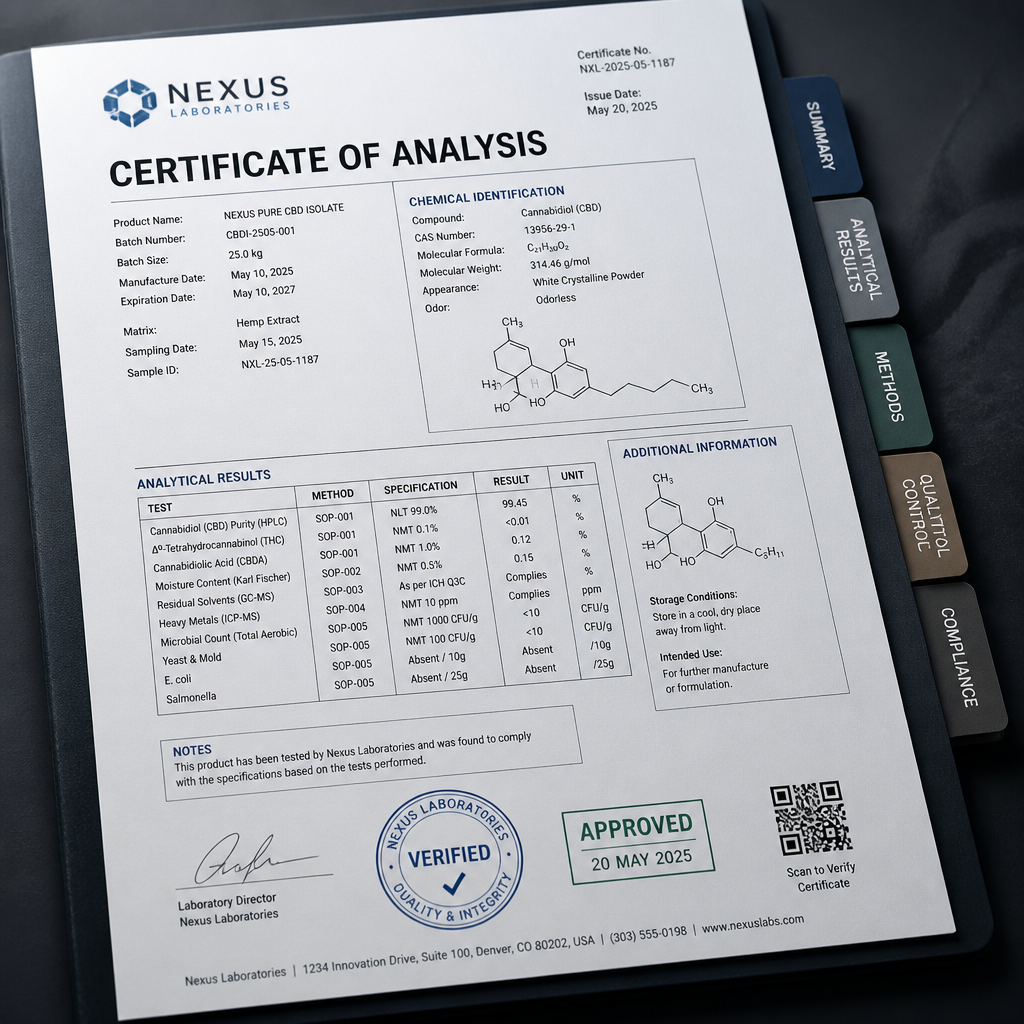
A Certificate of Analysis (COA) is the primary document connecting a specific batch of Retatrutide to its measured quality characteristics. The problem is that not all COAs are equal, and a poorly constructed COA is more dangerous than no COA at all because it creates false confidence.
Minimum Required Fields on Any Research-Grade COA
A valid COA for a research peptide must include: the product name and CAS number, the specific lot or batch number, the date of synthesis and the date of testing, Purity as a percentage with the method conditions documented, mass spectrometry data confirming molecular weight and sequence identity, appearance description, and storage conditions with shelf life. Any COA missing the lot number, the testing date, or the analytical method conditions should be treated as unverified.
One common mistake researchers make when evaluating suppliers is accepting a COA that lists a purity figure without listing the Analytical testing method. Column type, gradient conditions, and detection wavelength all affect what gets counted as purity. A supplier who publishes the raw chromatogram alongside the COA is demonstrating a level of transparency that separates them from those who simply print a number.
Pro tip: Before ordering from any new supplier, request the HPLC or LC-MS/MS chromatogram and mass spectra for the specific lot you are purchasing, not a generic archived COA. A reputable research-grade supplier will provide these without hesitation. A supplier who declines or delays should be treated as unverified.
Batch-Specific vs. Representative COAs
Some suppliers issue COAs that cover a product line rather than a specific production batch. This practice is insufficient for any serious research application. When you reconstitute a specific vial of Retatrutide for an assay, the relevant purity figure is the one for that vial's lot, not an average across multiple synthesis runs. Insist on batch-specific documentation. If a supplier says they test "representative samples," ask directly: what is the sampling interval, and can they guarantee the vial you receive came from a tested batch?
Third-Party Verification: The Only Standard That Matters
In-house testing by a supplier is not independent verification. It is self-reporting. A supplier that tests its own products and certifies its own results has a structural conflict of interest, regardless of how well-intentioned their quality control team may be. Third-party analytical testing by an independent, named laboratory is the only form of verification that carries genuine evidentiary weight.
High peptide purity is essential for accurate and reproducible research outcomes. Variations in synthesis quality or incomplete documentation can introduce inconsistencies into experimental data that are difficult to trace after the fact.
For Canadian researchers, this means looking for suppliers who work with recognized Canadian laboratories and can name the testing facility in their documentation. When the lab is named and the report is traceable, a researcher can independently contact that lab to confirm the result. That traceability is what converts a quality claim into a quality guarantee.
A supplier who has their products verified by Canadian laboratories and provides documentation that names the specific facility and the analyst is operating at a fundamentally different accountability level than one whose COA simply says "tested internally" or cites an unspecified third party.
Pro tip: When evaluating a supplier's third-party test results, cross-reference the lot numbers on the test report against the lot numbers on the vial labels when your order arrives. Lot number mismatches between the COA and the received product are a serious documentation failure and a reason to contact the supplier before using the material in any experiment.
Chain of Custody and Batch Traceability
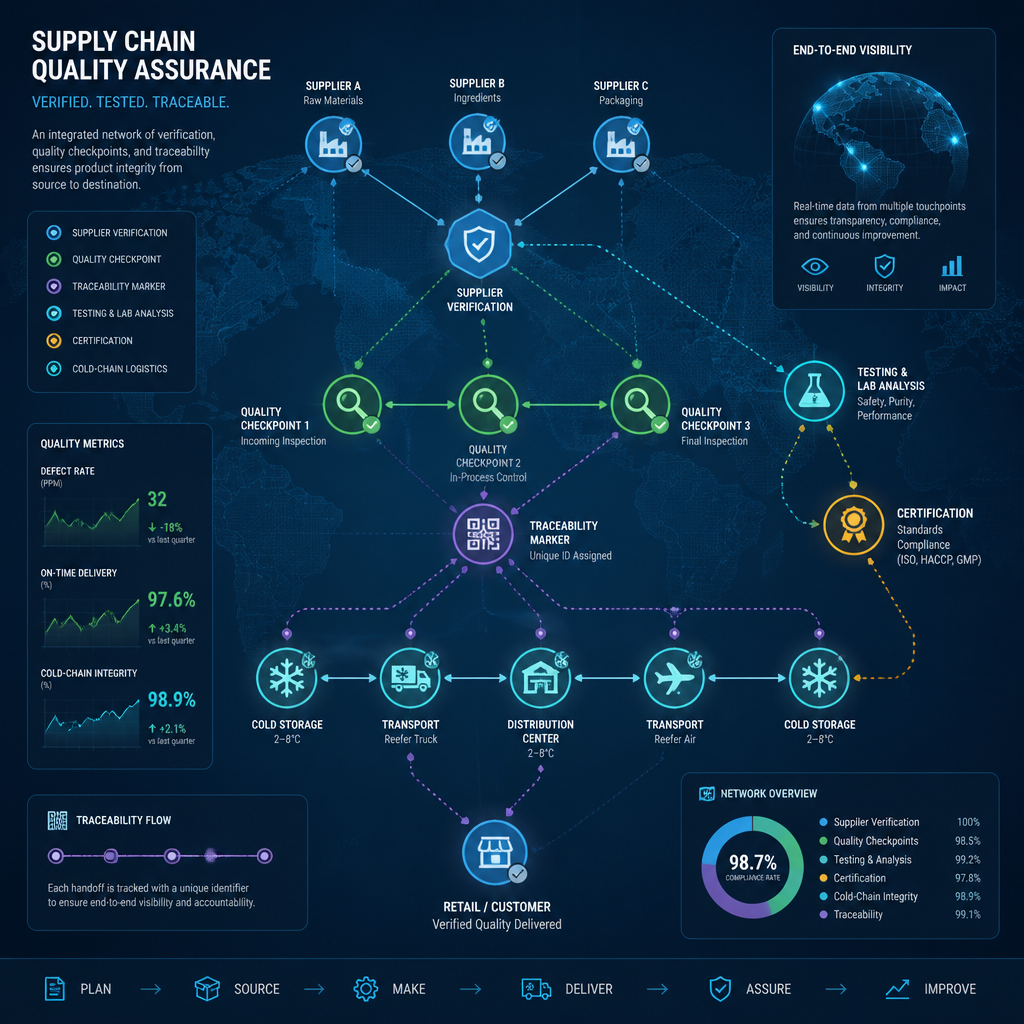
Chain of Custody (CoC) documentation answers four practical questions for any batch of research peptide: what material was received, where it has been, who controlled it at each stage, and whether any event occurred that could have affected its integrity. For a compound like Retatrutide used in in vitro research, this documentation is not administrative overhead. It is a structural component of the experiment's validity.
What Full Chain of Custody Covers
A complete Chain of Custody record for a research peptide connects raw material sourcing, synthesis facility and date, QC testing with a named laboratory, any repackaging or relyophilization steps, shipping and cold-chain handling records, and final delivery condition at the receiving lab. The record should include lot numbers, personnel signatures or electronic equivalents at each transfer point, and timestamps.
In practice, most research scientists do not ask for Chain of Custody documentation until something goes wrong: a failed assay, an unexpectedly flat dose-response, a result they cannot replicate. At that point, retrieving a coherent chain of custody record from a supplier is often impossible if they do not generate it systematically. The time to demand this documentation is before the first order, not after the first anomalous result.
Batch Traceability Across Reorders
Longitudinal research projects face a specific challenge that single-experiment purchasing decisions do not: lot-to-lot consistency. If your lab is running a study across six months, you may need to reorder Retatrutide two or three times. Each new batch must be analytically equivalent to the previous one, or your data across time points becomes non-comparable.
Ask any prospective supplier directly: can you provide the purity and mass spec data for the last three production batches of this compound? If a supplier cannot produce that data or presents data that shows meaningful purity variation across lots, that is a quantitative argument against using them for any longitudinal study.
Lyophilization Quality and Shipping
Retatrutide supplied as a lyophilized powder has significantly better stability characteristics than solution-form peptides, but lyophilization quality is not uniform across suppliers. The lyophilization process itself, if done improperly, can introduce moisture retention, structural degradation, or aggregation that is not always visible in appearance but does affect bioactivity.
What to Verify About Lyophilization
A well in-vial-lyophilized Retatrutide batch will have a consistent cake appearance, documented residual moisture content, and verified reconstitution behavior. The COA should note that the peptide was tested post-lyophilization, not pre-lyophilization. Purity figures obtained before the lyophilization step do not guarantee the integrity of the final product you receive.
Shipping conditions matter as much as the formulation. For Canadian orders, rapid Xpresspost shipping is a practical advantage because it minimizes the time the compound spends in transit conditions that may not be fully temperature-controlled.
Supplier Evaluation Comparison
Not all research peptide supplier evaluation criteria carry equal weight. The table below compares three distinct supplier profiles you are likely to encounter when searching for a Canadian Retatrutide source. This is not a comparison of specific named competitors but of the supplier quality tiers that exist in the Canadian research peptide market.
Supplier Profile | Documentation Standard | Suitability for In Vitro Research |
|---|---|---|
Research-grade supplier with Canadian third-party verification (e.g., Pepura Labs model: named Canadian labs, batch-specific COA, Chain of Custody, 99%+ purity) | Batch-specific COA with HPLC and MS data or LC-MS/MS, named independent Canadian lab, full Chain of Custody, lot-to-lot traceability | Fully suitable. Documentation supports publication-quality research and institutional audit requirements. |
Generic online peptide retailer with unspecified testing (no named lab, no chromatograms, purity stated as a range) | Product-level COA at best, no lot-specific testing, no named testing facility, purity often listed as "greater than 95%" without method | Not suitable for publishable in vitro research. Acceptable only for preliminary feasibility screening where data will not be cited. |
Offshore supplier with generic documentation (COA provided but lab is not verifiable, lot numbers cannot be cross-referenced) | COA format present but not independently verifiable, no Chain of Custody, shipping conditions undocumented, lot numbers may be reused across different orders | High risk. Unusable for any research where reproducibility or data integrity is a requirement. Chain of Custody gaps make audit compliance impossible. |
Red Flags That Disqualify a Supplier Immediately
Most suppliers in this market look credible at first glance. The differentiators are in the details they do not volunteer. The following issues, if present, should disqualify a supplier from consideration for serious in vitro research, regardless of price or availability.
Documentation Red Flags
Purity stated as a range rather than a batch-specific measurement. A COA that covers a product rather than a lot. A named testing laboratory that cannot be independently located or contacted. Mass spectrometry data absent from the COA. Any of these individually is a reason to ask hard questions. More than one of them together is a reason to move on.
Operational Red Flags
A supplier who cannot confirm lot numbers before shipment. A supplier who cannot answer questions about their third-party testing partner by name. Slow or non-existent customer service response to technical questions. These are not bureaucratic concerns. They are indicators of how that supplier will respond when something goes wrong with a batch.
A common mistake is assuming that a lower price point reflects a lapse in quality. In the research peptide market, price variation can but not always reflect a quality control difference, In the case of Pepura Labs, it reflects competitiveness only; quality is not compromised.
Frequently Asked Questions
What purity level is required for Retatrutide in in vitro research applications?
For in vitro research involving receptor-binding assays, signaling pathway studies, or any work where dose-response data will be cited or published, 99%+ purity is the appropriate threshold. Lower purity levels introduce uncharacterized impurities that may have partial agonist or antagonist activity at GLP-1, GIP, or glucagon receptors, making results unreliable and difficult to interpret.
Is a Certificate of Analysis sufficient on its own to verify peptide quality?
No. A COA is a starting point, not a complete quality guarantee. The COA must be batch-specific, include HPLC and MS data or LC-MS/MS purity data with documented methodology, and include mass spectrometry confirmation of molecular identity. It should also be issued by or verified by a named independent laboratory. A COA without supporting raw data, such as the actual chromatogram, is a document that summarizes testing but cannot be independently verified.
Why does it matter whether the testing laboratory is Canadian?
Canadian laboratory verification signals that the testing facility operates under Canadian regulatory oversight and can be independently contacted and verified by the purchasing researcher. It also means that the chain of custody for the product has not passed through international transit points where documentation continuity could be disrupted. For institutional research compliance, domestically verified testing documentation is considerably easier to defend in an audit.
How do I evaluate a supplier's lot-to-lot consistency before committing to a long-term research project?
Request the batch-specific COA and mass spectrometry data for the last two or three production lots of the compound. Compare the HPLC or LC-MS/MS purity values and the reported molecular weight confirmation across those lots. Meaningful variation in purity across batches is a direct indicator that the supplier's synthesis process lacks the consistency required for longitudinal research. A supplier confident in their quality control will share this data without hesitation.
What shipping method is appropriate for lyophilized research peptides in Canada?
Rapid delivery, such as Canada Post Xpresspost, is preferable for lyophilized peptides because it minimizes the time the compound spends outside controlled storage conditions. While lyophilized Retatrutide is more stable than solution-form peptides, extended time in uncontrolled ambient conditions during shipping can still affect integrity. Verify that the supplier uses packaging designed to maintain appropriate temperature conditions during transit and that they can document the shipping conditions for each order.
Can I use Retatrutide purchased from a research supplier for human or animal use?
No. Research-grade Retatrutide is classified as a Research Use Only (RUO) compound and is intended exclusively for in vitro laboratory research applications. It is not approved for therapeutic, diagnostic, or any in vivo human or animal use. Responsible suppliers clearly label their products with RUO status and document this designation in all product and shipping materials.
If you are currently evaluating Retatrutide suppliers for your research program, share what documentation gaps you have encountered most frequently. The research community benefits when scientists are specific about what they have seen in practice.
References
Research peptide quality standards: HPLC, COA, and third-party testing requirements explained
Peptide chain of custody for research laboratories: what full traceability requires
Vetting peptide vendors: a documentation and verification checklist for researchers
Retatrutide as a GLP-1, GIP, and glucagon triple agonist: clinical and research overview
How to evaluate peptide purity, COA authenticity, and HPLC testing quality standards