
Sourcing research-grade peptides in Canada used to mean settling for inconsistent purity, thin documentation, and cross-border shipping gambles. If you need to buy retatrutide Canada and your work depends on verified compound integrity, that tradeoff is simply not acceptable. Retatrutide (LY3437943) has become one of the most closely watched triple-receptor agonist peptides in metabolic research, and demand from Canadian laboratories has grown sharply. The problem is that supply quality varies wildly. This guide explains what separates a research-grade retatrutide source from a substandard one, what dosage formats exist, and why domestic verification matters for any serious research programme.
Table of Contents
- Quick Takeaways
- What Is Retatrutide and Why Is It Significant in Research
- Retatrutide Dosage Formats Available in Canada
- Quality Verification: What Research-Grade Actually Means
- Reconstitution and Storage for In Vitro Research
- Buying Retatrutide Online in Canada: What to Look For
- Comparing Retatrutide Procurement Approaches
- Frequently Asked Questions
- References
Quick Takeaways
| Key Insight | Explanation |
|---|---|
| Purity threshold matters for reproducible data | Research-grade retatrutide should be independently verified at 99%+ purity via HPLC and mass spectrometry. Anything below that introduces confounding variables into in vitro assays. |
| Lyophilized format is the standard for peptide stability | Freeze-dried powder retains compound integrity far longer than liquid-state peptides under typical lab storage conditions. Always confirm the format before ordering. |
| Canadian lab verification is not the same as overseas third-party testing | Domestically verified COAs shorten the chain of custody and make batch traceability straightforward for Canadian research institutions. |
| Multiple dosage formats allow protocol flexibility | Retatrutide is available in 10 mg, 20 mg, 40 mg, 60 mg, and 84 mg vials, letting researchers match compound volume to study scale without overpaying. |
| Bacteriostatic water is an essential companion reagent | Lyophilized retatrutide must be reconstituted before use. Sourcing bacteriostatic water from the same verified supplier simplifies your procurement and ensures reagent compatibility. |
| Xpresspost domestic shipping reduces transit degradation risk | Temperature-sensitive peptides benefit from rapid, tracked domestic delivery. Prolonged cross-border transit introduces uncontrolled temperature exposure. |
| Chain of custody documentation protects research integrity | Full batch traceability from synthesis to delivery is not a bonus feature. It is a baseline requirement for any institution conducting publishable or regulated research. |
What Is Retatrutide and Why Is It Significant in Research
Retatrutide (also catalogued as LY3437943, CAS 2381089-83-2) is a synthetic peptide that acts as a triple receptor agonist, binding simultaneously to the GLP-1 receptor (GLP-1R), the glucose-dependent insulinotropic polypeptide receptor (GIPR), and the glucagon receptor (GCGR). That multi-receptor engagement is what distinguishes it from earlier generations of incretin-based research compounds and makes it an unusually rich subject for metabolic pathway studies.
Published phase 2 data from The New England Journal of Medicine (NCT04881760) demonstrated mean weight reductions of up to 24.2% at 48 weeks in participants treated with the 12 mg dose, making it among the most potent metabolic peptides with published human data. In a separate substudy reported in Nature Medicine, retatrutide treatment corresponded with up to 82% reduction in liver fat in participants with metabolic dysfunction-associated steatotic liver disease at 24 weeks. For researchers studying incretin signalling, appetite regulation, lipid metabolism, and hepatic function, those findings represent a compelling rationale for in vitro work.
It is important to be precise about context: the compounds sold by Canadian research suppliers, including Pepura Labs, are intended exclusively for in vitro laboratory research, not for clinical, diagnostic, or human use. Researchers who want to study the biochemical mechanisms that explain retatrutide's receptor activity in a controlled lab environment need a compound source that matches the purity standards of the underlying science.
"Retatrutide is the first triple agonist acting on GLP-1, GIP, and glucagon receptors with published phase 2 data in people with obesity as well as in people with type 2 diabetes, achieving up to 24.2% mean weight loss after 48 weeks." - synthesis from peer-reviewed literature on triple-agonist metabolic peptides
Retatrutide Dosage Formats Available in Canada
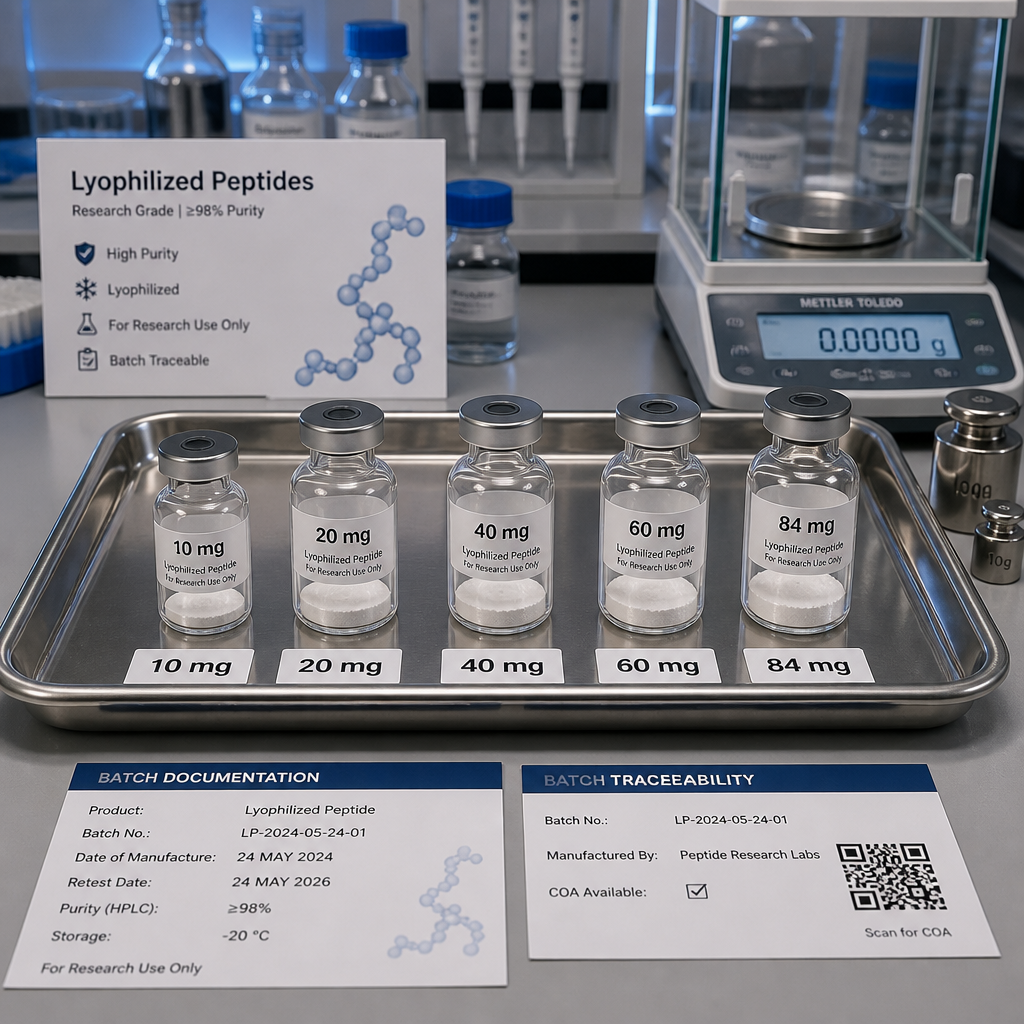
One practical friction point when sourcing retatrutide for Canadian laboratories is matching compound volume to study design. A researcher running a small-scale receptor binding assay has different requirements from a team conducting a multi-condition in vitro metabolic study. Pepura Labs addresses this by offering five lyophilized vial sizes: 10 mg, 20 mg, 40 mg, 60 mg, and 84 mg.
Choosing the Right Vial Size for Your Protocol
The 10 mg vial is the natural starting point for pilot experiments, assay optimization runs, or labs procuring retatrutide for the first time. It limits upfront cost and allows researchers to confirm reconstitution behaviour and assay compatibility before scaling. The 20 mg and 40 mg formats suit mid-scale studies where consistency across multiple experimental runs matters. The 60 mg and 84 mg vials are designed for high-volume research programmes, extended time-course assays, or institutions that benefit from bulk procurement economics without sacrificing verified purity.
A common mistake is ordering the smallest vial regardless of study scale, then facing a mid-experiment shortage that introduces an unwanted batch variable. If your protocol extends beyond a few assay runs, ordering one vial size up from your estimated requirement is a straightforward way to maintain batch consistency throughout the study.
Pro tip: When planning multi-week in vitro experiments, calculate your total compound requirement before placing the order and add a 10-15% buffer. Running out mid-study and switching to a new vial, even from the same supplier, introduces a batch variable that reviewers will ask about. Starting with sufficient volume from a single verified batch is cleaner science.
Bacteriostatic Water as a Protocol-Critical Companion
Every lyophilized peptide order needs a reconstitution vehicle, and bacteriostatic water is the standard choice for in vitro research applications. Pepura Labs stocks bacteriostatic water alongside its retatrutide range. Procuring both from the same source with matched documentation simplifies your reagent inventory and keeps your chain of custody records tidy.
Quality Verification: What Research-Grade Actually Means
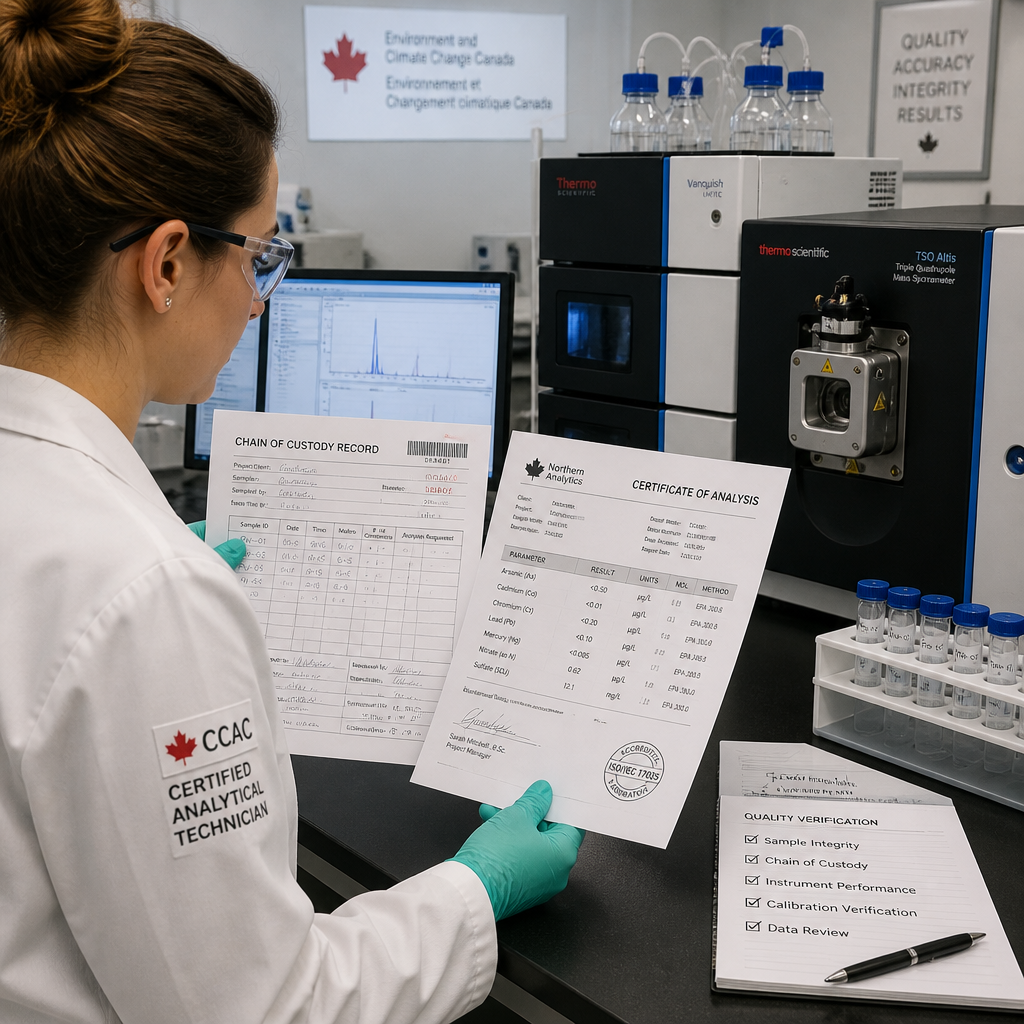
The phrase "research-grade" is used loosely across the peptide supply market. In practice, it should mean at minimum: independent analytical verification of identity and purity, a batch-specific Certificate of Analysis (COA), and clear documentation linking that COA to the exact vial the researcher receives. Pepura Labs meets all three requirements through Canadian laboratory testing, with COAs independently verified by Canadian labs and full Chain of Custody documentation for every batch.
HPLC and Mass Spectrometry as the Standard Analytical Pair
High-performance liquid chromatography (HPLC) quantifies purity by separating peptide from impurities. Mass spectrometry (MS) confirms molecular identity by verifying the exact mass of the compound. Together they constitute the minimum acceptable analytical standard for any peptide used in published research. A supplier that provides only HPLC without MS, or provides MS without HPLC, is leaving half the verification picture blank. Pepura Labs compounds are independently tested to 99%+ purity using this paired approach.
Why Canadian Laboratory Verification Matters
Some suppliers send samples to overseas testing facilities and relay the results. That is better than no testing, but it extends the chain of custody and creates documentation that can be harder to audit. When a Canadian research institution needs to demonstrate reagent traceability for an internal ethics review or a grant body, domestically issued COAs from recognized Canadian laboratories are simpler to validate. The verification does not rely on a foreign lab's accreditation records.
Pro tip: Before placing any significant peptide order, request the COA for the specific batch being shipped, not a generic COA from a previous batch. Batch-to-batch variation is a real issue in peptide synthesis. A responsible supplier will provide the batch-specific document without hesitation. If there is any reluctance, that is informative.
Reconstitution and Storage for In Vitro Research
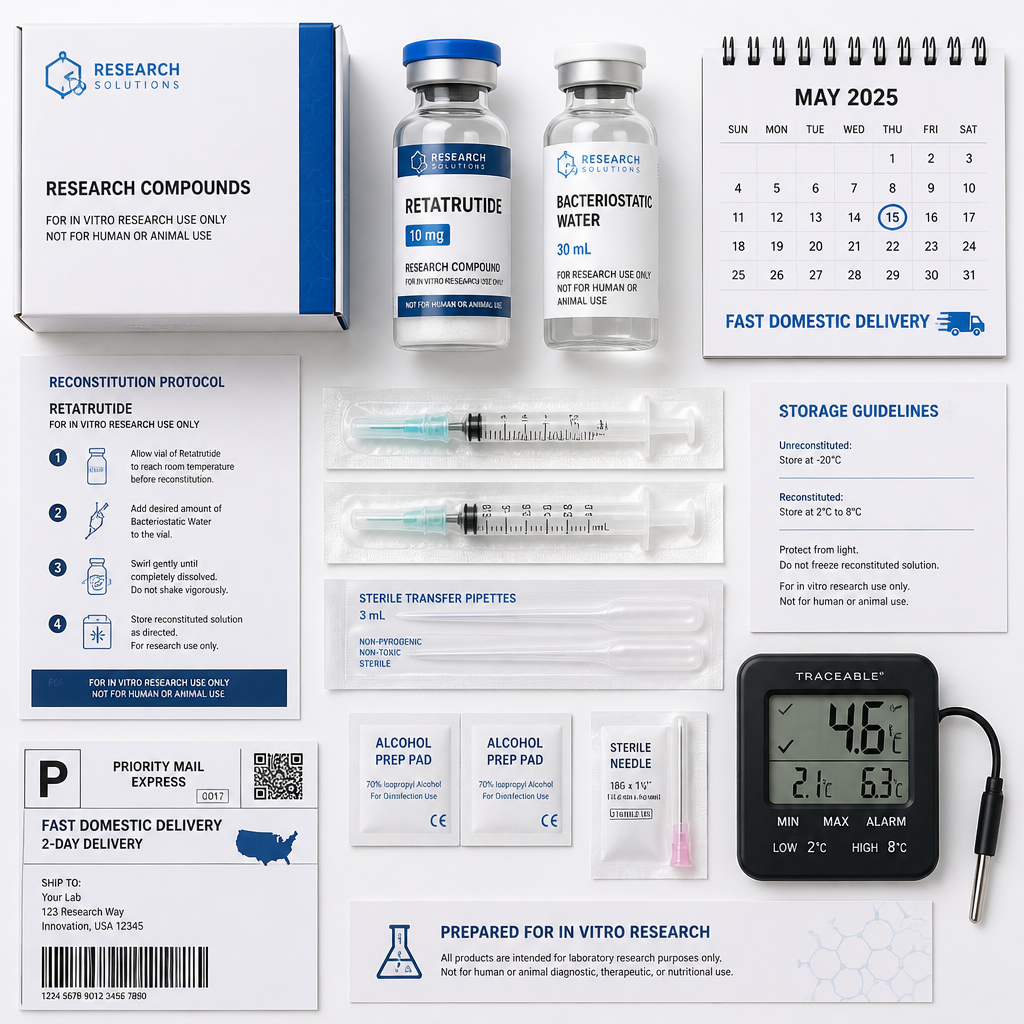
Lyophilized retatrutide is stable in powder form under correct storage conditions. Once reconstituted with bacteriostatic water, the compound requires different handling. The general protocol for peptide reconstitution involves directing the diluent slowly along the inner wall of the vial rather than directly onto the powder, then swirling gently rather than shaking, to minimize foaming and protect structural integrity.
For in vitro applications, reconstituted solutions prepared with bacteriostatic water (0.9% benzyl alcohol) are generally stable for up to 20 days when stored at 2 to 8 degrees Celsius after first entry into the vial. Solutions prepared without a bacteriostatic preservative should be used as quickly as possible. These handling standards apply broadly to peptide reconstitution protocols and are consistent with published guidance on lyophilized peptide research reagents. Always refer to the COA and product-specific documentation provided with each Pepura Labs batch for confirmed handling specifications.
Unreconstituted lyophilized vials should be stored in a freezer, away from light and moisture. A common error is leaving vials at room temperature for extended periods between uses. Even a few hours of temperature excursion above recommended storage conditions can degrade purity faster than most researchers expect, especially in a summer lab environment.
Buying Retatrutide Online in Canada: What to Look For
When you decide to buy retatrutide online Canada, the decision variables are purity documentation, domestic sourcing, shipping speed, and available dosage formats. Each of these has a practical consequence for your research.
Purity Documentation is Non-Negotiable
A supplier that cannot produce a batch-specific COA for the exact vial being shipped is not a research-grade supplier. The COA should specify the analytical method used (HPLC, MS or both), the tested purity percentage, the batch number, and the testing laboratory. Cross-referencing the batch number on the vial against the COA is a basic quality check that takes under a minute and should be standard practice in any research lab.
Domestic Shipping vs. Cross-Border Procurement
Cross-border peptide procurement introduces two problems. First, temperature control during transit is not guaranteed. Peptides are sensitive compounds and extended transit, especially cross-border air freight with uncertain handling, creates real degradation risk. Second, customs processes add unpredictable delays. A Canadian supplier using Xpresspost delivers within Canada under more controlled, faster conditions. For time-sensitive research timelines, that reliability matters.
Pepura Labs ships across Canada via Xpresspost, which provides tracked, rapid domestic delivery. Every order from a Canadian address avoids the customs friction and temperature uncertainty that international procurement carries.
Evaluating Dosage Range and Availability
A supplier offering only a single dosage format forces researchers to either under-order or accept waste. The availability of 10 mg through 84 mg formats from Pepura Labs means the dosage choice can follow the research design, rather than the research design being constrained by what happens to be in stock.
Comparing Retatrutide Procurement Approaches
Research institutions sourcing retatrutide in Canada typically face a choice among three general procurement approaches. The table below compares them on the criteria that most directly affect research quality and operational efficiency.
| Procurement Approach | Key Strengths | Key Limitations |
|---|---|---|
| Domestic Canadian supplier with in-country lab verification (e.g., Pepura Labs) | Canadian COA traceability, Xpresspost domestic delivery, no customs delays, full chain of custody documentation, multiple dosage formats (10 mg to 84 mg) | Requires evaluating supplier documentation carefully; not all domestic suppliers meet research-grade standards |
| International peptide supplier shipping to Canada | Sometimes broader catalogue of less common peptides | Cross-border customs delays, temperature exposure during transit, overseas COA documentation harder to audit for Canadian institutions, higher degradation risk |
| Bulk synthesis to order from a contract manufacturer | Volume pricing for very large quantities, custom specifications possible | Long lead times (weeks to months), high minimum order quantities, often impractical for standard laboratory research budgets and timelines |
Frequently Asked Questions
Is retatrutide from Pepura Labs approved for human use?
No. All retatrutide compounds sold by Pepura Labs are supplied exclusively for in vitro laboratory research purposes. They are not approved for, and must not be used for, clinical, diagnostic, or human administration. Retatrutide remains an investigational compound in clinical development as of the publication date of this article.
What purity level should research-grade retatrutide reach?
The accepted minimum for research-grade peptides used in publishable in vitro studies is 99% purity, verified by HPLC and mass spectrometry. Pepura Labs supplies retatrutide at 99%+ purity, independently verified by Canadian laboratories, with batch-specific COAs provided for every order.
What dosage formats does Pepura Labs offer for retatrutide?
Pepura Labs offers retatrutide in five lyophilized vial sizes: 10 mg, 20 mg, 40 mg, 60 mg, and 84 mg. This range allows research teams to match compound volume to study scale, from small pilot assays to extended multi-condition experiments, without unnecessary surplus or mid-study reorder risk.
Why is bacteriostatic water the preferred reconstitution solution for lyophilized peptides?
Bacteriostatic water (containing 0.9% benzyl alcohol) inhibits microbial growth in reconstituted peptide solutions, extending usable shelf life after reconstitution to up to 20 days when the solution is stored at 2 to 8 degrees Celsius. Standard sterile water without preservative requires immediate use, which is impractical for most multi-session research protocols. Pepura Labs supplies bacteriostatic water alongside its retatrutide range for convenient, matched procurement.
How does Pepura Labs verify that each batch meets its stated purity?
Each batch is independently tested by Canadian laboratories using HPLC and mass spectrometry. The resulting Certificate of Analysis is batch-specific, meaning the COA corresponds to the exact batch number on the vial received. Full Chain of Custody documentation is maintained from synthesis through delivery, supporting audit requirements for research institutions operating under ethics oversight or grant conditions.
How quickly can Canadian researchers expect delivery after ordering?
Pepura Labs ships across Canada via Xpresspost, Canada Post's tracked rapid delivery service. Domestic shipping eliminates customs clearance delays and keeps temperature exposure within a more controlled range than international transit. Exact delivery timelines depend on destination province and order timing, but Xpresspost consistently outperforms cross-border alternatives on both speed and tracking transparency.
What makes Pepura Labs different from other peptide suppliers operating in Canada?
The combination of 99%+ purity verified by Canadian (not overseas) laboratories, full Chain of Custody documentation, five dosage formats from 10 mg to 84 mg, and domestic Xpresspost delivery positions Pepura Labs as a research-grade supplier rather than a general-market peptide vendor. The documentation standard is designed specifically to satisfy the traceability requirements that serious research institutions need, not just to satisfy basic marketing claims.
If you have sourced retatrutide for in vitro research in Canada, we would like to hear what documentation standards and delivery requirements matter most to your laboratory.
We would love your feedback and any insights you would share with others. What perspective would you add?
References
- Phase 2 trial of retatrutide for obesity published in The New England Journal of Medicine, including 48-week weight reduction data
- Nature Medicine phase 2 substudy on retatrutide's effect on liver fat in metabolic dysfunction-associated steatotic liver disease
- Peer-reviewed review of triple GLP-1, GIP, and glucagon receptor agonists including retatrutide phase 2 clinical data summary
- Eli Lilly press release on phase 2 retatrutide results and the TRIUMPH phase 3 clinical programme
- Guidance on reconstituting lyophilized retatrutide with bacteriostatic water for research applications