
Research
Chain of Custody in Peptide Research: Full Guide
September 4, 2026
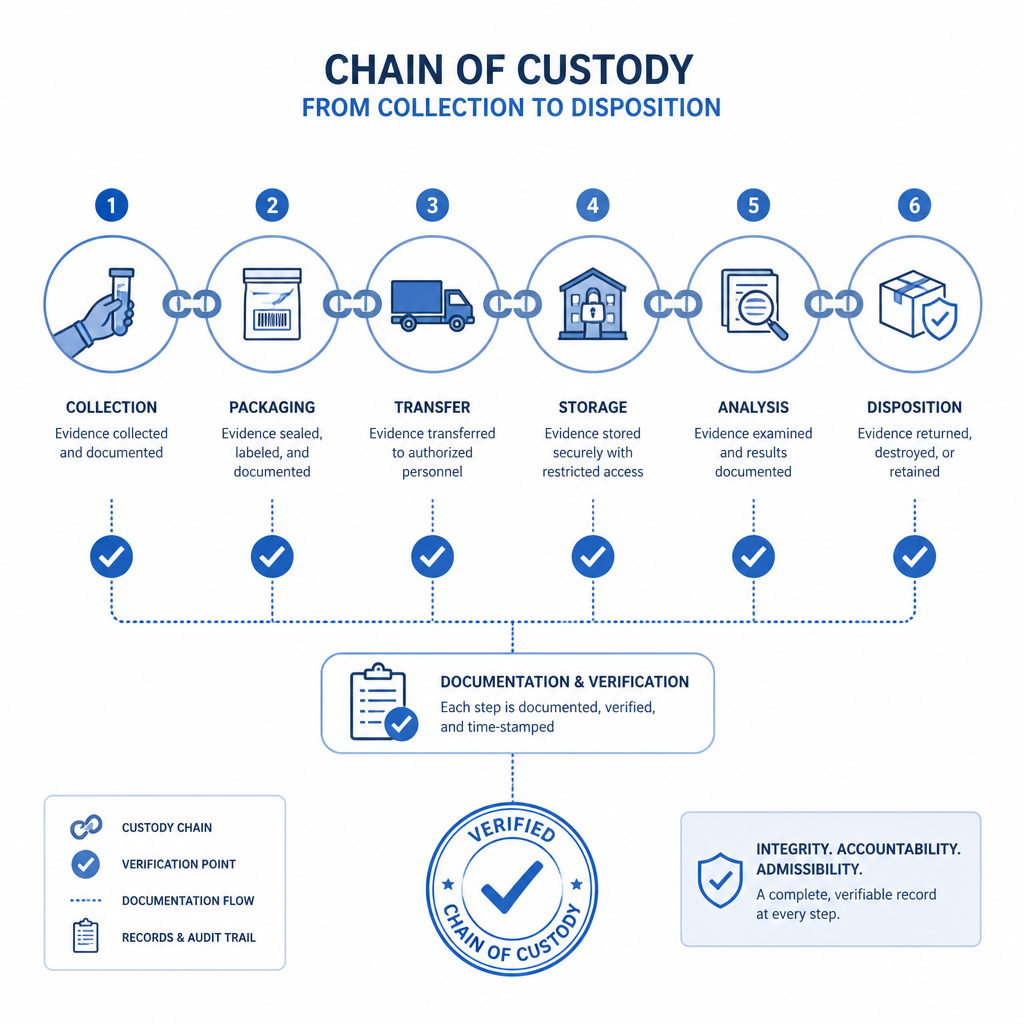
Most researchers purchasing peptide compounds spend significant time evaluating purity percentages and HPLC charts, then essentially trust the rest to luck. That gap, between analytical verification at the point of synthesis and what actually happens between synthesis and your assay plate, is exactly where chain of custody peptide documentation earns its place. A vial that shipped at 99.5% purity but was stored incorrectly, transferred without logging, or received with a mismatched batch number is not a 99.5% purity compound anymore. It is an unknown. This guide explains precisely what chain of custody documentation covers, what it must include to be useful, and how to distinguish suppliers who have built real systems from those who have built the appearance of one.
Table of Contents
- Quick Takeaways
- What Chain of Custody Means for Peptide Research
- The Five Links of a Complete Documentation Chain
- Reading a COA Correctly: What the Numbers Actually Mean
- Supplier Documentation vs. Independent Verification
- Documentation Standards Comparison
- What Peptide Batch Traceability Actually Requires
- Frequently Asked Questions
- References
Quick Takeaways
Key Insight | Explanation |
|---|---|
A batch number alone is not traceability | A lot number only has value when it links directly to a batch-specific Certificate of Analysis. Without that connection, the number is a label, not a documentation system. |
Chain of custody starts before your lab receives the vial | The supplier's synthesis records, analytical testing, and shipping conditions are all part of the same chain. A gap at any earlier stage cannot be fixed by careful in-lab handling. |
Supplier-issued COAs and independent third-party COAs are not equivalent | A supplier testing its own product is not independent verification. Truly independent COAs come from accredited external laboratories with no commercial relationship to the outcome. |
Receipt verification is the most frequently skipped step | Confirming that the lot number on the vial label matches the lot number on the COA at the moment of receipt is a one-minute check that most labs skip. This single step closes a major documentation gap. |
Lyophilized peptides still require storage logging | Lyophilized format increases stability, but temperature excursions, repeated freeze-thaw cycles, and humidity exposure must still be logged to maintain chain of custody integrity. |
HPLC purity and mass spectrometry serve different purposes | HPLC measures purity (what percentage of the sample is the target compound), while mass spectrometry confirms identity (whether the compound has the correct molecular weight). Both are required for a complete COA. |
Documentation gaps create reproducibility risk, not just compliance risk | When experimental results cannot be replicated, undocumented compound handling is routinely identified as a confounding factor. Proper COA documentation and chain of custody records are protective for research integrity. |
What Chain of Custody Means for Peptide Research
Chain of custody, in the context of research-grade peptides, is the documented evidence that a specific compound remained identifiable, controlled, and suitable for its intended application from the point of synthesis through every transfer, storage event, and handling step until final use or disposition. It is not a single document. It is a connected record system.
The practical implication is direct: if a result is ever questioned, whether by a collaborator, a journal reviewer, or a compliance officer, the chain of custody is what allows a laboratory to determine whether an anomalous finding reflects genuine biology or a handling failure. Without that record, the question cannot be answered. The experiment must be discarded or repeated.
For peptide compounds specifically, this matters more than it does for many other reagent classes. Peptides are sensitive to pH, temperature, moisture, and oxidation. A small deviation in storage conditions or reconstitution protocol can alter binding behavior, stability, and downstream assay results. Documentation is not administrative overhead. It is the mechanism by which you retain the ability to interpret your own data.
A chain of custody record is what allows a laboratory to distinguish an analytical finding from a handling failure. Without it, that distinction is not possible regardless of how careful the underlying work was.
The record should connect the product identity, batch or lot number, Certificate of Analysis, receipt condition, storage environment, individual handling events, and any deviation that could affect the material. Each of these is a link. A break at any link ends traceability at that point, regardless of how thorough the documentation is before or after.
We would love your feedback and any insights you would share with others. What perspective would you add?
The Five Links of a Complete Documentation Chain
True chain of custody for a research peptide compound requires documentation at five distinct stages. Understanding what each stage must capture helps researchers evaluate whether a supplier's documentation system actually supports reproducible science, or just appears to.
Stage 1: Synthesis and Analytical Testing
The chain begins at the point of production. The supplier must assign a unique batch or lot identifier at synthesis and connect that identifier to the analytical testing performed on that specific batch. General specification sheets that apply across multiple batches do not constitute batch-specific documentation. The COA must be lot-specific, dated, and must include the methods used and the results obtained for that production run.
Stage 2: Supplier Verification and Release
Before a compound ships, the supplier's quality review should confirm that analytical results meet the stated specifications and that the labeling on the vial matches the batch record. For research-grade compounds at 99%+ purity, this step must include HPLC purity data and mass spectrometry identity confirmation as a minimum. Compounds that pass this review should ship with documentation that the researcher can independently cross-reference.
Stage 3: Receipt Verification by the Receiving Laboratory
On arrival, the receiving researcher should verify that the lot number on the vial label matches the batch identifier on the accompanying COA. This check is performed far less consistently than it should be. It takes under one minute and closes a meaningful documentation gap. Any condition issue at receipt, damage, temperature excursion, or incorrect labeling, should be recorded immediately with photographic documentation where possible.
Stage 4: In-Laboratory Storage and Handling Logging
Traceability does not end when a package arrives. The laboratory's inventory management must track the lot number from receipt through storage, reconstitution, and all uses. For lyophilized peptides, this includes logging the storage location, temperature, date of reconstitution, solvent used, and the identity of the researcher performing each step. Each vial used in an experiment should be traceable to its original lot record.
Stage 5: Experimental Use and Disposition
The final link connects the documented compound to the data generated using it. Experimental records should reference the batch ID and COA for every compound used. When a compound is fully used or disposed of, the final disposition should be logged. This completes the chain and creates a complete, auditable record linking the original analytical testing to the experimental results.
Pro tip: Store a printed or PDF copy of the batch-specific COA alongside the physical inventory record for each compound. When a lot is exhausted, the COA should move to the archive rather than disappear. Historical documentation is what allows retrospective audits to succeed.
Reading a COA Correctly: What the Numbers Actually Mean
A Certificate of Analysis for a research-grade peptide should contain specific elements, and knowing what each element confirms, and what it does not, prevents common misinterpretations that lead to bad sourcing decisions.
HPLC Purity Data
High-Performance Liquid Chromatography measures what percentage of the sample is the target compound. A stated purity of 99%+ means that approximately 99% or more of the UV-absorbing material in the sample elutes at the retention time assigned to the target peptide. It does not confirm identity. A degradation product or a related impurity could, in theory, co-elute with the target under certain method conditions. This is why HPLC purity data alone is insufficient.
Mass Spectrometry Identity Confirmation
Mass spectrometry confirms that the compound has the expected molecular weight and fragmentation pattern. Together with HPLC, it provides both a purity measurement and an identity confirmation. A COA that includes both HPLC chromatogram data and mass spectrum data provides the analytical baseline required for in vitro research applications.
What a COA Does Not Tell You
A COA reflects the analytical status of the compound at the time of testing. It does not guarantee that handling and storage after testing maintained that status. This is the exact gap that chain of custody documentation closes. The COA is the starting point of the record, not the entirety of it.
A common mistake in evaluating supplier documentation is treating a COA as a complete quality assurance system. It is one component. The COA confirms what the compound was at the point of analytical testing. The chain of custody record confirms what happened to it after that.
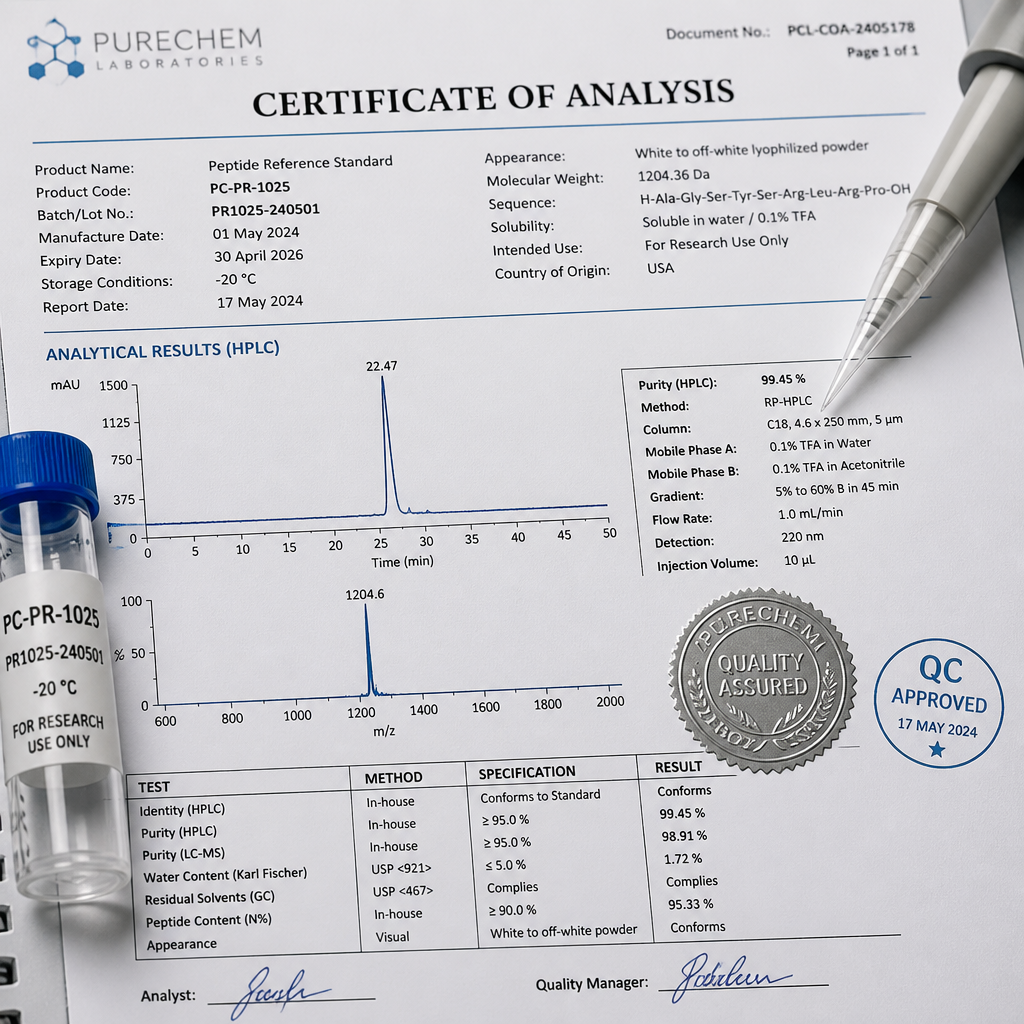
Pro tip: When reviewing a COA from any supplier, check whether the lot number printed on the document matches the lot number on your vial before you log the compound into inventory. Mismatches, while uncommon, do occur and catch them early rather than mid-experiment.
Supplier Documentation vs. Independent Verification
The most important distinction researchers must draw when evaluating a supplier's documentation is whether the COA comes from an independent accredited laboratory or from the supplier's own internal testing function. These are not equivalent, and treating them as equivalent is a significant risk to research integrity.
A supplier-issued COA is generated by the same organization that has a commercial interest in the result. Internal testing can be rigorous and accurate, and often is. But it cannot be independently verified, and it does not carry the same evidentiary weight as a COA issued by an accredited external laboratory with no commercial stake in the outcome.
Independent third-party COAs, particularly those from laboratories operating under recognized accreditation standards, provide a verification chain that researchers and reviewers can audit without relying on the supplier's word. The critical feature is that the documentation trail leads to an entity that is structurally separate from the supplier.
For Canadian research institutions, this matters in practice. When sourcing compounds for in vitro applications, the documentation provided by the supplier will be reviewed if results are submitted for publication, regulatory filing, or internal audit. Independent laboratory verification with Canadian laboratory documentation creates a defensible record under domestic research standards.
Pepura Labs provides independently verified COA documentation for its Retatrutide compounds through Canadian laboratories, with full Chain of Custody records accompanying each order. The documentation connects the analytical result to the specific batch received, not to a general product specification. That distinction is what separates genuine traceability from the appearance of it. You can review Pepura Labs' compound listings and associated documentation at pepuralabs.ca/shop.
Documentation Standards Comparison
Not all suppliers approach documentation with the same depth. The table below compares three documentation approaches commonly seen in the research peptide supply market, based on what each approach actually provides and what it leaves unaddressed.
Documentation Approach | What It Provides | Key Limitation |
|---|---|---|
Generic specification sheet (no lot specificity) | General purity and identity claims for the compound class. May include method references. | Does not document the specific batch received. Cannot be cross-referenced to a production run. Provides no traceability value. |
Supplier-issued lot-specific COA | Batch-specific purity and identity data. Links COA to a specific production lot. Enables basic batch traceability. | Source of the testing is the same organization with a commercial interest in the result. Cannot be independently verified without access to raw analytical data. |
Independent third-party lot-specific COA with Chain of Custody documentation | Batch-specific purity and identity data from an accredited external laboratory. Accompanied by chain of custody records connecting synthesis to delivery. Full audit trail. | Requires supplier investment in external verification systems. Less common in the research peptide market. Represents the appropriate standard for serious research applications. |
The practical implication of this comparison is clear: a supplier that assigns batch numbers but cannot produce batch-specific COA documentation for each one has implemented the appearance of traceability without the substance. Researchers evaluating suppliers for ongoing research programs should require the third column as a minimum standard.
What Peptide Batch Traceability Actually Requires
Batch traceability is frequently described as though it is simply a matter of printing lot numbers on labels. It is significantly more demanding than that, and the gap between superficial and genuine traceability is where research integrity is lost.
Lot Number Assignment and Format
A lot number should be assigned at the point of production and should be structured in a way that encodes meaningful information about the production run. Ideally it connects to: the compound identity, the date of production, and a revision or iteration marker if applicable. A lot number that is just a sequential integer provides less information and makes records harder to interpret retrospectively.
COA Linkage to the Lot Number
Every assigned lot number must connect directly to a specific, dated COA that contains the analytical results for that batch. A supplier that cannot produce this on request, or that provides a COA for a different lot as a proxy, has not implemented real traceability. The COA must be for the actual lot in the researcher's hands, not a representative lot or a prior batch with similar specifications.
Lot-to-Lot Variability Awareness
Even when a supplier consistently achieves 99%+ purity, there will be measurable differences between production batches in impurity profiles, residual solvent levels, and moisture content. Researchers running multi-phase studies need to know when they cross a lot boundary, because that boundary is a potential confounding variable. Batch traceability makes lot changes visible and documentable. Without it, lot changes are invisible, which means any effect they have on results is also invisible.
Archival Period and Record Retention
Traceability records have no value if they are discarded after the sale. Suppliers committed to genuine batch traceability maintain lot records indefinitely or for a defined extended period. Researchers should confirm this policy before establishing a supply relationship, particularly for long-duration studies where documentation may be needed years after the initial procurement.
For researchers in Canada sourcing high-purity peptides like Retatrutide for in vitro applications, the question of documentation depth is directly relevant to research defensibility. A supplier providing full chain of custody documentation, including Canadian lab verification, gives your research program an auditable foundation that generic suppliers cannot match. Learn more about Pepura Labs' documentation approach at pepuralabs.ca/about.
Frequently Asked Questions
What is a chain of custody document for a research peptide?
A chain of custody document for a research peptide is a connected record system that establishes the identifiability and controlled handling of a specific compound from the point of synthesis through every transfer, storage event, and handling step until final experimental use or disposal. It is not a single form. At minimum, it includes the supplier's batch record, the lot-specific COA, receipt documentation, storage logs, handling records, and the connection of the lot to experimental use. The purpose is to allow any step in the compound's history to be audited and any anomaly in results to be evaluated against handling history.
Why is a third-party COA more valuable than a supplier-issued COA?
A supplier-issued COA is generated by the same organization that benefits commercially from a positive result. Third-party COAs are produced by accredited external laboratories with no stake in the analytical outcome. This structural independence is what makes them independently verifiable. A researcher, collaborator, or reviewer can contact the testing laboratory directly to confirm that the document is genuine and that the results reported are accurate. Supplier-issued documentation cannot be verified in this way, which limits its evidentiary weight for serious research applications.
How do HPLC and mass spectrometry differ in what they confirm about a peptide?
HPLC (High-Performance Liquid Chromatography) measures purity: what proportion of the sample is the target compound versus other UV-absorbing material. Mass spectrometry confirms identity: whether the compound has the correct molecular weight and fragmentation pattern consistent with the named peptide. Both are required for a complete analytical picture. HPLC alone cannot confirm you have the right compound, only that the sample is mostly one thing. Mass spectrometry alone does not quantify purity. Together, they provide the analytical baseline that a research-grade COA must include.
What should I check when a peptide order arrives at my laboratory?
At minimum, verify that the lot number printed on the vial label matches the lot number on the COA provided with the shipment. Record the condition of the packaging on arrival, including any temperature indicator readings if present. Log the receipt date, the condition, and the compound location in your laboratory inventory system. Cross-reference the stated purity and analytical method on the COA against what was specified in your purchase order. Any discrepancy should be documented immediately and communicated to the supplier before the compound enters active inventory use.
Does the lyophilized format of a peptide eliminate the need for chain of custody documentation?
No. Lyophilized (freeze-dried) peptide formulations are more stable than liquid preparations, but they are not immune to degradation from moisture exposure, temperature excursions, or repeated handling without appropriate controls. The lyophilized format reduces degradation risk during shipping and storage, but chain of custody documentation remains necessary to establish that those favorable storage conditions were actually maintained at every stage. The COA confirms what the compound was at synthesis. The chain of custody record confirms what it was exposed to afterward. Both are required.
How does poor chain of custody documentation affect research reproducibility?
When experimental results cannot be replicated, undocumented compound handling is one of the most common confounding factors identified in post-hoc analysis. If a researcher cannot confirm which lot was used in a prior experiment, whether the storage conditions were maintained, or whether the compound was reconstituted consistently, they cannot distinguish a genuine non-replication from a compound quality or handling issue. Chain of custody documentation creates the record that makes this distinction possible. Without it, a failed replication attempt leaves the underlying question permanently unresolved.
What documentation should a Canadian research laboratory require from a peptide supplier?
Canadian research laboratories should require: a batch-specific COA from an independent, accredited laboratory (not a generic specification sheet), the lot number clearly printed on both the vial label and the COA so they can be cross-referenced at receipt, documentation of the analytical methods used (HPLC and mass spectrometry as a minimum), and a clear chain of custody record connecting the analytical testing to the specific shipment received. Suppliers that can also confirm their record retention policy and provide documentation on request for prior lots offer the strongest foundation for ongoing research programs.
If you work with research peptide compounds in Canada, we would like to hear what documentation gaps you have encountered when sourcing from suppliers. Share your experience in the comments or reach out directly.
References
Chain of custody requirements for research-grade peptides in laboratory settings
What peptide batch traceability actually means and how to evaluate supplier documentation
Essential guide to reading and interpreting Certificates of Analysis in peptide research
Researcher's guide to verifying peptide purity through HPLC and COA documentation
Why peptide lot number traceability matters for experimental reproducibility