
Research
Peptide Purity 99%: Why It Matters in Retatrutide Research
August 31, 2026
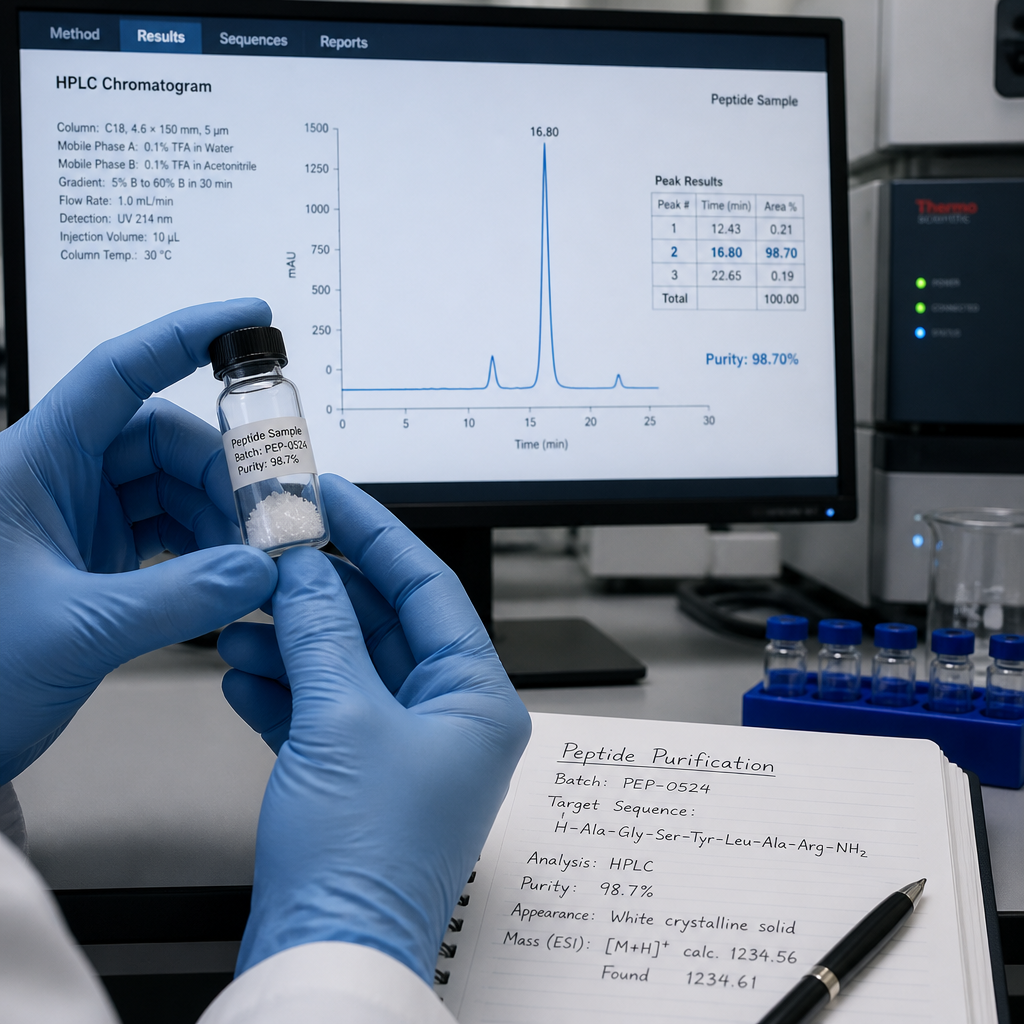
Ask any researcher who has spent weeks optimizing a receptor binding assay only to discover their dose-response curve makes no biological sense, and the first question they will face from a colleague is: what was the purity of the peptide you used? Peptide purity 99% is not a marketing number. It is a functional specification that determines whether your experimental data is interpretable or noise. With a compound as mechanistically demanding as Retatrutide, a synthetic 39-residue triple receptor agonist targeting GLP-1, GIP, and glucagon pathways simultaneously, the margin for impurity tolerance is narrower than with simpler peptides. This article explains precisely why that is, what a credible COA actually tells you, and what to demand from any supplier before a vial reaches your bench.
Table of Contents
- Quick Takeaways
- What Peptide Purity Actually Means (and What It Does Not)
- Why Retatrutide Demands 99%+ Purity Specifically
- How to Read a Peptide COA: What Every Researcher Must Verify
- Purity Levels Compared: 95%, 98%, and 99%+ in Practice
- Chain of Custody Documentation: The Step Most Labs Skip
- Red Flags in Supplier Documentation
- Frequently Asked Questions
- References
Quick Takeaways
| Key Insight | Explanation |
|---|---|
| HPLC purity percentage is area-based, not mass-based | A small chromatogram peak can represent a highly potent impurity. A 1% peak is not trivial if that 1% is a biologically active truncation sequence. |
| HPLC alone does not confirm identity | Mass spectrometry must accompany HPLC to verify the correct molecular weight. A high-purity result could reflect the wrong sequence without MS confirmation. |
| 99%+ is the recommended threshold for receptor binding assays | Truncation sequences from synthesis can compete directly at the target receptor, corrupting IC50 and EC50 determinations in Retatrutide binding studies. |
| COA lot-specificity is non-negotiable | A generic COA not tied to the specific batch you received is not meaningful documentation. Every vial must trace back to a unique lot identifier with matching analytical data. |
| Chain of custody begins at dispatch, not delivery | Cold-chain integrity during shipping affects the compound's condition regardless of what was verified at manufacture. Domestic suppliers with short fulfillment lanes reduce this risk. |
| Missing methodology in a COA is a substantive red flag | Legitimate COAs disclose HPLC column type, mobile phase, gradient, and detection wavelength. Omitting this information signals the vendor may not fully control their own testing process. |
| Lyophilized format preserves verified purity during storage | Lyophilized peptides are chemically stable over longer timescales than reconstituted solutions, making them the appropriate format for research-grade Retatrutide. |
What Peptide Purity Actually Means (and What It Does Not)
Peptide purity, as reported on a certificate of analysis, is a percentage derived from HPLC chromatography. Reversed-phase HPLC separates sample components based on hydrophobicity. The target peptide appears as a distinct peak, and the area under that peak relative to all other detected peaks produces the purity figure. A result of 99.4% purity by HPLC means 99.4% of the detected UV-absorbing material is the target compound.
What this does not tell you is whether that compound is the correct sequence. A synthesis error could produce a structurally similar peptide that elutes at nearly the same retention time, registers as a single dominant peak, and yields a high purity number while being the wrong molecule entirely. This is why mass spectrometry confirmation is not optional. MS verifies the exact molecular weight of the compound, and only the combination of high HPLC purity plus correct MS identity constitutes verified research-grade material.
The impurities present in synthetic peptides are not random contaminants. They are structurally related synthesis byproducts: truncation sequences missing terminal amino acids, deletion sequences missing internal residues, oxidized variants, and deamidated variants. These are the direct consequence of solid-phase peptide synthesis. Multi-stage purification reduces their concentration, but elimination to zero is not achievable. The question is how much remains, and what biological effect that remainder can produce in your specific assay.
Why Retatrutide Demands 99%+ Purity Specifically
Retatrutide (development code LY3437943) is a 39-residue synthetic peptide engineered to act as a triple agonist at GLP-1, GIP, and glucagon receptors. Its mechanistic complexity is precisely what makes purity requirements more demanding than for a simple single-target peptide.
Triple-Receptor Binding and the Impurity Interference Problem
When your experimental design requires measuring differential binding affinities across three separate receptor systems, any truncation sequence in your Retatrutide sample becomes a variable that is very difficult to account for. Truncations of a 39-residue peptide are not biologically inert. Shorter fragments of GLP-1-family peptides retain partial receptor affinity. A truncation sequence present even at 1% concentration can compete at one receptor subtype while failing to activate another, producing a signal profile that does not reflect the intact compound.
For receptor binding assays such as radioligand displacement and fluorescence polarization, the recommended minimum purity threshold is 99%, because competing binding by truncation sequences at the receptor directly confounds IC50 determinations. With a triple-agonist like Retatrutide, where you may be running binding assays across GLP-1R, GIPR, and GCGR simultaneously, the problem multiplies. An impurity that skews one binding curve will distort the relative potency profile that is the whole point of the experiment.
Dose-Response Curves and Quantitative Accuracy
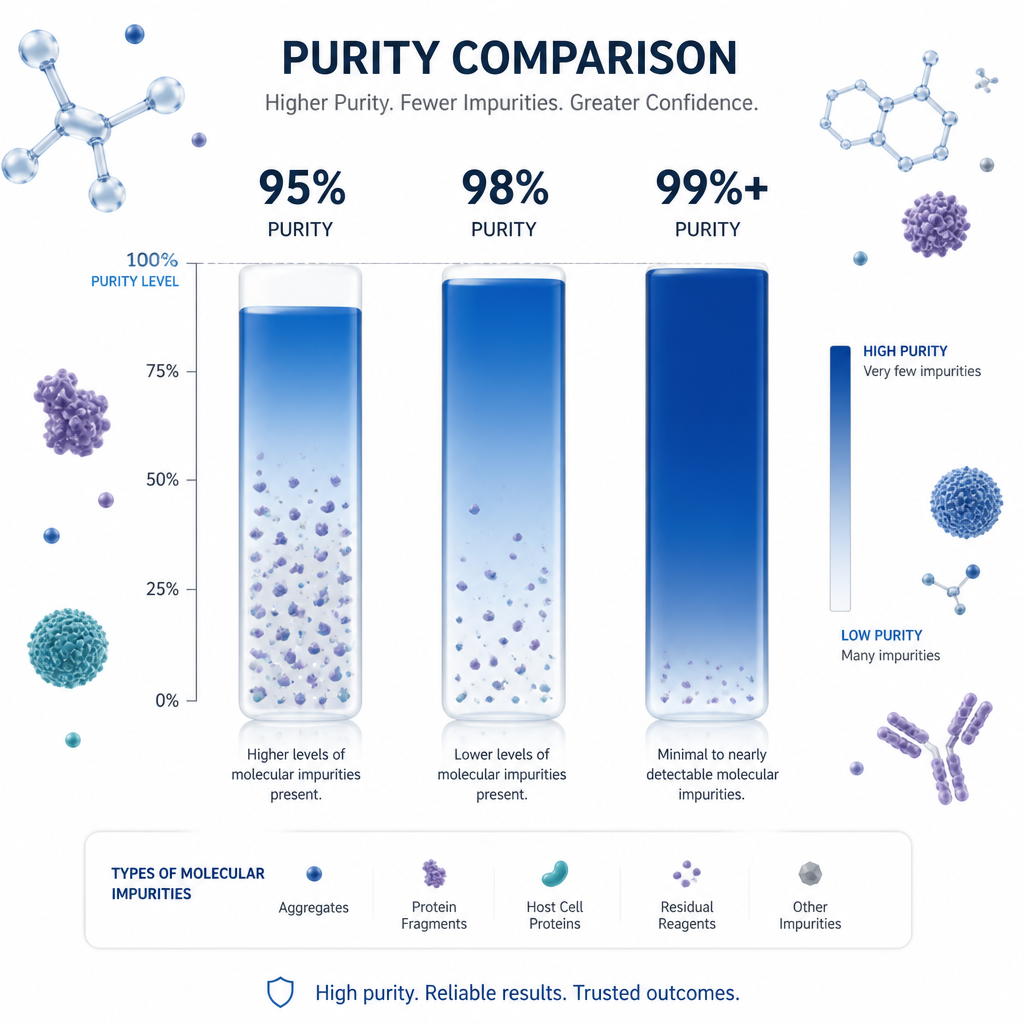
Below 98% purity, there is enough impurity mass to potentially affect dose-response relationships and shift apparent EC50 values. At 99%+, the impurity fraction is small enough that its contribution to a dose-response curve is negligible at typical research concentrations. This matters practically: if you are generating data intended for comparison against published Retatrutide pharmacology, your starting material must be clean enough that purity is not a confounding variable in the interpretation.
Pro tip: When you calculate your working concentration of Retatrutide, remember that the 99.X% purity figure is area-based, not mass-based. A small chromatogram peak can represent a disproportionate amount of a highly potent impurity. Factor this into your assay design, particularly for high-sensitivity formats like cAMP accumulation assays at sub-nanomolar concentrations.
How to Read a Peptide COA: What Every Researcher Must Verify
A Certificate of Analysis is only as useful as the information it actually contains. A COA is a batch-level quality document that compiles analytical test results for a specific production lot. The critical word is "batch-level." A COA that is not tied to a specific lot number with a traceable connection to the vial in your hand is not meaningful documentation. It is a marketing document.
The Minimum Acceptable COA Contents for Retatrutide
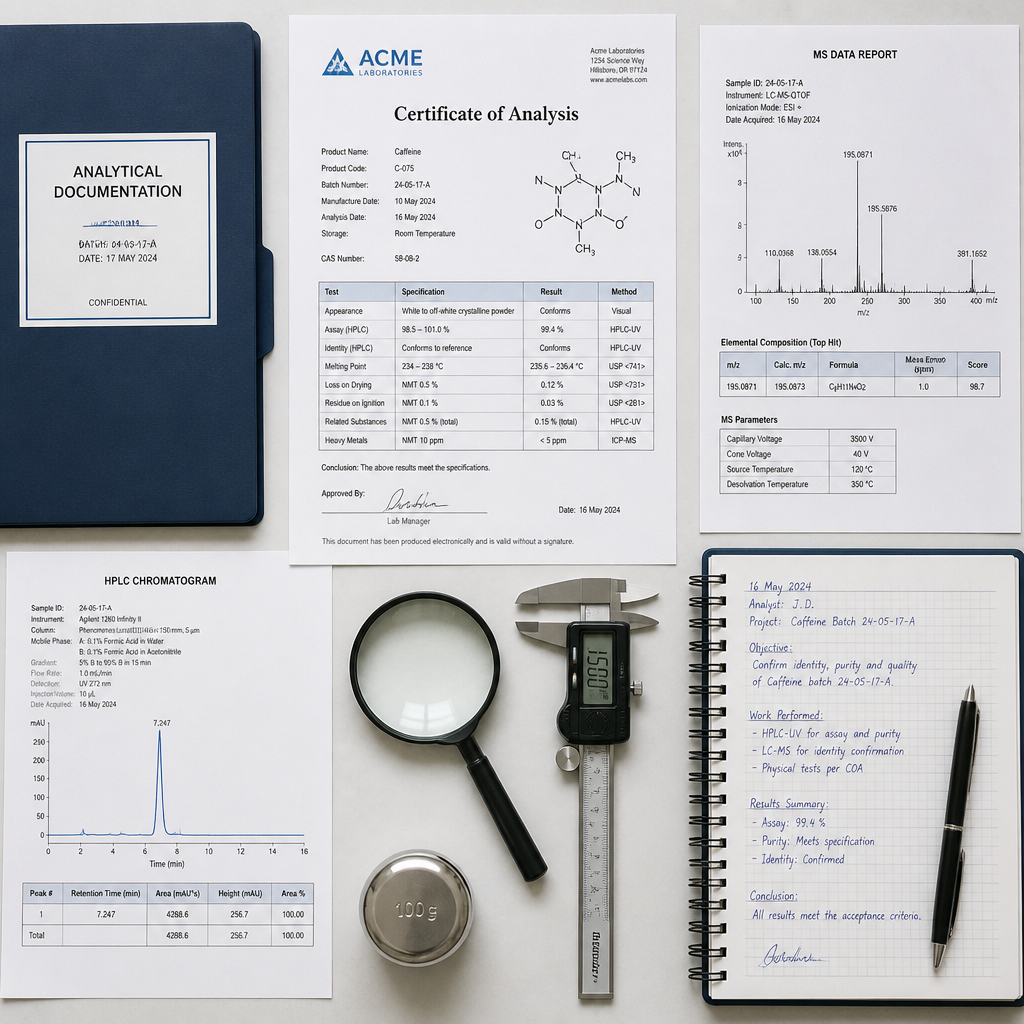
Every COA for research-grade Retatrutide should contain: a unique lot or batch identifier, HPLC purity expressed as a percentage with the accompanying chromatogram showing peak profile, mass spectrometry data showing observed versus theoretical molecular weight, testing dates, and full analytical methodology. That methodology section is not a formality. It should specify the HPLC column type, mobile phase composition, gradient program, detection wavelength, and the mass spectrometry ionization mode used.
When this methodology information is missing, it signals that the vendor either does not understand their own testing process or is presenting results generated by a third party without full comprehension of the analytical conditions. Either scenario is a problem for a researcher who needs to evaluate the quality of the data being presented to them.
A purity figure from chromatographic analysis does not automatically prove full structural identity, and a mass confirmation does not describe every possible impurity. The most credible certificates of analysis make clear what was measured and what was not.
Independent Lab Verification vs. In-House Testing
In-house HPLC testing conducted by the supplier themselves is standard practice and not inherently unreliable, but researchers benefit from independent third-party verification. When a Canadian laboratory independent of the supplier runs the same analysis and produces consistent results, that agreement across two separate testing events adds a meaningful layer of confidence. It also removes the obvious conflict of interest in self-reported quality numbers.
When evaluating a COA, verify that the testing laboratory is accredited and that the document includes specific batch information, testing dates, and detailed methodology descriptions. For Retatrutide specifically, confirm that mass spectrometry results show the observed molecular weight matching theoretical values within acceptable instrument tolerance.
Purity Levels Compared: 95%, 98%, and 99%+ in Practice
The differences between purity grades are not academic. They translate directly into which assay types a given batch of Retatrutide is suitable for, and which it is not. The table below summarizes practical suitability by application type.
| Purity Grade | Suitable Research Applications | Limitations for Retatrutide Research |
|---|---|---|
| 95% HPLC purity | Initial screening, non-quantitative exploratory work | Impurity fraction large enough to influence sensitive assay readouts; unsuitable for receptor binding or dose-response work |
| 98% HPLC purity | Standard cell-based assays, cell viability, migration, cAMP accumulation at moderate concentrations | Marginal for quantitative dose-response work; inadequate for publication-grade receptor binding studies where IC50 accuracy is required |
| 99%+ HPLC purity (with MS confirmation) | Receptor binding assays (GLP-1R, GIPR, GCGR), quantitative dose-response, publication-grade in vitro research | No material limitations for standard in vitro research applications; appropriate starting point for all Retatrutide mechanistic studies |
The 95% threshold is where purity becomes a clearly material concern. Below that point, the impurity fraction is large enough that its influence on sensitive assay readouts is no longer speculative. Between 98% and 99%, the distinction matters most in quantitative work. Numbers between 95% and 98% may be acceptable for screening studies but are inadequate for quantitative dose-response work or publication-grade research. For a triple agonist like Retatrutide, where the research question is often about the relative contributions of three distinct receptor pathways, starting below 99% is a choice to introduce unnecessary uncertainty into an already complex experimental system.
Pro tip: If a supplier offers Retatrutide at multiple purity grades, the 99%+ grade is not an upgrade for edge cases. It is the appropriate specification for any Retatrutide in vitro study that you intend to interpret and report. Saving cost on purity at this stage typically costs far more in repeated experiments.
Chain of Custody Documentation: The Step Most Labs Skip
A verified COA establishes what the peptide was at the moment of manufacture. Chain of custody documentation establishes what happened to it between that moment and the point it reached your bench. These are two separate questions, and in peptide research, both matter.
For research-grade peptides, traceability must extend beyond an order confirmation. The record needs to connect the product identity, batch or lot number, COA, receipt condition, storage environment, individual handling events, and any deviation that could affect the material. A chain of custody answers four practical questions: what material was received, where it has been, who controlled it, and whether any event occurred that may have affected its identity or condition.
Why Domestic Suppliers Shorten the Risk Window
The COA is meaningful only if the chain of custody between dispatch and delivery preserves what was verified. Cold-chain integrity during shipping affects a lyophilized peptide's condition in ways that are not always visible upon receipt. International shipments across multiple jurisdictions, customs holds, and extended transit times all create windows during which temperature excursions can occur without triggering any obvious warning signal.
A Canadian supplier providing Xpresspost delivery within Canada keeps that chain short and traceable. When a batch is released against a verified purity specification and ships domestically within a documented cold chain, the gap between what the COA states and what arrives in your lab is minimized. This is not an abstract quality point. It is a practical argument for sourcing from suppliers whose fulfillment infrastructure matches the quality claims on their documentation.
Reconstitution and the Custody Transfer Problem
Reconstitution is the point where a lyophilized vial becomes a prepared solution, and from that moment, the original container label alone is not sufficient to preserve traceability. When your lab reconstitutes Retatrutide, that event should be documented with the preparation date, solvent used, resulting concentration, prepared volume, and the identity of the person performing the reconstitution. Any aliquoting event, storage condition change, or usage event after that point is a new custody entry. This is the level of recordkeeping that supports reproducible data and defensible methodology when the work reaches peer review.
Red Flags in Supplier Documentation
When evaluating a Retatrutide supplier, the documentation they provide tells you more about their actual quality control than any claim on their homepage. Certain patterns in COA documentation are consistent indicators of a supplier who is not operating at research-grade standards, regardless of the purity number they display.
A COA that is vague, missing lot information, or inconsistent with labeling warrants serious caution. Specifically, watch for: COAs with no chromatogram attached (a number without a chromatogram cannot be independently evaluated), COAs where the testing date predates the product's listed manufacture date, missing or generic methodology sections that do not specify instrument parameters, and purity numbers reported without the accompanying mass spectrometry identity confirmation. Any single one of these patterns is sufficient reason to request clarification before ordering.
Legitimate COAs include verification mechanisms such as unique report IDs, QR codes, or database lookup options that allow a researcher to confirm document authenticity independently. Contacting the testing laboratory directly using contact information obtained independently of the COA itself is the most reliable way to verify authenticity. Do not use the phone number or email printed on the COA as your verification contact. Obtain the lab's contact information from an independent source and make the inquiry directly.
Pepura Labs addresses this verification gap with independently verified COA documentation through Canadian laboratories, including full batch traceability that connects each vial to its specific lot number and analytical record. That structure makes the verification process straightforward rather than an act of faith.
Frequently Asked Questions
What does 99%+ purity actually mean on a Retatrutide COA?
It means that 99% or more of the UV-absorbing material detected in the HPLC chromatogram is the target peptide. The remaining fraction consists of synthesis-related impurities such as truncation sequences, deletion sequences, and oxidized or deamidated variants. The percentage is derived from peak area calculations, not from mass measurement, so even small impurity peaks should be evaluated in the context of their potential biological activity at your working concentrations.
Why is mass spectrometry confirmation required alongside HPLC purity?
HPLC measures the relative proportion of components in a sample but does not confirm the molecular identity of the dominant component. A synthesis error could produce a structurally similar peptide that co-elutes with the target compound and registers as a high-purity result. Mass spectrometry verifies that the observed molecular weight matches the theoretical molecular weight of the correct sequence. Only the combination of high HPLC purity and correct MS identity confirms that what you have is research-grade Retatrutide and not a near-sequence analog.
Is 98% purity sufficient for Retatrutide in vitro research?
For standard cell-based assays such as cell viability, migration, or cAMP accumulation at moderate concentrations, 98% purity is generally sufficient. However, for receptor binding assays where IC50 and EC50 accuracy are required, and for any quantitative dose-response work intended for publication, 99%+ is the appropriate specification. Given that Retatrutide studies typically involve multi-receptor binding comparisons across GLP-1R, GIPR, and GCGR, starting with 99%+ removes purity as a potential confound from the outset.
What should I look for when evaluating a Retatrutide COA from a Canadian supplier?
Verify that the COA is lot-specific, meaning it contains a unique batch or lot number that corresponds to the actual vial you received. It should include the HPLC purity percentage with the full chromatogram, mass spectrometry identity confirmation with observed versus theoretical molecular weight, testing dates, and complete analytical methodology including column specifications, mobile phase composition, gradient conditions, and detection wavelength. A COA missing any of these elements is incomplete documentation, regardless of the purity number it shows.
How does chain of custody documentation protect research reproducibility?
Chain of custody documentation establishes a continuous record of where the peptide has been, who has handled it, and whether any conditions that could affect its integrity have occurred, from the moment it left the supplier through storage, reconstitution, and use in your lab. Without this record, a discrepancy in experimental results cannot be traced to a material handling event. With it, you can eliminate or confirm sample condition as a variable when results are unexpected, and you have the documentation required to support reproducibility claims in peer-reviewed publication.
Why does the lyophilized format matter for Retatrutide storage and purity maintenance?
Lyophilized peptides are chemically stable over longer storage timescales than reconstituted solutions. The freeze-drying process removes water, which is the primary medium for hydrolytic degradation pathways. A Retatrutide batch verified at 99%+ purity at manufacture will remain closer to that specification in lyophilized form during appropriate cold storage than the same batch maintained as a solution. Reconstitution should be performed immediately before use, with documentation of the preparation event as part of your in-lab chain of custody record.
If you work with research-grade peptides in your lab, we would genuinely like to hear how you approach COA verification and chain of custody documentation in your own protocols - share your experience in the comments or reach out directly.
We would love your feedback and any insights you would share with others. What perspective would you add?
References
- Guide to interpreting COA purity metrics and HPLC methodology for research peptides
- Overview of HPLC and mass spectrometry standards for research-grade peptide purity testing
- How to read a peptide certificate of analysis: HPLC methodology, purity thresholds, and documentation standards
- Chain of custody documentation requirements for research-grade peptide traceability
- What 99%, 98%, and 95% HPLC purity percentages mean for different peptide research applications