
Gastric emptying delay is one of the most experimentally consequential effects produced by GLP-1 receptor activation, yet it remains among the most poorly controlled variables in peptide research. Studies using the wrong measurement method have drawn incorrect conclusions. Studies using the right method but the wrong compound concentration have missed dose-dependent effects entirely. If you are designing experiments around gastric emptying GLP-1 research, the mechanistic picture and the methodological choices are inseparable. Getting one wrong means misreading the other. This guide is written for bench scientists and research teams who need to understand exactly what is happening at the receptor level and exactly how to build experiments that capture it cleanly, including when working with next-generation triple-agonist compounds such as Retatrutide.
Table of Contents
- Quick Takeaways
- The GLP-1 Gastrointestinal Mechanism: What Actually Slows Gastric Emptying
- Retatrutide and Gastric Motility: A Triple-Agonist Perspective
- Measurement Methods and Why Your Choice of Assay Determines Your Results
- Experimental Study Design for GI Motility Research
- Comparing Assessment Approaches: Scintigraphy, Stable Isotope Breath Test, and Acetaminophen Absorption
- Common Design Failures That Invalidate GLP-1 Gastric Emptying Data
- Frequently Asked Questions
- References
Quick Takeaways
| Key Insight | Explanation |
|---|---|
| Gastric emptying delay is neurally mediated, not receptor-direct | GLP-1 slows gastric emptying primarily through vagal nerve inhibition and enteric neural pathways, not through direct action on gastric GLP-1 receptors, which are expressed in the mucosa but not functionally linked to motility. |
| The acetaminophen absorption test systematically underestimates the delay | Multiple studies using scintigraphy as the gold standard have shown that the acetaminophen assay produces misleading or non-significant results for solid-phase gastric emptying when GLP-1 receptor agonists are involved. |
| Short-acting agents produce a stronger acute emptying delay than long-acting ones | Short-acting GLP-1 receptor agonists have a more pronounced effect on solid gastric emptying, while long-acting formulations exhibit partial tachyphylaxis over time, though this attenuation is incomplete and variable between agents. |
| Pyloric tone and antral contractility are the two primary effector targets | The mechanistic cascade from GLP-1 receptor activation leads to decreased antral contractility, increased pyloric tone, altered gastric accommodation, and longer retention of solid gastric contents. |
| Tachyphylaxis is real and must be factored into longitudinal study designs | The gastric motility inhibition produced by continuous GLP-1 receptor stimulation wanes over time because of autonomic nervous system adaptation, which means single-exposure and repeat-exposure experiments are not directly comparable. |
| Retatrutide engages gastric motility through its GLP-1 receptor agonism component | As a triple GLP-1/GIP/glucagon receptor agonist, Retatrutide's gastric emptying effects are anchored in its GLP-1 receptor activity, making it a relevant model compound for studying GI motility in the context of multi-receptor incretin pharmacology. |
| Scintigraphy remains the reference method for solid-phase gastric emptying in GLP-1 research | The pooled mean difference in gastric emptying half-time measured by scintigraphy between GLP-1 receptor agonist and placebo conditions is approximately 36 minutes, a quantifiable and reproducible class effect that liquid-phase assays fail to detect reliably. |
The GLP-1 Gastrointestinal Mechanism: What Actually Slows Gastric Emptying
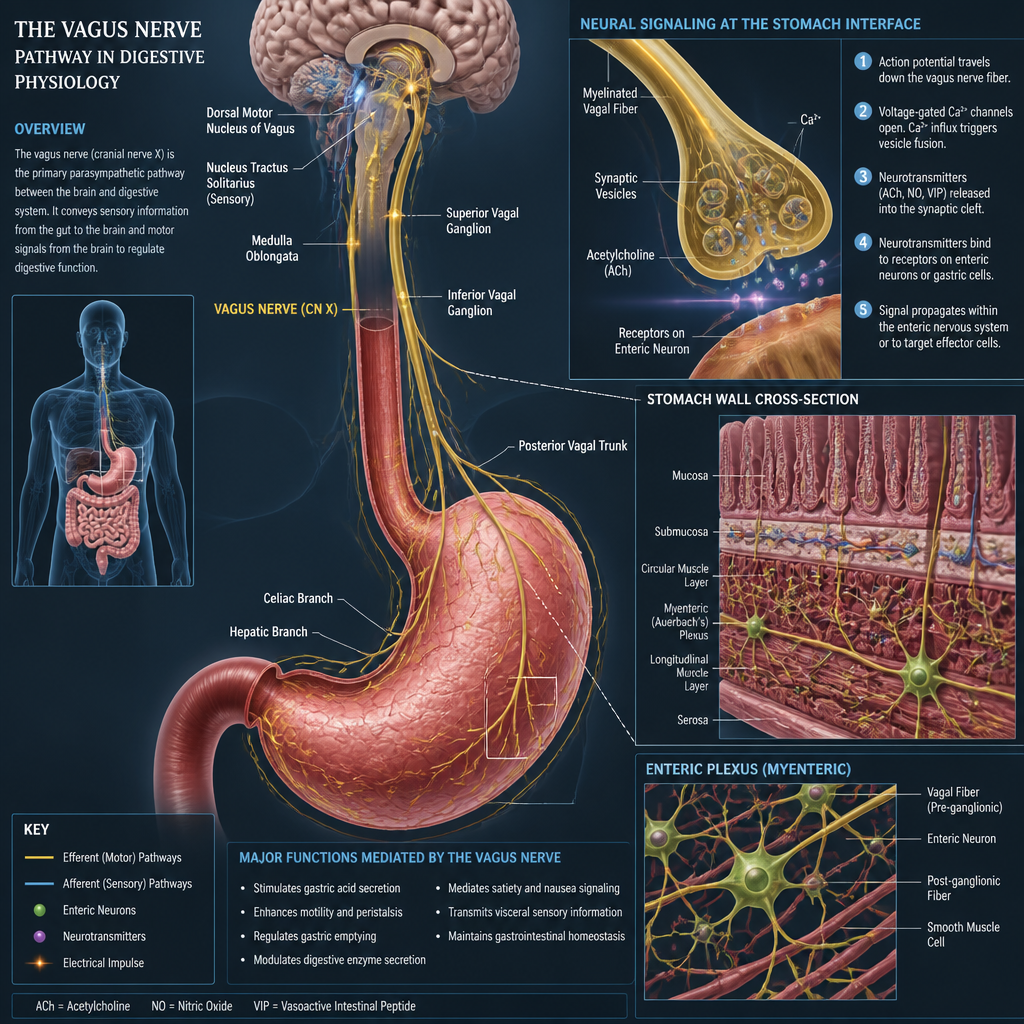
The most important thing to establish before designing any experiment in this space is that GLP-1 does not slow gastric emptying by acting directly on gastric smooth muscle through local receptor activation. The evidence on this is now fairly clear. GLP-1 receptors are expressed in the gastric mucosa, but that expression is compatible with regulating secretion, not motility. The motility effects are mediated through vagal and enteric neural pathways.
Mechanistically, GLP-1 receptor activation couples to the Gs-alpha subunit, stimulating adenylyl cyclase and increasing intracellular cyclic AMP. This enhances nitrergic transmission via nitric oxide and modulates vagal efferent pathways. The net result at the organ level is a well-defined set of functional changes: decreased antral contractility, increased pyloric tone, altered gastric accommodation, and longer retention of solid gastric contents. Animal studies have demonstrated suppression of fed-state antral contractility and attenuation of duodenojejunal propulsive activity following GLP-1 administration.
The Vagal Nerve as the Primary Relay
The consensus view is that GLP-1-induced gastric emptying delay is neurally mediated, with vagal inhibition as the primary relay. One indicator of this is the behavior of pancreatic polypeptide, which serves as a surrogate marker of vagal nervous activity. During initial GLP-1 exposure, pancreatic polypeptide levels are markedly suppressed. With continued administration, that suppression becomes significantly attenuated, which reflects adaptation of the autonomic nervous system to persistent GLP-1 receptor stimulation. This is the same mechanism behind tachyphylaxis of the gastric emptying effect.
For research teams, this has a direct methodological consequence: experiments using a single acute exposure will capture the full neural inhibitory response, while experiments designed to model chronic or subchronic exposure need to account for this autonomic adaptation explicitly. It is not a confound to be dismissed. It is a real physiological signal worth studying in its own right.
Pyloric Tone and the Antroduodenal Junction
Increased pyloric tone is a central part of the GLP-1 gastrointestinal mechanism. The pylorus acts as a gatekeeper between the stomach and the duodenum, and when GLP-1 receptor signaling elevates its baseline contractile state, gastric outflow is mechanically restricted independent of antral pump function. This dual effect, reduced propulsive force from the antrum combined with increased resistance at the pylorus, creates a robust delay in emptying rate that is reliably detectable by scintigraphy but less consistently captured by liquid-phase surrogate assays.

Retatrutide and Gastric Motility: A Triple-Agonist Perspective
Retatrutide is a GLP-1, GIP, and glucagon receptor triple agonist, and it represents the most mechanistically complex compound currently in the triple-agonist class. For researchers studying Retatrutide gastric motility effects, the starting point is understanding which receptor arm drives the GI phenotype and how the other two receptor activities modulate it.
The GLP-1 receptor agonism component provides the core gastric emptying delay. This is the same mechanism observed with single-receptor GLP-1 agonists: slowed meal absorption, inhibited antral contractility, and increased pyloric tone. GIP receptor co-agonism does not independently produce the same degree of gastric motility inhibition, and glucagon receptor agonism in the GI context is primarily linked to altered hepatic glucose output and gastric relaxation effects rather than the classical pyloric tone increase associated with GLP-1.
The pharmacological design of triple receptor agonists means that the gastric emptying phenotype cannot be attributed to a single receptor arm without controlled receptor-selective experiments. Researchers working with Retatrutide need to plan for this interaction systematically, not treat the compound as a simple GLP-1 agonist with extra features bolted on.
Why Retatrutide Matters for GI Research Specifically
Phase 2 clinical trial data for Retatrutide has demonstrated weight loss outcomes of up to approximately 24% after 48 weeks in individuals with obesity, and HbA1c improvements of around 2.2% in people with type 2 diabetes. These metabolic endpoints are partly driven by GI mechanisms, including the gastric emptying delay produced through GLP-1 receptor engagement. For research scientists modeling incretin pharmacology in vitro, Retatrutide provides a compound through which the relative contributions of GLP-1 receptor versus GIP receptor versus glucagon receptor to the GI phenotype can be systematically dissected.
At Pepura Labs, Retatrutide is supplied at 99%+ purity as a lyophilized peptide, independently verified by Canadian laboratories, with full batch traceability and Chain of Custody documentation. For research teams designing GI motility studies, compound quality at this level is not a marketing claim. It is a prerequisite for drawing any reproducible mechanistic conclusion.
Pro tip: When designing receptor-selective inhibition experiments with Retatrutide, run your GLP-1 receptor antagonist controls at the same molar concentration as the agonist dose and confirm receptor occupancy independently before interpreting motility outputs. Partial receptor blockade produces ambiguous data that cannot be used to attribute GI effects to a specific receptor arm.
Measurement Methods and Why Your Choice of Assay Determines Your Results
This is the section most research teams wish they had read before running their first experiment. The choice of measurement method in gastric emptying research is not a logistical decision. It is a scientific one that will determine whether your data is interpretable at all.
Three methods dominate the field: gastric emptying scintigraphy, the stable isotope breath test, and the acetaminophen absorption test. Each measures something slightly different, and their agreement breaks down specifically under GLP-1 receptor agonist conditions in ways that have produced genuinely misleading published findings.
Why the Acetaminophen Test Fails in GLP-1 Contexts
The acetaminophen absorption test works by adding acetaminophen to a liquid test meal. As the meal empties from the stomach, the drug is absorbed in the proximal small intestine and measured in plasma. The problem is that this method measures liquid-phase gastric emptying exclusively, and it relies on the assumption that acetaminophen is rapidly absorbed in the duodenum once it arrives there. Under GLP-1 receptor agonist conditions, both the rate of liquid emptying and small intestinal transit are altered, which violates this assumption.
A meta-analysis of fifteen studies found that scintigraphy-based measurement showed a pooled mean difference in gastric emptying half-time of approximately 36 minutes between GLP-1 receptor agonist and placebo conditions. The same meta-analysis found no statistically significant delay in gastric emptying when measured by the acetaminophen absorption test across Tmax, AUC4hr, and AUC5hr outcomes. These are not minor discrepancies. They reflect a fundamental mismatch between what the assay measures and what GLP-1 receptor agonists actually affect in the stomach.
Pro tip: If your experimental protocol relies on the acetaminophen absorption test as the primary endpoint for GLP-1 gastric emptying research, you are very likely to report a null result that is a measurement artifact rather than a true biological finding. Switch to scintigraphy or stable isotope breath testing for solid-phase emptying endpoints before you run the study, not after you have non-significant results you cannot explain.

Experimental Study Design for GI Motility Research
Good study design in peptide GI research around gastric emptying requires explicit decisions about compound exposure duration, the solid versus liquid distinction in the test meal, the timing of measurement relative to dose, and how tachyphylaxis will be handled or controlled for. Each of these decisions will affect your results in ways that are predictable if you plan for them in advance.
Acute Versus Repeated Exposure Protocols
Single-dose acute exposure protocols capture the maximal gastric emptying inhibitory response because the autonomic nervous system has not yet adapted to sustained GLP-1 receptor stimulation. Repeated exposure protocols, which are more physiologically relevant for modeling therapeutic use, will produce a weaker and more variable gastric emptying delay because of the tachyphylaxis effect described earlier. These two experimental designs cannot be treated as equivalent, and their results should not be pooled or compared without explicit adjustment.
Short-acting GLP-1 receptor agonists produce a more pronounced and acute effect on solid gastric emptying compared to long-acting formulations. With long-acting agents, partial tachyphylaxis is observed over time, though this attenuation is incomplete and variable between compounds. Dose-escalation periods, which are standard in clinical use of compounds like Retatrutide, represent a particularly unstable pharmacodynamic window for gastric emptying measurement because receptor occupancy and autonomic adaptation are both changing.
Test Meal Composition and Solid Phase Selection
The composition of the test meal has a direct impact on measured gastric emptying rate and on which assay method is valid. For scintigraphy, a solid radiolabeled meal is used, capturing the physiologically relevant solid-phase emptying process. For breath testing, a carbon-13 labeled substrate is incorporated into a solid meal component. Both of these capture what GLP-1 receptor agonists actually delay. Liquid-only test meals miss the solid-phase delay almost entirely.
In practice, researchers designing first-in-class experiments with a new triple-agonist compound should run solid and liquid phase measurements in parallel in separate experimental arms rather than combining them, because the compounds affect these two phases through partially distinct mechanisms and to different degrees.
Timing of Measurement Relative to Dose
The gastric emptying effect of GLP-1 receptor agonism is present acutely after a dose and begins to attenuate with repeated exposure. For a lyophilized peptide administered in a research setting, the peak plasma concentration window and the gastric emptying measurement window must be explicitly aligned in the protocol. Measuring gastric emptying outside the active concentration window will produce data that reflects baseline GI function rather than drug effect, and this error is not obvious unless plasma concentration is co-measured.
Comparing Assessment Approaches: Scintigraphy, Stable Isotope Breath Test, and Acetaminophen Absorption
| Assessment Method | What It Measures | Suitability for GLP-1 Gastric Emptying Research |
|---|---|---|
| Gastric Emptying Scintigraphy (GES) | Solid and liquid gastric emptying using radiolabeled meals; direct imaging of gastric content over time; T½ derived from emptying curve | Gold standard for diagnostic and research purposes. Detects the ~36-minute mean delay associated with GLP-1 receptor agonism. Required for solid-phase endpoint studies. Radiation exposure limits repeat measurements in short intervals. |
| Stable Isotope Breath Test (SIBT) | Solid-phase emptying via carbon-13 labeled substrate incorporated into a meal; exhaled CO2 measured over time; non-invasive | Strong agreement with scintigraphy for solid-phase gastric emptying. Well-suited for repeated-measures designs because there is no radiation exposure. Validated for GLP-1 receptor agonist research in multiple study types. |
| Acetaminophen Absorption Test (AAT) | Liquid-phase gastric emptying proxy; acetaminophen added to liquid meal, plasma concentration measured after gastric release into duodenum | Not suitable as a primary endpoint for GLP-1 gastric emptying research. Meta-analytic data shows no statistically significant delay detected with this method across Tmax and AUC endpoints, even when scintigraphy shows a clear 36-minute difference. Assumption of rapid duodenal absorption is violated under GLP-1 agonist conditions. Useful only for studying liquid absorption kinetics as a secondary endpoint. |
Common Design Failures That Invalidate GLP-1 Gastric Emptying Data
A pattern emerges when reviewing the literature: the same experimental errors appear repeatedly across research groups and produce the same category of uninterpretable results. Naming them explicitly is more useful than writing around them in diplomatic language.
The most common failure is using the acetaminophen absorption test as the primary or sole endpoint and interpreting a null result as evidence of no gastric emptying effect. The assay does not measure what the researcher assumes it measures in this context. A null result means the assay failed, not that the compound is inactive on gastric motility.
The second most common failure is not controlling for or reporting the exposure duration and dosing history of the compound. Tachyphylaxis is a real and documented phenomenon in GLP-1 gastric emptying research. If a study does not specify whether animals or cells received acute or repeated exposure, the gastric emptying data cannot be compared to anything else in the literature with any confidence.
The third failure is measuring gastric emptying in liquid-only models when the relevant physiological effect of GLP-1 receptor agonism is on solid-phase emptying. This is especially relevant for in vitro model systems where the researcher controls the substrate entirely. Choosing a liquid substrate because it is easier to work with will produce data that systematically underestimates the GI effect of the compound.
For research teams sourcing compounds for these experiments, the quality of the peptide itself is a potential confounder that is often overlooked. Impure or degraded compounds will produce inconsistent receptor occupancy across assay runs, which generates the kind of high variance, low reproducibility data that looks like biological noise but is actually a supply chain problem. This is precisely why working with a supplier like Pepura Labs, which provides independently verified 99%+ purity with full batch traceability, matters for producing research-grade results rather than just obtaining any sample of the compound.
Pro tip: Build a concurrent plasma concentration measurement into your gastric emptying protocol from the start. Without confirmed compound exposure at the time of GI measurement, you cannot distinguish between a true null effect and an under-dosed or degraded peptide. This single addition to your protocol will save months of troubleshooting later.
Frequently Asked Questions
Does GLP-1 receptor activation slow gastric emptying through a direct or indirect mechanism?
The effect is indirect and neurally mediated. GLP-1 receptors are expressed in the gastric mucosa and in the enteric and central nervous systems. The current evidence supports vagal nerve inhibition and enteric neural modulation as the primary mechanism, not direct action on gastric smooth muscle via locally expressed receptors. This distinction matters for experimental design because it means that cell-based assays measuring downstream gastric smooth muscle contractility in isolation will miss the primary pathway.
Is tachyphylaxis to the gastric emptying effect of GLP-1 complete with prolonged exposure?
No. Tachyphylaxis to the gastric emptying delay produced by GLP-1 receptor stimulation is documented and associated with adaptation of the autonomic nervous system, but the attenuation is incomplete and variable across different receptor agonist compounds. Clinically significant gastric retention can still occur with long-acting formulations, especially during dose escalation periods. Research designs that assume chronic exposure eliminates gastric motility effects will underestimate the actual GI phenotype.
Which measurement method should be used for solid-phase gastric emptying in GLP-1 research?
Gastric emptying scintigraphy is the gold standard and is the method that has reliably detected the approximately 36-minute mean delay associated with GLP-1 receptor agonism. The stable isotope breath test is also validated for solid-phase emptying and is preferable for repeated-measures designs because it does not involve radiation exposure. The acetaminophen absorption test should not be used as a primary endpoint for GLP-1 gastric emptying research, because it measures liquid-phase emptying and systematically fails to detect the solid-phase delay that characterizes this pharmacological class.
How does Retatrutide's triple receptor agonism affect the gastric emptying phenotype compared to a single GLP-1 receptor agonist?
Retatrutide's gastric emptying delay is anchored in its GLP-1 receptor agonism component. GIP receptor co-agonism does not independently produce the same degree of pyloric tone increase and antral contractility suppression. Glucagon receptor agonism contributes separately to gastric relaxation effects. The net GI phenotype of Retatrutide cannot be predicted by summing the effects of each receptor arm studied separately. Controlled receptor-selective inhibition experiments are necessary to attribute specific GI outcomes to specific receptor contributions in this compound.
What is the most common experimental design error in GLP-1 gastric emptying research?
Using the acetaminophen absorption test as the primary endpoint and interpreting the resulting null finding as evidence that the compound does not affect gastric emptying. This error has appeared repeatedly in the published literature and has been corrected by subsequent scintigraphy-based studies showing a clear and significant delay. The second most common error is failing to document and control for compound exposure duration when tachyphylaxis to the GI effect is a documented and predictable phenomenon.
Why does compound purity matter specifically for gastric emptying endpoint studies?
Inconsistent purity across batches produces inconsistent receptor occupancy across experimental runs. In gastric motility studies, where the GI effect is neurally mediated and therefore sensitive to the precise dose of active compound reaching the receptor, impure or degraded peptide will generate high between-run variance that cannot be distinguished from true biological variability without knowing the compound's actual active concentration. Research-grade purity with batch-level verification is not optional for this application.
Are you designing a GLP-1 or multi-receptor incretin study and facing questions about assay selection or compound sourcing? Share your experimental setup in the comments and let us know what design decisions are giving you the most uncertainty.
References
- Clinical review: GLP-1 receptor agonists, gastric emptying delay, tachyphylaxis, and retained gastric content - mechanisms and consequences
- Systematic review and meta-analysis of gastric emptying half-time in GLP-1 receptor agonist versus placebo conditions, comparing scintigraphy and acetaminophen absorption outcomes
- Oxford Endocrinology review of GLP-1-based therapies including triple agonist retatrutide and measurement of gastrointestinal function effects
- Translational narrative synthesis on GLP-1 receptor agonist effects on gastric motility via vagal and enteric neural pathways and peri-endoscopic outcomes
- Research on neural mediation of GLP-1 gastric emptying delay and waning of the effect under continuous receptor exposure