
A supplier's product page says "99% pure." That claim means nothing without a certificate of analysis peptide document that backs it up with measured data, a named testing laboratory, and a batch number you can trace to your vial. For researchers working with research-use-only compounds such as Retatrutide, the COA is not a formality. It is the primary quality assurance instrument available. Because research-grade peptides are not regulated like approved pharmaceuticals, the burden of verification falls entirely on you. Knowing how to read a COA properly is the difference between reproducible data and experiments built on an unknown compound.
Table of Contents
- What Is a Peptide Certificate of Analysis?
- Quick Takeaways
- Anatomy of a Legitimate COA: Section by Section
- HPLC Purity: What the Number Actually Means
- Mass Spectrometry: Confirming Identity
- Chain of Custody and Batch Traceability
- COA Testing Methods Compared
- Red Flags That Invalidate a COA
- What Canadian Researchers Should Demand from a Supplier COA
- Frequently Asked Questions
- References
What Is a Peptide Certificate of Analysis?
A peptide certificate of analysis is a lot-specific laboratory document that summarizes the analytical testing results for a single batch of a synthesized peptide compound. It reports identity, purity, and other key quality attributes that determine whether a compound is fit for use in controlled laboratory conditions.
The operative word is lot-specific. A COA that covers a "representative sample" or a generic batch from a previous production run does not document the compound you are receiving. Every legitimate supplier issues one COA per production batch, referenced by a unique batch or lot number that physically appears on the vial label.
A COA transforms an unmarked white powder into a scientifically verifiable reagent. Without it, you have no documented basis for the identity or purity of what you are working with.
Quick Takeaways
Key Insight | Explanation |
|---|---|
Batch number must match the vial label exactly | Any discrepancy means the COA document is irrelevant to the compound you received. This is a non-negotiable verification step before any experiment. |
HPLC purity is an area percentage, not a total content figure | It measures the target peptide peak relative to other UV-absorbing organic impurities detected at the time of analysis. Water, salts, and non-chromophore species are invisible to standard UV detection. |
Mass spectrometry confirms identity, not purity | A passing mass spec result tells you the molecular weight matches the expected peptide sequence. It does not tell you how pure the sample is. |
Third-party ISO 17025 accredited labs carry the highest evidentiary weight | The testing laboratory has no financial stake in the outcome. In-house supplier testing introduces a conflict of interest that cannot be resolved by looking at the document itself. |
An HPLC chromatogram image should accompany the purity percentage | A number without the chromatogram that produced it cannot be independently assessed. The peak shape, baseline noise, and integration boundaries are part of the result. |
Test date matters for lyophilized peptides | Lyophilized peptides can degrade under improper storage. A COA dated several years prior may not describe the current chemical state of the material you receive. |
Residual solvent and endotoxin panels strengthen confidence | A COA that only reports purity and identity is incomplete. Contamination from handling, lyophilization, and transit is not captured by HPLC or mass spectrometry alone. |
Anatomy of a Legitimate COA: Section by Section
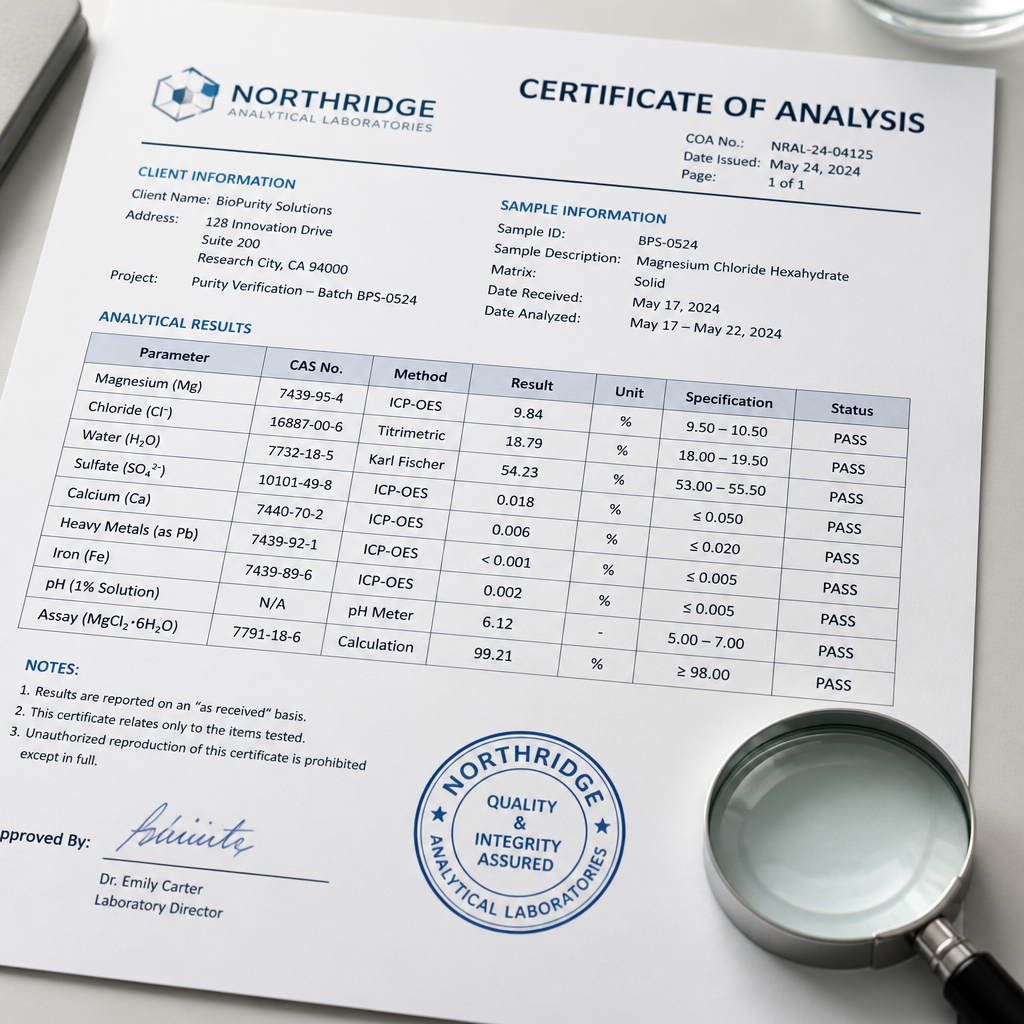
A complete peptide COA is a one-to-two page laboratory document with a predictable structure. Understanding each section prevents misreading a marketing document as an analytical report.
The Header Block
The header must identify the testing laboratory by name, address, and contact information. This is not the supplier's branding. If the header carries only the supplier's logo with no separate testing entity identified, the document has been issued by the party selling you the product. That is a structural conflict of interest regardless of the numbers it reports.
The header also carries a unique report number, the date of testing, and the name of the customer who submitted the sample. A legitimate contract testing laboratory will have a verifiable website, appear in industry directories, and be reachable by phone or email.
The Sample Identification Block
Directly below the header, a legitimate COA states the compound name, the batch or lot number, the manufacturer or submitting party, the date the sample was received by the laboratory, and the date testing was performed. Every one of these fields matters. The batch number is the primary traceability anchor. The receive date and test date together tell you how current the data is.
The Methods Section
A COA that states results without naming the analytical method used to generate them is not verifiable. The methods section should identify which techniques were applied. For peptide research compounds, this typically means HPLC for purity assessment, mass spectrometry for sequence identity confirmation, and potentially Karl Fischer titration for water content or gas chromatography for residual solvents. The detection wavelength used for HPLC, typically in the 210 to 220 nm range where the peptide backbone absorbs, should be stated. A COA that reports a purity percentage with no method attached is a number without a provenance.
HPLC Purity: What the Number Actually Means
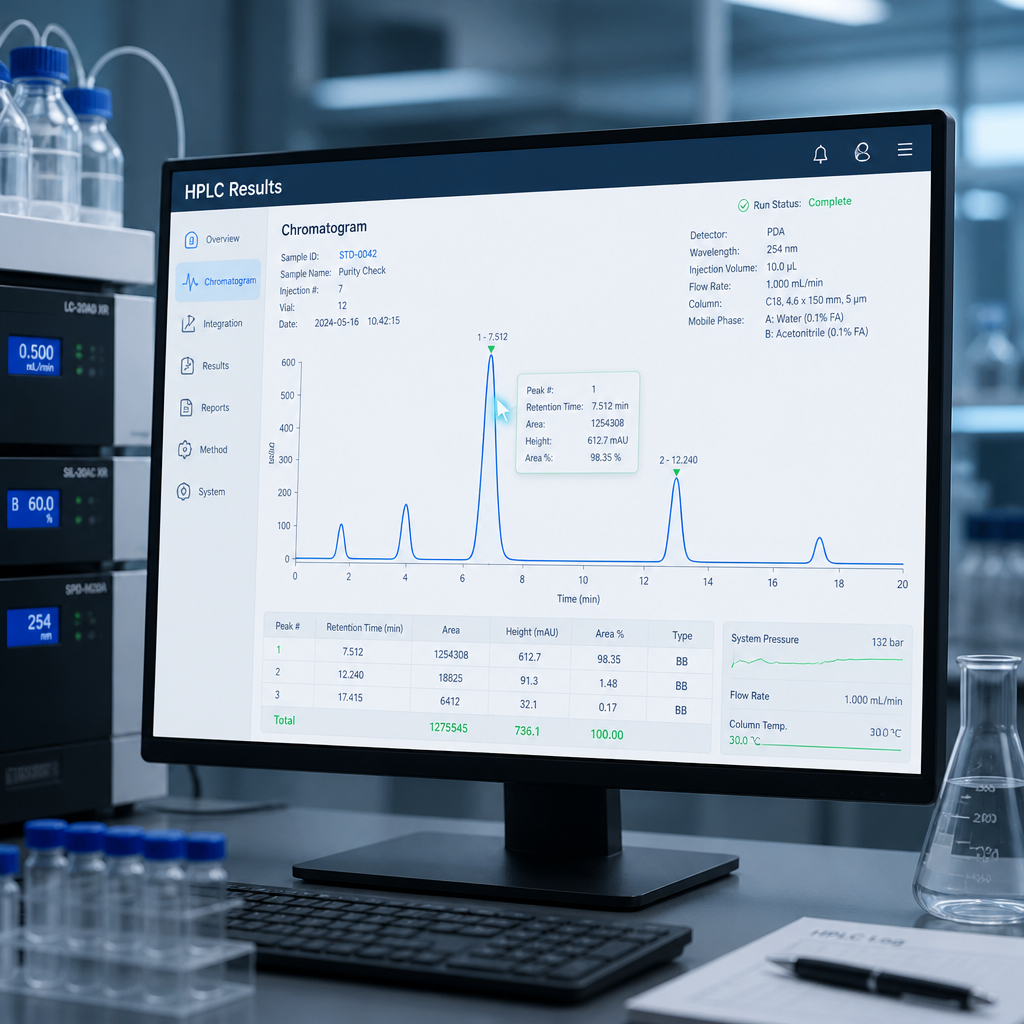
Purity on a peptide COA is commonly reported as an HPLC area percentage. The calculation is straightforward: the area of the target peptide peak is divided by the total area of all UV-absorbing peaks detected in the chromatogram. A result of 99.2% means that 99.2% of the UV-absorbing signal belongs to the compound of interest, and 0.8% belongs to other detected species.
What this number does not capture is equally important. Standard UV detection at 210 to 220 nm does not see water, inorganic salts, or non-chromophore species. A peptide could be 99% pure by HPLC and still carry significant water weight or a counterion load that affects net peptide content. This is why a robust COA reports additional parameters beyond HPLC purity alone.
Pro tip: When comparing purity figures across suppliers, confirm that the same detection wavelength was used. Results generated at different wavelengths on different column chemistries are not directly comparable, even when expressed as the same percentage format.
Reading the Chromatogram
The HPLC chromatogram image is not decorative. It is the actual analytical output from which the purity number was derived. A single dominant peak with a clean baseline on either side is what a high-purity compound looks like. Multiple peaks, a noisy baseline, or a main peak with a visible shoulder indicate impurities. If a COA reports a purity figure without including the chromatogram that produced it, there is no way to assess whether the integration was performed correctly or whether the method conditions were appropriate for the compound.
Suppliers who publish the chromatogram alongside the percentage are showing their work. Suppliers who publish only the number are asking for trust they have not earned.
Mass Spectrometry: Confirming Identity
Mass spectrometry serves a distinct and complementary function to HPLC. Where HPLC tells you how pure the sample is, mass spectrometry confirms that the compound present is the one you ordered. A mass spectrometry result on a COA reports the measured molecular weight of the compound alongside the theoretical molecular weight calculated from the expected peptide sequence.
A match within acceptable mass tolerance confirms that the compound has the correct molecular composition. It does not confirm purity. A heavily contaminated batch can still pass a mass spectrometry check if the target peptide is present in sufficient abundance to produce the expected signal.
A COA that includes both HPLC purity and mass spectrometry confirmation is answering two different questions: what the compound is, and how much of the sample is that compound. Both questions need answers before you begin any experimental protocol.
Electrospray Ionization and Charge States
Peptides are commonly analyzed by electrospray ionization mass spectrometry, which produces multiple charge states from larger molecules. A COA for a higher molecular weight peptide like Retatrutide may report multiple m/z values corresponding to different charge states of the same molecule. All observed charge states should be consistent with the expected molecular weight when the charge multiplier is applied. If the COA only reports a single m/z value for a peptide that should produce multiple charge states, the analyst may have reported a partial result.
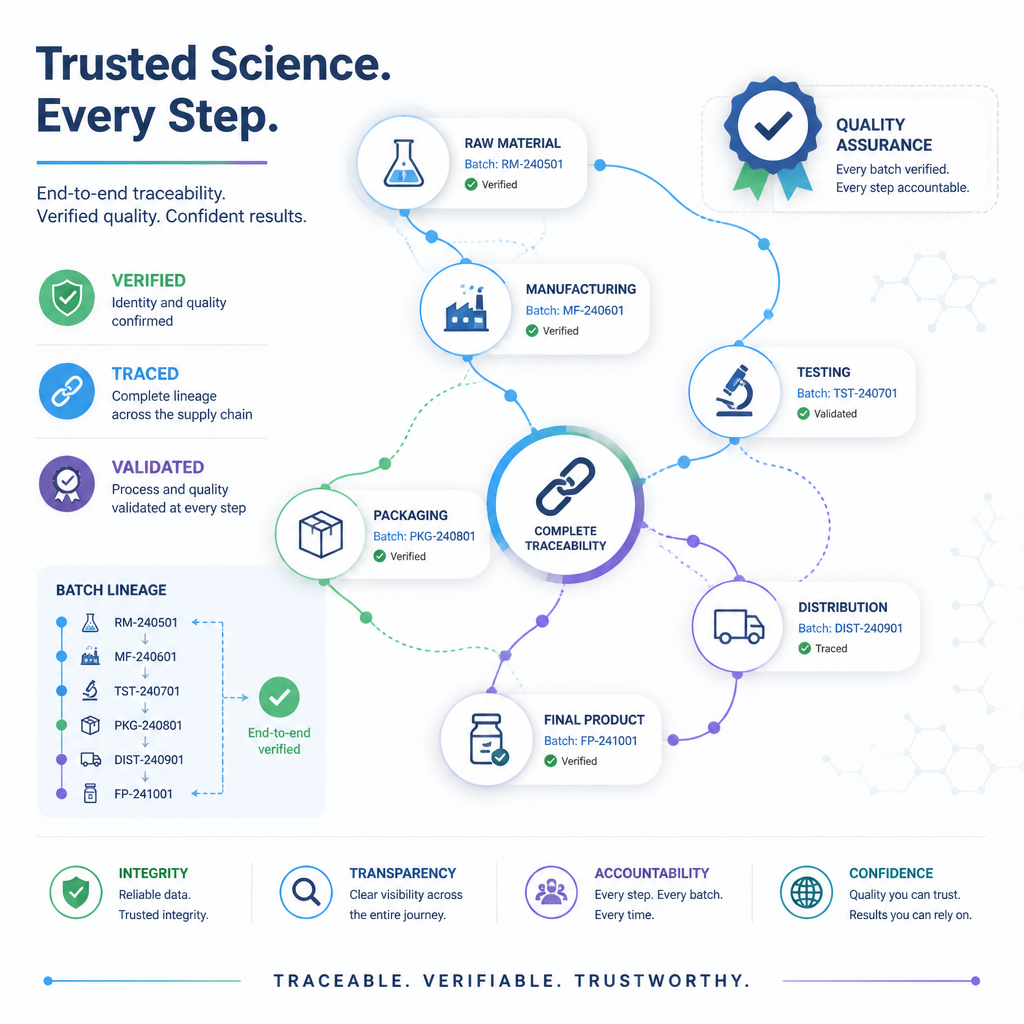
Chain of Custody and Batch Traceability
A COA functions as a technical chain of custody document. It establishes a continuous, documented record connecting the peptide from the point of synthesis through testing and into your laboratory. The chain breaks the moment you cannot verify that the batch number on your vial matches the batch number on the analytical report. Even a small discrepancy, a transposed digit or an abbreviated format, is analytically disqualifying.
Chain of custody documentation matters beyond the COA itself. Cold-chain shipping records, handling protocols during lyophilization and vial filling, and storage conditions all affect the compound you receive. A COA issued at the time of synthesis does not document what happened to the material in transit. This is why suppliers who provide full chain of custody documentation, covering synthesis, testing, packaging, and delivery conditions, offer a materially stronger quality guarantee than those who only supply the analytical report.
Pro tip: When you receive a peptide shipment, photograph the vial label alongside the COA before opening. This creates your own custody record and makes it straightforward to reconcile batch numbers against your experimental logs later.
COA Testing Methods Compared
Not all analytical methods reported on a peptide COA carry equal weight for every research application. Understanding what each method measures helps you evaluate whether a given COA is fit for your specific protocol.
Analytical Method | What It Measures | Limitations to Know |
|---|---|---|
HPLC (Reverse-Phase, UV Detection) | Purity as a percentage of the UV-absorbing peak area attributable to the target compound. Detection typically at 210 to 220 nm. | Does not detect water, inorganic salts, or non-chromophore species. Results depend on column chemistry, gradient, and detection wavelength. Not directly comparable across different method conditions. |
Mass Spectrometry (ESI-MS) | Molecular identity confirmation by comparing measured molecular weight against the theoretical value for the peptide sequence. | Confirms identity, not purity. A contaminated sample can still produce a correct mass spectrum. Does not quantify the ratio of target compound to impurities. |
Karl Fischer Titration | Water content as a percentage of total vial weight. Critical for calculating accurate net peptide content from a lyophilized compound. | Less commonly included in supplier COAs. Its absence means the HPLC purity figure may overstate the effective peptide content available for use in experiments. |
Red Flags That Invalidate a COA
COA interpretation is as much about knowing what to reject as what to accept. Several structural and informational characteristics indicate a document that does not provide independent verification.
No Separate Testing Laboratory Identified
A COA that carries only the supplier's branding, with no independently named testing laboratory, is an internal document. Internal testing introduces a conflict of interest that cannot be resolved by examining the numbers the supplier chose to report. The party that profits from the sale should not be the sole party certifying its quality.
Missing Batch Number or Mismatched Batch Number
A COA without a batch number cannot be traced to a specific production lot. It is a generic document, not an analytical record for your compound. A batch number that does not match the label on your vial makes the COA irrelevant to what you received, regardless of what it reports.
No Chromatogram Included
A purity percentage without the chromatogram image that produced it is an unverifiable claim. The chromatogram shows the peak shape, baseline quality, integration boundaries, and the presence or absence of co-eluting impurities. A COA that omits it is asking you to accept a conclusion while withholding the data behind it.
Outdated Test Date for the Current Batch
A test date that predates the current production run suggests the supplier is applying historical data to new inventory. Lyophilized peptides are stable under proper conditions, but degradation can occur through improper handling, storage, and transit. A COA that reflects the chemical state of a sample from several years prior does not document the compound in your freezer.
No Verifiable Laboratory Credentials
A laboratory named on a COA should be independently verifiable. A search for the laboratory name should return a functional website, a verifiable address, and contact information. Laboratories accredited to ISO 17025 appear in the public databases maintained by their national accreditation body. If the named laboratory does not appear in any independent search, the document may be fabricated.
What Canadian Researchers Should Demand from a Supplier COA
Canadian research institutions working with high-purity peptide compounds have access to a domestic supply chain that can support genuine analytical verification, without relying on overseas documentation chains that are difficult to audit. The standard researchers should hold any Canadian supplier to is specific and non-negotiable.
Every batch should be accompanied by a COA issued by an independent Canadian laboratory, not a document generated by the supplier's own facility. The COA should include both HPLC purity at the appropriate detection wavelength and mass spectrometry identity confirmation. Batch numbers must appear on both the vial label and the COA with exact alignment. Full chain of custody documentation, covering synthesis, packaging, and delivery conditions, should be available on request.
At Pepura Labs, every Retatrutide compound batch is independently verified by Canadian laboratories, with full chain of custody documentation included as a standard part of each order. Purity is confirmed at 99% or above. The batch traceability record follows the compound from synthesis to Xpresspost delivery. That is the documentation standard that protects your research investment and ensures your experimental results are built on verified biochemical inputs, not marketing claims.
Pro tip: Before ordering from any peptide supplier, ask specifically whether the COA was produced by a third-party laboratory or by the supplier's internal quality control team. The answer to that single question tells you more about documentation integrity than anything else on the product page.
Frequently Asked Questions
What is the minimum purity level a peptide COA should show for in vitro research applications?
For most quantitative in vitro research applications, a purity of 95% or above by HPLC is the baseline. For applications where the compound is being used to generate dose-response data or where impurities may have independent biological activity, 98% or above is the appropriate standard. Research-grade suppliers targeting serious laboratory use should be operating at 99% or above, which is the level that provides meaningful confidence in experimental reproducibility.
Can a supplier COA be trusted if it only shows in-house testing results?
In-house testing is not automatically fraudulent, but it introduces a conflict of interest that the document itself cannot resolve. The party selling you the compound has a financial incentive for the compound to pass. Third-party independent testing by an ISO 17025 accredited laboratory removes that incentive entirely. For research where the identity and purity of the compound directly affect the validity of your results, in-house-only documentation is an insufficient quality standard.
What does it mean when a COA reports multiple m/z values for a peptide?
Multiple m/z values on a mass spectrometry result typically represent different charge states of the same molecule, which is expected for larger peptides analyzed by electrospray ionization. Each charge state produces a different mass-to-charge ratio. All reported values should be internally consistent with the same molecular weight when you apply the relevant charge multiplier. If the values are inconsistent with each other, that is an analytical error in the report.
Is an HPLC purity of 99% the same thing as the compound being 99% of the vial contents by weight?
No, and this is one of the most commonly misread figures on a peptide COA. HPLC purity expressed as an area percentage reflects the proportion of UV-absorbing signal attributable to the target compound. Water, inorganic salts, and counterions are invisible to standard UV detection and are not included in the calculation. The net peptide content by weight can be considerably lower than the HPLC purity figure suggests, which is why Karl Fischer water content and counterion data strengthen a COA significantly.
How do I verify that the laboratory named on a COA is real and accredited?
Search the laboratory name independently. A legitimate contract testing laboratory will have a functioning website, a verifiable physical address, and be reachable by phone or email. If the laboratory claims ISO 17025 accreditation, that status is publicly verifiable through the accreditation body for the country in question. In Canada, the Standards Council of Canada maintains a searchable directory of accredited laboratories. If the named laboratory does not appear in any independent search, treat the COA as unverified.
Why does the test date on a COA matter for lyophilized peptides?
Lyophilized peptides are stable when stored correctly, but the COA only documents the chemical state of the compound at the time of testing. A report dated several years before your order was processed may not reflect the current composition of the material. Improper storage, handling during transit, or temperature excursions can cause degradation that a dated COA will never capture. Fresh, batch-specific analytical reports tied to current production lots are the only way to be confident that the COA describes what you actually received.
Have you encountered a COA that raised questions about its authenticity, or does your lab follow a specific verification protocol before accepting a new peptide batch? Share your experience below.