
Most peptide buyers glance at a Certificate of Analysis, see a purity number above 99%, and move on. That habit is exactly what makes a COA easy to manipulate. A well-formatted document with an impressive percentage tells you almost nothing on its own if you do not know which test produced that number, who ran it, and whether the document actually corresponds to the vial in your hand. For researchers sourcing Retatrutide for in vitro work, where compound identity and concentration directly affect the validity of your data, knowing how to read a peptide certificate of analysis is not optional. This guide walks you through every section of a COA, in the order that matters, so you can evaluate a supplier's documentation the way an analytical chemist would.
Table of Contents
- Quick Takeaways
- What a COA Actually Is (and What It Is Not)
- Step-by-Step Reading Guide for a Peptide COA
- HPLC Purity: What the Number Really Means
- Mass Spectrometry: Identity Confirmation
- Net Peptide Content: The Most Overlooked Field
- Verifying the Testing Laboratory
- Batch-Specific vs. Generic COAs
- Red Flags That Should Stop a Purchase
- COA Quality Comparison: What Separates Acceptable from Excellent
- Retatrutide COA Specifics for Canadian Research Labs
- Frequently Asked Questions
- References
Quick Takeaways
| Key Insight | Explanation |
|---|---|
| Purity alone is not identity | HPLC area percentage tells you how clean the dominant peak is; mass spectrometry tells you whether that peak is actually the compound you ordered. Both tests must appear on the same COA. |
| Lot number is the document's anchor | Every other field is only meaningful if the lot number on the COA matches the lot number printed on the vial you received. Mismatched lots make the entire document irrelevant. |
| Net peptide content is not the same as vial weight | A lyophilized vial labeled "10 mg" can contain significantly less actual peptide once counter-ions, residual water, and salts are accounted for. A complete COA states net peptide content as a separate figure or percentage. |
| Third-party testing outweighs in-house testing | An independent laboratory has no commercial incentive to inflate purity numbers. A COA signed only by a vendor's internal "QC Department" with no external lab identity is not third-party verification. |
| ISO/IEC 17025 accreditation matters | Accreditation to ISO/IEC 17025 means the lab's methods and reporting have been independently assessed. A logo on a COA is not the same as named, scope-specific accreditation. |
| Test date must match current inventory | A COA dated before the current production run was manufactured cannot document the compound you are receiving. Fresh inventory paired with an old COA is a traceability failure. |
| Chain of Custody documentation extends the COA's value | A COA records what was true at the moment of testing. Chain of Custody records confirm how the compound was handled from manufacture through delivery, protecting the integrity of the data after the test date. |
What a COA Actually Is (and What It Is Not)
A Certificate of Analysis is a formal record of test results performed on a specific sample or batch of a compound. It documents identity, purity, quantity, and in some cases sterility or endotoxin levels, but only for the tests that were actually run. A COA cannot prove more than its own listed methods.
This distinction is important: a COA showing 99.4% HPLC purity does not confirm the compound's identity, the actual peptide mass in the vial, the absence of endotoxins, or the suitability of the compound for any specific research application. Each of those claims requires its own separate test. A COA that shows only one number is answering only one question.
For Retatrutide researchers in Canada, this matters practically. When you are designing a dose-response experiment or setting up receptor binding assays, an incomplete COA introduces variables that cannot be controlled after the fact. A document that answers all four analytical questions, identity, purity, content, and safety testing, is the only document that genuinely de-risks the compound.

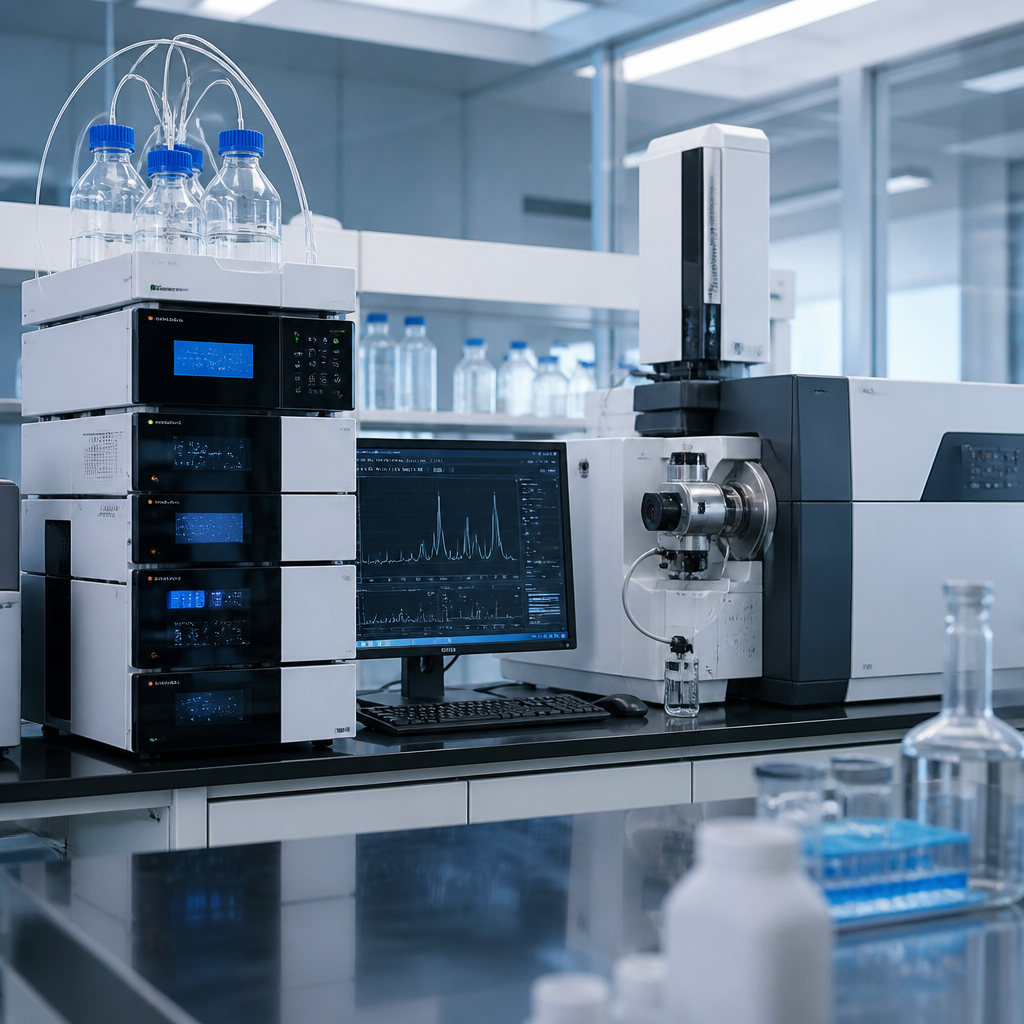
Step-by-Step Reading Guide for a Peptide COA
Read a COA in this order. Each step builds on the last, and skipping any one of them leaves a gap that a superficially convincing document can exploit.
Step 1: Confirm Product Identity on the Document Header
The product name, chemical form (for example, lyophilized powder vs. solution), and ideally the amino acid sequence or CAS number should appear at the top of the COA. For Retatrutide, the document should name the compound explicitly, not just a lot code. If the product name is absent or generic, the document cannot be anchored to a specific molecule.
Step 2: Match the Lot Number to Your Vial
This is the single most important verification step. The lot or batch number on the COA must match the lot number printed on the label of the vial you received. If those two numbers differ, the COA is describing a different batch and tells you nothing about what is in your vial. Do this check before reading any analytical results.
Step 3: Check the Test Date Against Manufacturing Timeline
A COA should be dated after the batch was manufactured and reasonably close to the date you are purchasing. A document dated years before your purchase and attached to current inventory is a red flag. The test date defines the moment in time the data describes. Everything after that moment is covered by handling and storage records, not by the COA itself.
Step 4: Read the HPLC Purity Result and Chromatogram
The purity result should state the method (reverse-phase HPLC), the detection wavelength (typically 220 nm), and the result as an area percentage. The chromatogram itself should accompany the number so you can see the peak resolution, not just the reported figure.
Step 5: Read the Mass Spectrometry Result
Mass spectrometry answers a different question than HPLC purity. It confirms whether the dominant peak in the chromatogram is actually the molecule it claims to be. The COA should list both the theoretical molecular weight and the observed molecular weight. A correctly identified peptide will show a match, often within a fraction of a Dalton on modern high-resolution instruments.
Step 6: Locate Net Peptide Content
Look specifically for a net peptide content figure, sometimes labeled "peptide assay" or "actual peptide mass." This is separate from the weight of the lyophilized powder. Salts, water, and counter-ions add mass to the vial without contributing to the active compound. A vial labeled 10 mg that contains only 80% net peptide holds 8 mg of active compound, which directly affects any concentration-dependent experimental design.
Step 7: Confirm Laboratory Identity and Accreditation
The COA should name the laboratory, provide a contact address, and identify the analyst or signatory. ISO/IEC 17025 accreditation should be listed with a scope that covers the relevant tests. A logo without a named accreditation body and scope number is decorative, not documentary.
Pro tip: Search the named laboratory independently on its own website or on an accreditation body's public register before accepting the COA. Any laboratory whose contact information cannot be independently verified should be treated as unconfirmed, regardless of how official the document looks.
HPLC Purity: What the Number Really Means
High-Performance Liquid Chromatography (HPLC) separates a sample's components by their affinity for a stationary phase. The purity percentage reported on a COA is the area of the target peptide's peak expressed as a fraction of all detected peaks at the measurement wavelength. It answers the question: how clean is the dominant component?
For research-grade Retatrutide, a purity of 99% or above by HPLC area at 220 nm represents an analytically rigorous standard. Compounds below 98% introduce measurable impurity loads that can affect receptor binding assays, cAMP response experiments, and any other assay where the compound's concentration is a controlled variable.
The chromatogram is as important as the number. A clean chromatogram shows a single dominant peak with a flat baseline and no significant secondary peaks. If a supplier publishes only the percentage and not the underlying chromatogram, you are being asked to trust a reported conclusion rather than examine the actual evidence. For critical in vitro work, that is not an acceptable substitution.
Pro tip: The detection wavelength matters. HPLC purity reported at 214 nm and 220 nm can differ slightly depending on the peptide's aromatic content. Confirm that the COA specifies the wavelength and that the method is reverse-phase HPLC, which is the standard for synthetic peptides.
Mass Spectrometry: Identity Confirmation
HPLC tells you the compound is pure. Mass spectrometry tells you it is the right compound. These are different questions, and a COA that only answers one of them is incomplete for research purposes.
Mass spectrometry measures the mass-to-charge ratio of ionized molecules. For a peptide like Retatrutide, the COA should state the theoretical molecular weight (the expected value based on the amino acid sequence) and the observed molecular weight (the value measured by the instrument). A match between these two values confirms molecular identity.
For a correctly synthesized and correctly identified peptide, the observed mass should match the theoretical mass within approximately 1 Dalton, and on modern high-resolution instruments the match is typically much tighter than that. A significant discrepancy indicates either a misidentified compound, a synthetic error, or a modified molecule. None of those possibilities is acceptable for research-grade material.
Identity and purity are not the same measurement. A sample can be 99% pure and still be the wrong molecule. Mass spectrometry is the only field on a COA that directly confirms molecular identity.
Net Peptide Content: The Most Overlooked Field
This is the section most buyers skip and the one that matters most for quantitative research. When a peptide is synthesized, purified, and lyophilized, the final dried powder is not 100% active peptide. Counter-ions from the purification process (commonly trifluoroacetate, or TFA), residual moisture, and excipients all contribute to the total powder mass without contributing to the active compound.
A vial labeled "10 mg Retatrutide" may contain 10 mg of lyophilized powder, but if the net peptide content is 85%, the actual peptide mass in that vial is 8.5 mg. If you dissolve the entire vial in 1 mL of bacteriostatic water assuming a 10 mg/mL concentration, your working solution is actually 8.5 mg/mL. That 15% error propagates through every downstream dilution and every concentration point in your experiment.
A complete COA states net peptide content as a separate assay result, either as a mass (for example, "Net peptide: 10.5 mg") or as a percentage of total powder weight. If this field is absent, the vial weight and the peptide dose are not the same thing, and the COA cannot confirm how much active compound you are working with.
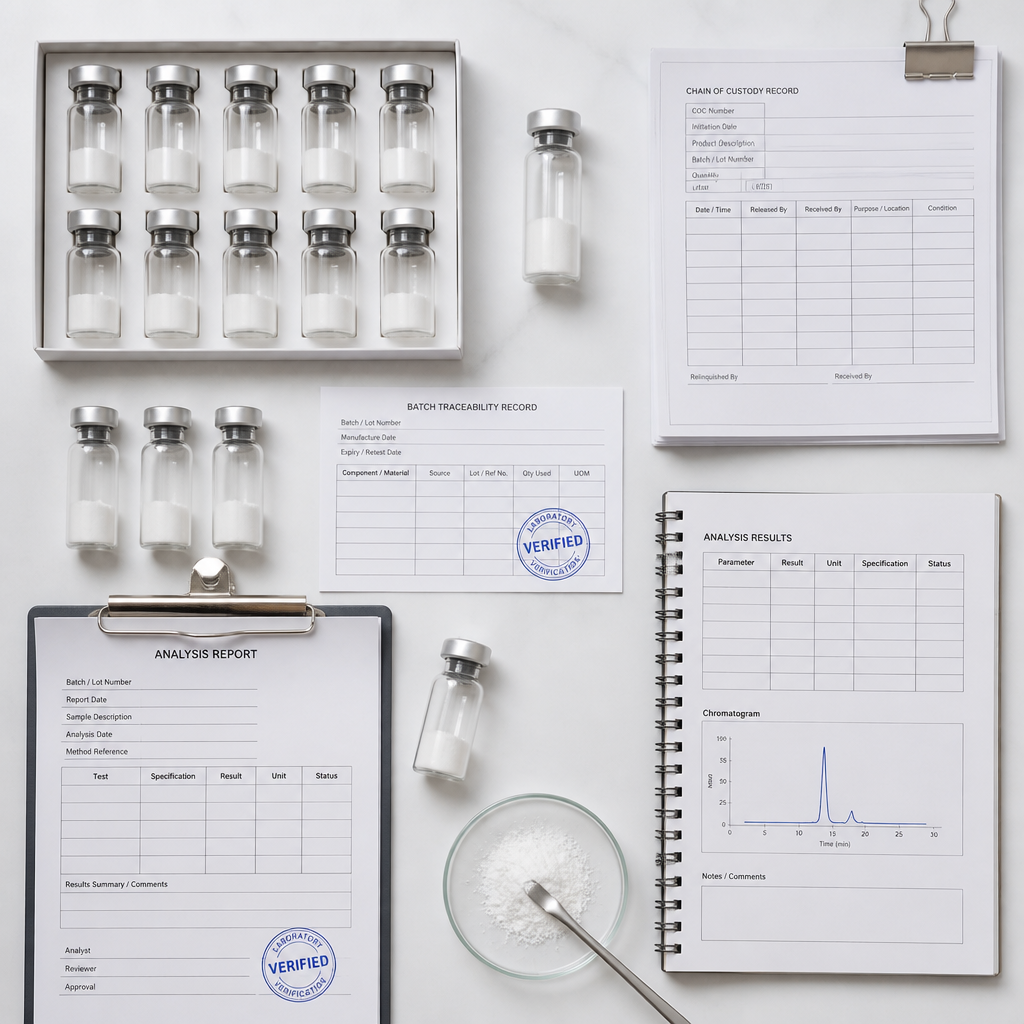
Verifying the Testing Laboratory
Third-party, independent testing is the structural difference between a COA that carries evidential weight and one that is simply a document produced by the vendor. An independent laboratory has no commercial relationship with the purity result. A vendor's internal quality control department, by contrast, reports to the same organization with a financial interest in selling the product.
To verify the testing laboratory, look for the following: the laboratory's name and physical address; a named accreditation standard (ISO/IEC 17025 is the relevant international standard for testing and calibration laboratories, covering the scope of analytical chemistry tests); a named signatory or analyst; and a report number that can be cross-referenced against the lab's own reporting system.
The strongest COAs from Canadian suppliers will identify a Canadian laboratory, which provides domestic traceability and makes the independent verification step straightforward. At Pepura Labs, every batch of Retatrutide is independently verified by a Canadian laboratory with full Chain of Custody documentation, so the traceability chain from synthesis to delivery is entirely domestic and auditable.
A QR code or access code on the COA that routes directly to the laboratory's own reporting portal is a stronger form of verification than a PDF alone. It eliminates the possibility of document alteration between the lab's report and what you receive from the supplier.
Batch-Specific vs. Generic COAs
A batch-specific COA documents a single, identified production run. The lot number is unique, the test date corresponds to that run's testing, and the analytical results reflect that actual batch of compound. This is the only type of COA that provides meaningful traceability.
A generic COA, by contrast, may have been produced for one batch and then reattached to subsequent inventory without re-testing. Some suppliers display COAs prominently on their product pages without making clear that the document was generated for a different batch than the one being shipped. The practical test is simple: ask the supplier whether the lot number on the COA you are shown will match the lot number on the vial you receive. The answer tells you immediately whether you are being given batch-specific documentation.
This distinction is particularly important for Retatrutide because it is a complex synthetic peptide where synthesis quality can vary between production runs. A COA from one excellent batch does not guarantee the same analytical profile for a subsequent batch made under different conditions or with different raw material lots.
Pro tip: When you receive a shipment, photograph both the vial label and the COA before opening. If the lot numbers match and both documents are dated appropriately, you have a complete traceability record that is useful for your own lab documentation and for any future troubleshooting of experimental results.
Red Flags That Should Stop a Purchase
Not every warning sign is obvious, but experienced researchers learn to recognize patterns that indicate documentation problems. The following are the most common and the most consequential.
A COA with no named laboratory and no independent contact information is an in-house document at best and a fabricated one at worst. No named lab means no way to verify. A COA signed only by a "QC Department" or internal title with no organizational identity outside the vendor does not meet the minimum standard for independent verification.
A purity claim with no accompanying chromatogram asks you to accept a conclusion without showing you the evidence. The chromatogram is the underlying data; the percentage is a derived number from that data. Publishing the number without the graph is equivalent to citing a study without providing the results table.
A missing mass spectrometry section means the compound's identity is not confirmed. HPLC purity alone cannot distinguish between Retatrutide and a different peptide of similar molecular composition but different sequence. For a compound where molecular identity directly determines receptor selectivity and binding behavior in your assay, this gap is not acceptable.
An absence of net peptide content means your concentration calculations cannot be verified. If the COA only reports HPLC area purity and not actual peptide mass, the 10 mg label on the vial is a nominal figure, not a confirmed one.
COA Quality Comparison: What Separates Acceptable from Excellent
| COA Attribute | Minimum Acceptable Standard | Research-Grade Best Practice |
|---|---|---|
| Purity testing | HPLC area percentage stated with method noted | HPLC chromatogram included, method, column, and wavelength specified, result at 99% or above |
| Identity confirmation | Mass spectrometry result with observed and theoretical molecular weight | MS result plus HPLC retention-time match against a reference standard for the specific compound |
| Net peptide content | Percentage of net peptide reported separately from total powder weight | Absolute mass figure (e.g., "net peptide: 10.3 mg") confirmed by amino acid analysis or quantitative assay |
| Laboratory identity | Named external laboratory with verifiable contact information | ISO/IEC 17025 accredited laboratory with named scope, signed by named analyst, report number verifiable on lab's own portal |
| Batch traceability | Lot number that matches vial label | Full Chain of Custody documentation from synthesis through delivery, lot number independently verifiable |
| Safety testing | Not always required for in vitro use | Endotoxin testing and residual solvent analysis (TFA content per ICH Q3C guidelines) documented |
Retatrutide COA Specifics for Canadian Research Labs
Retatrutide (LY3437943) is a triple-receptor agonist with activity at GIP, GLP-1, and glucagon receptors. Its complexity as a synthetic peptide makes analytical documentation more demanding than for simpler, shorter-sequence compounds. The receptor selectivity profile that makes Retatrutide pharmacologically interesting in research settings is also what makes identity confirmation by mass spectrometry non-negotiable. A peptide with the wrong sequence but a similar molecular weight can pass a superficial purity check while failing to engage the intended receptors in your assay.
Canadian research institutions also operate under specific compliance expectations. Chain of Custody documentation is directly relevant when experimental results need to be reproduced, audited, or submitted as part of a grant or publication. Knowing that the compound was tested at a Canadian laboratory, handled within a domestic supply chain, and delivered with batch-specific documentation removes a layer of uncertainty that can otherwise complicate reproducibility conversations.
Pepura Labs supplies Retatrutide in multiple dosages including 10 mg, 20 mg, 40 mg, 60 mg, and 84 mg configurations, all independently laboratory tested with full Chain of Custody records. For labs that also need reconstitution supplies, bacteriostatic water is available to support complete experimental setup from a single domestic source. Having both the compound and the reconstitution medium documented through the same supply chain simplifies traceability.
When you receive a Retatrutide vial, the verification process should take under five minutes. Match the lot number to the COA. Confirm the test date is recent and corresponds to the current inventory. Locate the HPLC purity result and the chromatogram. Confirm the mass spectrometry result shows an observed mass matching the theoretical molecular weight. Find the net peptide content figure. Identify the testing laboratory and verify it independently. If all six checks pass, you have a compound that is documented to research-grade standards.
Frequently Asked Questions
What HPLC purity percentage is acceptable for research-grade Retatrutide?
For sensitive in vitro work, 99% or above by HPLC area at 220 nm is the appropriate standard for research-grade Retatrutide. A result between 98% and 99% may be acceptable for preliminary experiments but introduces more impurity load than high-purity compounds. Anything below 98% should not be used in quantitative receptor binding or cAMP assay work where compound concentration is a controlled variable.
Can a COA be faked, and how do you detect it?
Yes, COA documents can be altered or fabricated. The most reliable detection method is to verify the report number directly on the testing laboratory's own portal or by contacting the lab independently. A COA with no report number, no named laboratory, and no independent verification pathway cannot be authenticated. If the supplier cannot direct you to a live, independently verifiable report, the document should be treated as unconfirmed.
What is the difference between HPLC purity and net peptide content?
HPLC purity measures the proportion of the total detected signal at the measurement wavelength that belongs to the target peptide peak. It tells you how clean the sample is relative to other detectable compounds. Net peptide content measures the actual mass of peptide present in the vial, accounting for the fact that lyophilized powder also contains counter-ions, residual moisture, and salts that add weight without contributing to the active compound. A vial can show 99% HPLC purity and still contain significantly less peptide mass than the label states if net peptide content is low.
Why does third-party testing matter more than in-house testing?
An independent laboratory has no financial stake in the purity result it reports. An in-house quality control department reports to the same organization that profits from a favorable result. This structural conflict does not mean in-house testing is always inaccurate, but it means in-house results cannot serve as independent verification. For research applications where data integrity matters, the analytical lab should have no commercial relationship with the supplier whose product it is testing.
What does Chain of Custody documentation add beyond a COA?
A COA records what was true about a compound at the moment of testing. Chain of Custody documentation records everything that happened to that compound after testing: how it was stored, how it was packaged, how it was shipped, and what the handling conditions were at each transfer point. For research labs, this matters because a compound that tested at 99.4% purity but was then stored improperly or exposed to temperature excursions during shipping may no longer match its COA by the time it arrives. Chain of Custody documentation closes the gap between what the lab found and what the researcher receives.
What should I do if the lot number on my vial does not match the COA?
Stop and contact the supplier immediately. A lot number mismatch means the COA you were provided does not document the compound you received. This could be a clerical error, a documentation failure, or an indication of a more serious inventory management problem. Do not use the compound in any experiment until you have received a COA that matches the vial's lot number and have verified that document independently. A supplier who cannot produce the correct lot-matched COA within a reasonable timeframe has a traceability gap that should affect your decision to continue purchasing from them.
Are endotoxin results required on a peptide COA for in vitro research?
Endotoxin testing is not always mandatory for in vitro cell-free assays, but it becomes critical for cell-based assays where bacterial lipopolysaccharide contamination can confound signaling results. Many inflammation-related pathways respond to endotoxins independently of any peptide effect, which means untested compounds can produce false positives or mask real effects in cell culture work. If your research involves live cells, particularly immune or metabolic cell lines, requesting endotoxin data on the COA is a reasonable and increasingly standard expectation for research-grade suppliers.
If you have applied these steps to evaluate a Retatrutide COA, or discovered documentation gaps with a previous supplier, we would like to hear what you found and what questions you still have.
References
- Researcher's guide to interpreting peptide COA sections, including purity, identity, and content verification steps
- Complete guide to reading and verifying a peptide Certificate of Analysis, covering batch-specific documentation and how to spot misleading COAs
- Step-by-step walkthrough for reading a peptide COA including HPLC purity standards, mass spectrometry confirmation, and third-party lab verification
- Interactive 12-point COA verification checklist covering accreditation, batch traceability, molecular weight, and residual solvent testing
- Reference guide to what a peptide Certificate of Analysis can and cannot establish, including how to confirm laboratory independence