
Ask a researcher why their in vitro results diverged from a colleague's seemingly identical protocol, and the honest answer is rarely "we made a mistake." More often, it comes down to the compound itself. Peptide batch traceability is the documentation chain that connects the vial in your centrifuge tube to every quality test, synthesis date, and purity verification performed on that specific production run. Without it, you are not running a controlled experiment. You are running an experiment with an uncontrolled reagent variable built in from day one. For Canadian research teams procuring Retatrutide and other high-complexity peptides, this is not a paperwork formality. It is the foundation of defensible science.
Table of Contents
- Quick Takeaways
- What Batch Traceability Actually Means
- The Lot Number Is Not Just an Inventory Code
- Why Reproducible Peptide Research Depends on Lot Documentation
- Chain of Custody: The Link Between COA and Confidence
- Comparing Traceability Documentation Levels
- What a Batch-Specific COA Must Actually Contain
- How Traceable Research Peptides Fit Canadian Institutional Requirements
- Frequently Asked Questions
- References
Quick Takeaways
| Key Insight | Explanation |
|---|---|
| A lot number is an access key, not an admin code | When linked to proper documentation, the batch ID connects the compound in your experiment to its synthesis date, purity result, testing laboratory, and mass confirmation - all in one reference point. |
| Generic COAs are insufficient for research use | A generic certificate describes a product standard. A batch-specific COA reports the actual test results for the identified lot. Only the second document confirms the material you received. |
| Irreproducibility is often a materials problem, not a methods problem | Two groups running identical protocols with different batches of the same peptide can get different results for legitimate compound-quality reasons - impossible to diagnose without batch-level documentation. |
| Chain of custody extends past the receiving dock | Traceability does not end when a shipment arrives. Storage conditions, reconstitution handling, and sub-aliquot transfers must all remain linked to the original lot record. |
| Independent third-party lab verification is the standard that matters | A COA issued by the same facility that manufactured the peptide is self-referential. Independent Canadian laboratory verification removes that conflict and validates purity claims objectively. |
| Batch documentation supports institutional review and grant defense | Institutional review committees and ethics boards routinely request batch numbers, purity data, and chain-of-custody logs before granting protocol clearance. Missing records stall approvals. |
| Recording lot numbers in your methods section is a publication requirement | Without the batch number in the methods section, a replicating researcher cannot determine whether a different batch they use has the same purity or impurity profile - making true replication impossible. |
What Batch Traceability Actually Means
Batch traceability is the ability to track a specific peptide lot throughout its entire lifecycle, from manufacturing and quality control testing to packaging, distribution, receipt, storage, and final experimental use. Each production run receives a unique lot number, also called a batch number, which links that material to its corresponding laboratory documentation and Certificate of Analysis.
This sounds simple. In practice, most peptide suppliers treat lot numbers as internal inventory codes that are unpublished, unverifiable, and unavailable to the researcher placing the order. That gap matters more than most procurement decisions recognize. A vial can arrive with a clean label, a stated purity value, and a professional-looking certificate - and still provide no meaningful traceability if the lot number on the certificate cannot be independently tied, without ambiguity, to the specific batch that was tested and released.
For Retatrutide research in particular, where compound complexity as a triple-receptor agonist peptide demands exacting analytical confirmation, that ambiguity is not a minor inconvenience. It is a structural flaw in the experimental design.
The Lot Number Is Not Just an Inventory Code
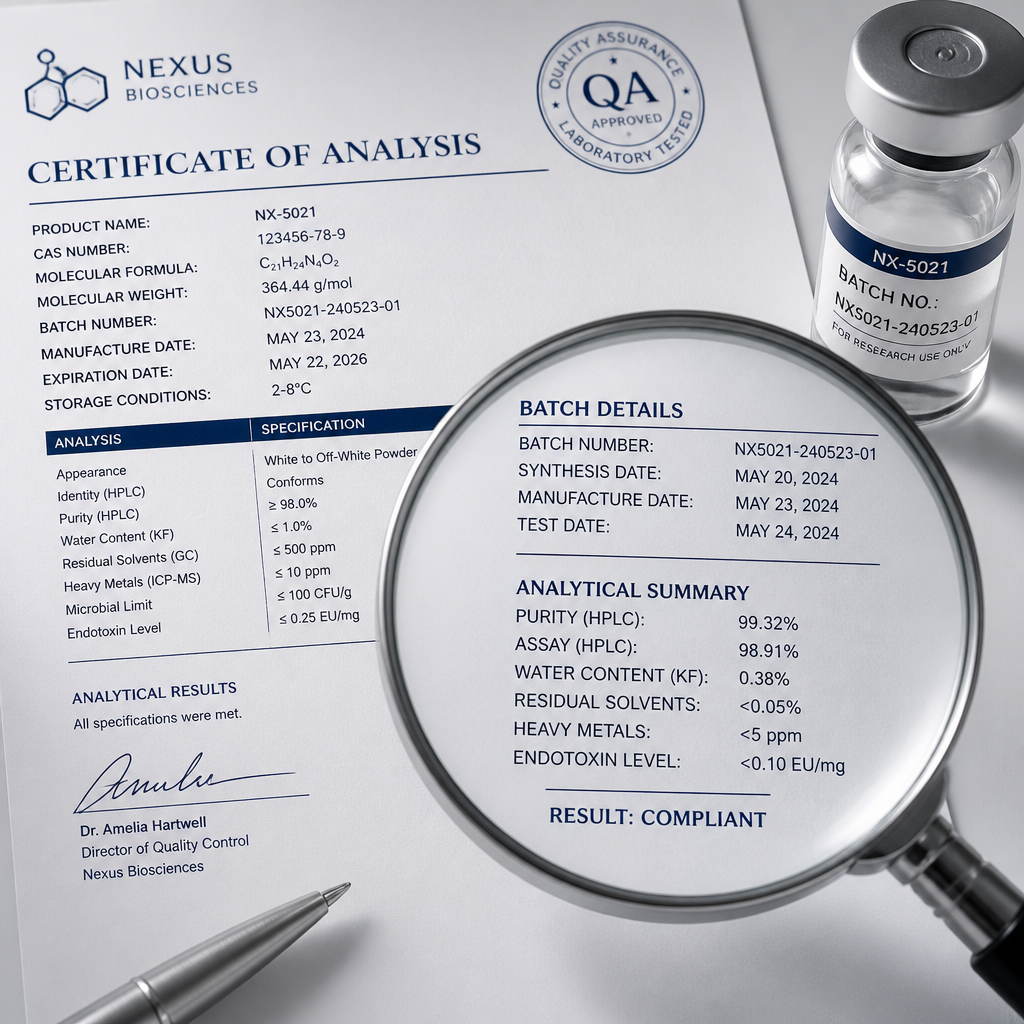
The lot number on a peptide vial is not administrative bookkeeping. It is the traceable link between the compound in your experiment and every quality test performed on that specific production batch. When that identifier is linked to a proper documentation system, it becomes the access key to the complete history of that material: synthesis date, analytical results, testing laboratory identity, purity value, and mass confirmation.
What a Real Batch ID Should Reveal
An effective batch identifier should allow you to retrieve at minimum three core data points: the lot number itself as a unique alphanumeric code tied to a single manufacturing run, the manufacturing date formatted to a specific day rather than a quarter or year, and an expiration date calculated from actual stability data rather than defaulted to a generic shelf-life estimate.
Beyond that baseline, a research-grade compound record should connect those identifiers to HPLC purity chromatograms, LC-MS mass confirmation, net peptide content as a percentage of gross weight, and the identity of the testing laboratory. If your supplier cannot provide all of these linked to your specific lot number, you do not have batch traceability. You have a product claim.
Pro tip: When you receive a peptide shipment, immediately cross-reference the lot number printed on the vial against the lot number on the COA before the material enters active inventory. Any mismatch means the certificate does not confirm that material, regardless of how clean the purity numbers look.
What a Missing Lot Number Costs You
Without the batch number documented in your methods section, a replicating researcher cannot determine whether a different batch they used had the same purity or impurity profile. The batch number is the traceable link between your result and the specific material that produced it. Remove that link and you have transformed a potentially reproducible finding into an anecdote.
Why Reproducible Peptide Research Depends on Lot Documentation
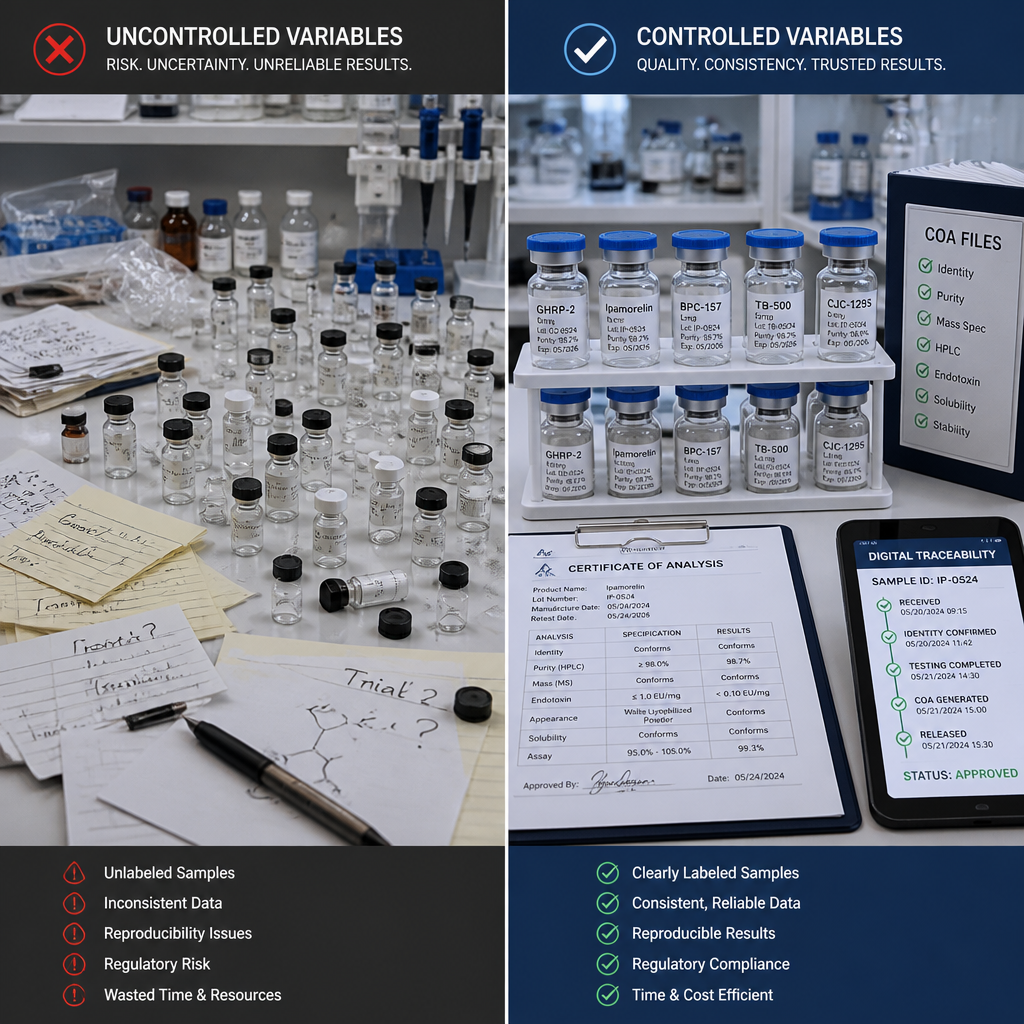
The reproducibility crisis in biomedical research has multiple contributing factors, but compound variability is one of the most tractable. Two research groups running ostensibly identical experiments with different batches of the same peptide may obtain different results for entirely legitimate compound-quality reasons that become impossible to diagnose without batch-level documentation. When neither group records the batch ID in their methods, the discrepancy appears as biological irreproducibility when it is actually materials irreproducibility.
Batch-to-batch variation is normal in solid-phase peptide synthesis. Minor differences in residual synthesis byproducts, TFA counterion concentration, moisture content, or optical purity can alter cell viability, binding kinetics, or enzymatic clearance rates in vitro. This is not a supplier failure. It is chemistry. The question is whether your documentation allows you to characterize and account for that variation rather than unknowingly absorb it as experimental noise.
Lot records make the material portion of that review possible. With a documented lot, a lab can determine whether a result is associated with a single batch, whether retained material was used, whether another project used the same lot, and whether a later purchase came from a different tested batch. Without a documented lot, a lab knows only that it purchased a named compound at some point. That is not a sufficient basis for scientific reproducibility.
"Transparent documentation is a cornerstone of scientific integrity, especially for high-value reagents such as synthetic peptides."
Chain of Custody: The Link Between COA and Confidence
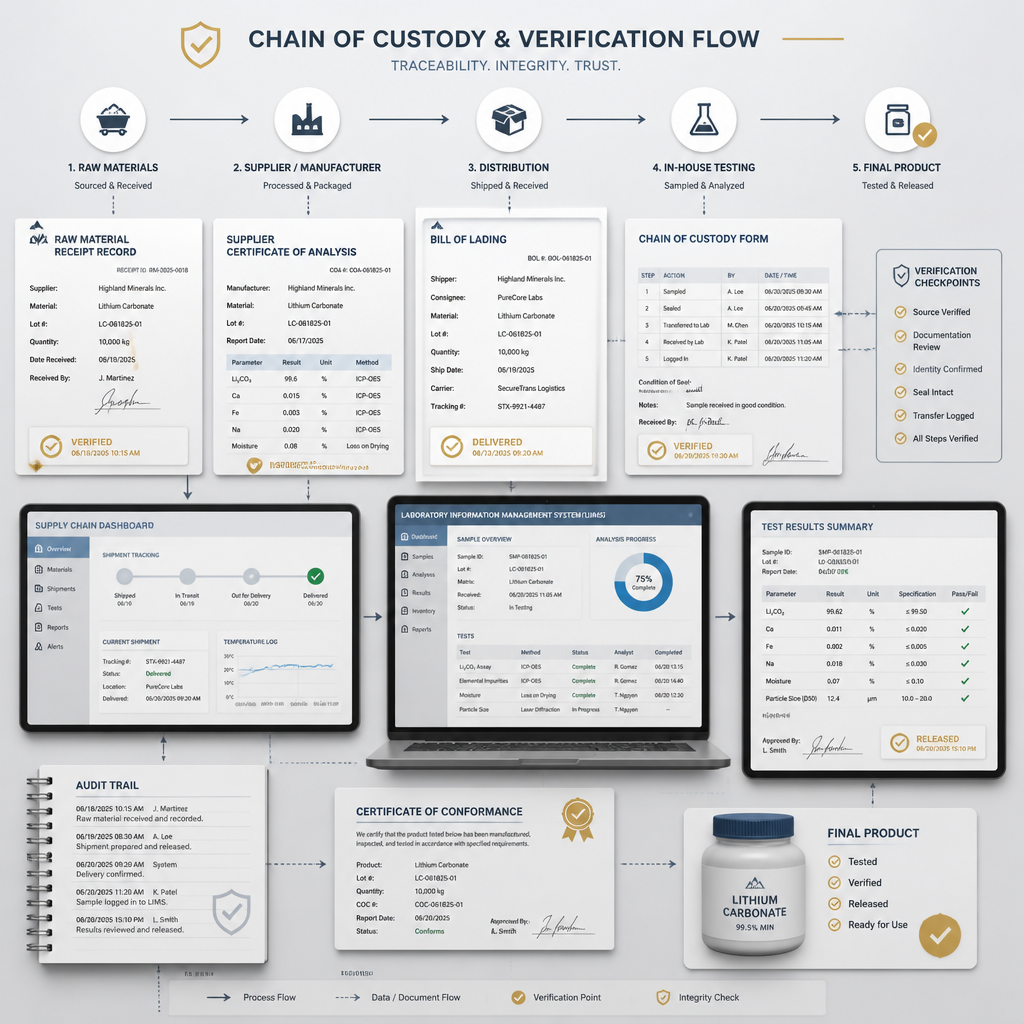
A Certificate of Analysis attached to an unverifiable chain of custody proves almost nothing. It tells you a lab tested a sample, not that the sample tested is identical to what shipped to your door. This is the distinction that separates a legitimate research-grade procurement process from a supplier that has simply learned to produce professional-looking documents.
A well-maintained chain of custody answers four practical questions: what material was received, where it has been since receipt, who controlled it at each stage, and whether any event occurred that may have affected its identity or condition. The record begins with the supplier's documented product information, including the batch identifier, analytical specifications, and COA. It continues through receipt, storage, reconstitution, and experimental use inside your own laboratory.
Why Independent Lab Verification Changes the Equation
When the same facility that manufactured the peptide also issues the COA, the documentation is self-referential. It is the equivalent of grading your own exam. Independent laboratory verification by a separate, accredited testing facility removes that conflict entirely. The purity claim on the certificate then reflects an objective third-party measurement, not an internal quality check performed by the same team that had an interest in passing the batch.
For Canadian researchers procuring traceable research peptides, this means specifically seeking suppliers that use independent Canadian laboratories for analytical verification rather than relying on manufacturer-issued documentation alone. The physical separation of the synthesis operation from the testing operation, with full documentation of that chain, is what makes the COA meaningful.
Pro tip: Ask your supplier whether the COA was issued by an independent third-party laboratory or by the manufacturing facility itself. If they cannot clearly identify the testing laboratory by name or accreditation, treat the documentation as unverified regardless of the purity number it reports.
Comparing Traceability Documentation Levels
Not all peptide suppliers provide the same level of batch documentation. Understanding the practical differences between documentation tiers helps research procurement teams ask the right questions before placing an order rather than discovering gaps after the material is already in use.
| Documentation Level | What Is Provided | Suitability for Research Use |
|---|---|---|
| Generic Specification Sheet | Product name, stated sequence, target purity threshold. No lot-specific test results, no identifiable testing laboratory, no manufacturing date. | Not suitable. Describes what the product is supposed to be, not what the received material actually tested as on this run. |
| Manufacturer-Issued Batch COA | Lot number, HPLC purity result, mass confirmation, manufacturing date. COA issued by the same facility that produced the compound. | Conditionally acceptable. Provides lot-level data but lacks independent verification. Self-referential documentation increases unresolved risk. |
| Independent Third-Party Verified COA with Chain of Custody | Lot number, HPLC chromatogram, LC-MS mass data, net peptide content, testing laboratory identity, manufacturing date, full chain-of-custody log from synthesis through delivery. | Research-grade standard. Provides defensible documentation for methods sections, institutional review, and audit requirements. The baseline for serious in vitro work. |
What a Batch-Specific COA Must Actually Contain
A generic COA can describe a product standard - a target sequence or a typical purity threshold. A batch-specific COA reports the actual test results for the identified lot. For research buyers, only the second document is meaningful. If the lot number on the COA does not match the vial or the purchase record, the certificate cannot confirm that particular material regardless of how the numbers read.
The minimum fields a research-grade batch COA should contain are the compound identity with full sequence, the unique lot number tied to that single production run, HPLC purity expressed as a percentage with the chromatogram attached, mass confirmation by LC-MS identifying the correct molecular weight, net peptide content as a percentage of gross weight to account for residual moisture and counterion mass, and the name and accreditation status of the testing laboratory. Storage recommendations and the expiration date derived from stability data should also appear on the document, not as boilerplate defaults.
For lyophilized peptide products, the COA should also address moisture content where relevant. Hygroscopic moisture absorption in lyophilized powders affects the actual net peptide content available per milligram, a variable that matters significantly in dose-preparation calculations for in vitro assays.
Many laboratories retain COAs as part of a broader chain-of-custody and quality-documentation practice: matching incoming shipments to their certificates, filing them by lot number, and referencing them in laboratory notebooks or electronic lab-notebook entries. This creates an audit trail that supports data integrity and reproducibility across a research project. Establish this practice from the first order, not retroactively when a result requires explanation.
How Traceable Research Peptides Fit Canadian Institutional Requirements
Institutional review committees and ethics boards at Canadian research institutions routinely request batch numbers, purity data, and chain-of-custody logs before granting protocol clearance. A single lapse in batch documentation can jeopardize grant funding, delay study timelines, or trigger additional review cycles that consume resources with no scientific return. Robust traceability is not a luxury qualification for premium-tier procurement. It is a foundational requirement that protects both scientific integrity and institutional compliance standing.
For researchers working with investigational compounds like Retatrutide, where the compound itself is under active study and the quality of the material directly determines the interpretability of in vitro findings, this documentation obligation is heightened. The research community cannot afford to introduce uncontrolled compound variables into studies that are designed to answer compound-specific biological questions.
Pepura Labs addresses this directly through independently verified batch documentation from Canadian laboratories, with full Chain of Custody records available for every lot. The research compound lot number on each lyophilized product links to test results from a separate accredited facility rather than a manufacturer-internal quality pass. That architecture is what makes the documentation defensible when institutional review asks for it, and what makes the compound itself reliable when the experiment runs.
Pro tip: Build lot number documentation into your laboratory intake SOP before your first peptide shipment arrives. Retrofitting a traceability system after results are already generated creates gaps that are difficult to close, particularly if the supplier cannot retroactively provide lot-specific records for previous orders.
Frequently Asked Questions
What is the difference between a batch number and a lot number for research peptides?
They refer to the same thing. A batch number, also called a lot number, identifies a specific production run of a compound. Every vial produced from the same synthesis, purification, and quality testing cycle carries the same batch ID. The terms are used interchangeably across different suppliers and documentation systems, but both should link to the same set of analytical records for that manufacturing run.
Why is a manufacturer-issued COA less reliable than an independently verified one?
A COA issued by the same facility that produced the peptide is self-referential. The testing was performed internally by the organization with an interest in passing the batch. Independent third-party verification by an accredited laboratory that has no commercial relationship with the manufacturer provides an objective analytical result. The purity number on an independent COA reflects a measurement made without production bias, which is the only kind that gives a research buyer genuine confidence in what they received.
How does batch traceability affect the reproducibility of in vitro research?
Batch-to-batch variation in peptide synthesis is normal. Minor differences in residual synthesis byproducts, counterion concentration, moisture content, or optical purity can produce measurably different results in binding assays, cell viability studies, and enzymatic clearance experiments. When batch IDs are documented in the methods section, other researchers attempting to replicate the work can determine whether a discrepancy is due to compound variation or methodology. Without that documentation, materials irreproducibility appears as biological irreproducibility, which is far harder to diagnose and correct.
What should I do when I receive a peptide shipment to maintain chain of custody?
Before the material enters active inventory, cross-reference the lot number printed on the vial against the lot number on the accompanying COA. Confirm that the testing laboratory on the COA is identifiable and independent from the manufacturer. Record the receipt date, storage location, and condition of the shipment in your laboratory notebook or electronic lab-notebook system. Store the COA with the lot record and, where possible, maintain a stable copy for long-term reference. Every subsequent handling event including reconstitution, aliquoting, and experimental use should remain linked to the original lot identifier in your records.
Does the lot number need to appear in the methods section of a published paper?
Yes. Without the batch number in the methods section, a replicating researcher cannot determine whether a different batch they use has the same purity or impurity profile. The batch number is the traceable link between your result and the specific material that produced it. Journal peer review processes increasingly flag the absence of this information, particularly for studies involving synthetic peptides where compound quality is a known variable in outcome interpretation.
What is the minimum documentation a Canadian research team should require when procuring research-grade peptides?
At minimum, every lot should come with a batch-specific COA that includes the unique lot number, HPLC purity with chromatogram, LC-MS mass confirmation, net peptide content as a percentage of gross weight, the identity and accreditation status of the testing laboratory, and the manufacturing date. For lyophilized products, moisture content documentation adds a further layer of accuracy for dose preparation. A full chain-of-custody log connecting synthesis through delivery is the standard that institutional review boards and ethics committees will expect when your protocol documentation is reviewed.
If you are currently working with research compounds in a Canadian laboratory and have thoughts on how traceability documentation has affected your procurement decisions or experimental reproducibility, we would genuinely like to hear your experience in the comments.
We would love your feedback and any insights you would share with others. What perspective would you add?
References
- Why batch lot documentation is the traceable link between research results and compound quality
- Practical guide to peptide lot traceability for research laboratory procurement
- How chain of custody documentation supports reproducibility in research laboratory settings
- Why batch traceability matters for peptide research quality assurance and documentation
- Reference standard lot traceability fields and metrological considerations for peptide documentation