
A single mishandled vial can erase weeks of experimental work. Researchers who treat peptide storage best practices as an afterthought pay for it in inconsistent dose-response curves, failed assays, and wasted budget. Retatrutide adds an extra layer of complexity: as a triple agonist targeting GLP-1, GIP, and glucagon receptors simultaneously, its molecular architecture is more chemically demanding than a typical mono-agonist peptide. Getting storage conditions right is not optional. It is the first quality control step in any experiment involving this compound, and it starts the moment the shipment arrives at your lab.
Table of Contents
- Quick Takeaways
- Why Retatrutide Is Harder to Store Than Simpler Peptides
- Receipt and Inspection: The First 30 Minutes Matter
- Lyophilized Peptide Stability: Temperature, Humidity, and Light
- Reconstitution Protocol: Technique Determines Shelf Life
- Freeze-Thaw Cycles: The Most Common Cause of Gradual Degradation
- Storage Method Comparison
- Signs of Degradation and When to Discard
- Frequently Asked Questions
- References
Quick Takeaways
| Key Insight | Explanation |
|---|---|
| Long-term lyophilized storage requires -20°C or colder | Storing lyophilized Retatrutide at -20°C to -80°C suppresses hydrolysis, oxidation, and aggregation reactions that destroy potency at warmer temperatures. |
| Reconstituted solutions degrade within 28 days at 2-8°C | Once rehydrated, aqueous conditions enable the same degradation pathways that lyophilization suppresses. The conservative benchmark for reconstituted Retatrutide stability is 28 days refrigerated. |
| Humidity above 50% RH accelerates lyophilized peptide degradation significantly | Lyophilized peptides are hygroscopic. Target 30-40% relative humidity in your storage environment. Use silica gel desiccant packs and replace them monthly or when saturated. |
| Aliquoting is not optional for high-value research compounds | Repeated freeze-thaw cycles cause microcondensation and cumulative degradation. Pre-aliquot into single-use vials before the first freeze to eliminate this risk entirely. |
| Never vortex a Retatrutide vial during reconstitution | Mechanical shear from vortexing promotes aggregation. Inject solvent down the inner vial wall and swirl gently until dissolved to preserve molecular integrity. |
| Chain of Custody documentation is part of your storage protocol | Batch traceability from supplier through every storage condition change protects experimental reproducibility and simplifies root-cause analysis when results are anomalous. |
| Visual signs of degradation mean discard, not cautious use | Opalescence, persistent cloudiness, or insoluble precipitates in a reconstituted solution are not recoverable. Using degraded material produces unreliable data, not marginal data. |
Why Retatrutide Is Harder to Store Than Simpler Peptides
Retatrutide is a GLP-1, GIP, and glucagon receptor tri-agonist. That structural complexity is not just pharmacologically interesting - it introduces specific steric and chemical vulnerabilities that demand more rigorous environmental controls than a standard mono-agonist peptide requires. More receptor-binding domains means more exposed chemical groups that can be attacked by oxygen, water, and heat.
The primary degradation pathways to control are deamidation (affecting asparagine and glutamine residues), oxidation (particularly methionine and tryptophan), and aggregation driven by hydrophobic interactions. Each of these accelerates with temperature, moisture, and light exposure. In practice, a temperature excursion that would be a minor concern for a simpler dipeptide can meaningfully compromise a complex triple agonist well before any visual change is apparent.
This is why research-grade Retatrutide supplied by Pepura Labs arrives as a lyophilized powder rather than a pre-dissolved solution. Freeze-drying removes the aqueous environment in which these reactions occur fastest, giving your compound its maximum useful shelf life from the point of manufacture through transit and into your freezer.
Receipt and Inspection: The First 30 Minutes Matter
Receipt is the highest-risk moment in your sample's journey. The compound has just completed transit, possibly through variable temperature conditions, and it is sitting in a box at ambient temperature. Every minute of delay before proper storage is a minute of unnecessary thermal exposure.
What to Check at the Point of Receipt
Open the shipment immediately and confirm that the vial is intact, the lyophilized cake is present and undisturbed, and the lot number matches your order documentation. Pepura Labs provides full Chain of Custody documentation with every shipment, and cross-referencing that documentation at receipt is step one of your own lab's traceability record. Do not assume the courier handled the package correctly just because the outer box looks fine.
Move the vial to your designated freezer within 30 minutes of receipt. If your lab cannot guarantee that window due to staffing or workflow constraints, assign a specific person as the responsible handler for incoming peptide shipments. An ad hoc handoff process is how expensive compounds end up sitting on a bench for two hours while everyone assumes someone else moved them.
Logging Receipt Conditions
Record the ambient temperature at the time of receipt, any visible anomalies with the packaging, and the time the compound was transferred to storage. This takes under two minutes and becomes invaluable if you need to investigate inconsistent results months later. Batch traceability only works if your lab's end of the chain is documented as rigorously as the supplier's end.
Pro tip: If your institution requires formal temperature monitoring for received biologics, use a min/max thermometer inside your shipping container rather than relying on verbal confirmation from the courier. A physical record is a real record.
Lyophilized Peptide Stability: Temperature, Humidity, and Light
The lyophilized form of Retatrutide is substantially more stable than its reconstituted counterpart, but it is not indestructible. Three environmental factors determine how much of your compound's potency survives to your experimental endpoint: temperature, humidity, and light.
Temperature: The Non-Negotiable Parameter
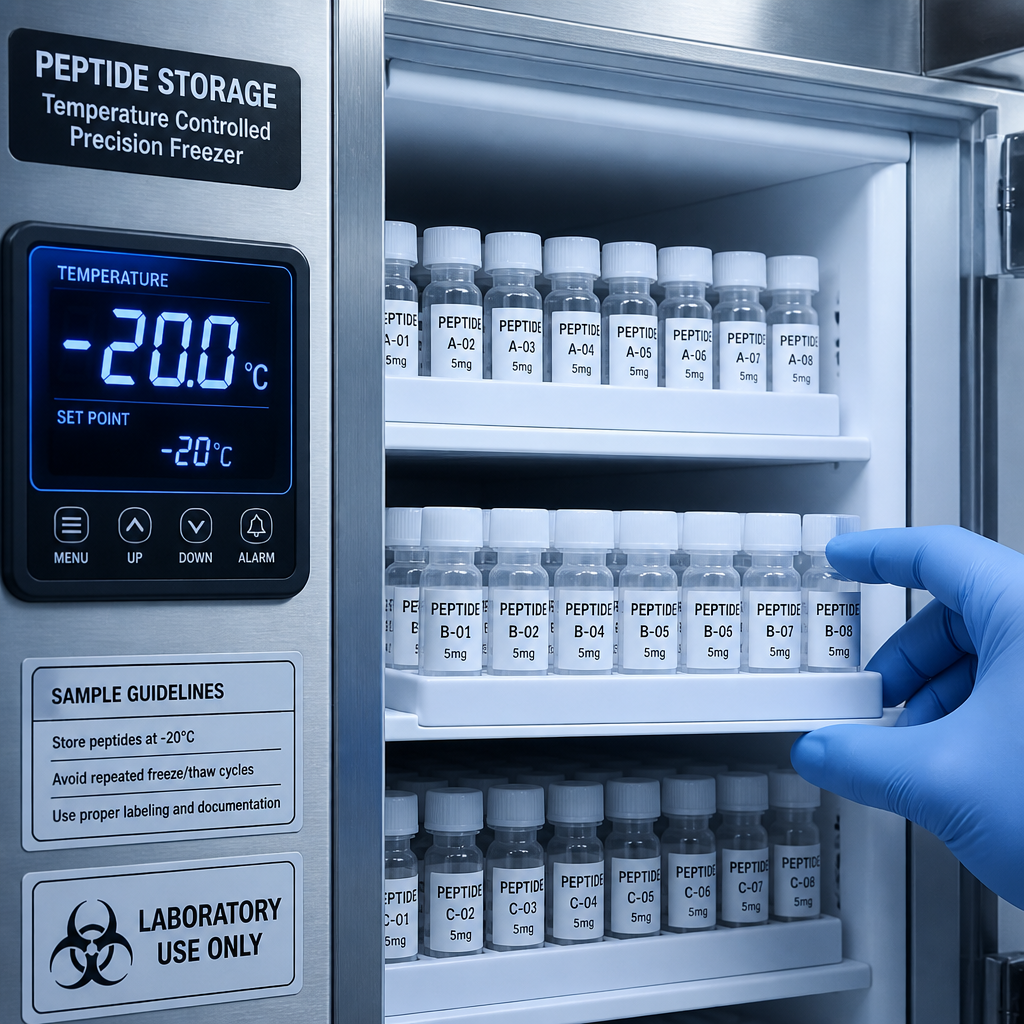
Storage at -20°C is the baseline requirement for lyophilized Retatrutide. For archival storage of material that will not be used for an extended period, -80°C is preferable. At these temperatures, most degradation reactions are kinetically suppressed to near zero, and properly stored lyophilized peptides can remain stable for years. Room temperature storage is only acceptable for the brief period between freezer and bench during an experiment, not as a long-term option.
Avoid storing peptide vials in the door of a laboratory freezer. Freezer door temperatures fluctuate significantly every time the door is opened, which means a vial stored on the door is being subjected to repeated mini-temperature excursions even before you formally thaw it. Keep vials in the back of a dedicated shelf inside the main freezer compartment.
Humidity Control: The Factor Researchers Underestimate
Lyophilized peptides are hygroscopic. They will absorb atmospheric moisture if given the opportunity, and that moisture is enough to initiate hydrolysis even while the powder remains technically "solid." Optimal humidity for lyophilized peptide storage is 30-40% relative humidity. Humidity above 50% significantly accelerates degradation.
In practice: store your vials in a sealed, airtight container with silica gel desiccant packets inside the freezer. Replace desiccant monthly, or immediately when the gel indicator changes color. Vacuum-sealed or nitrogen-flushed containers are ideal for critical compounds or long-term archival storage. Do not open vials at the bench until the vial has equilibrated to room temperature - opening a cold vial immediately exposes the hygroscopic powder to warm, humid ambient air, promoting condensation directly on the compound.
Light Protection for Sensitive Residues
Certain amino acid residues, particularly tryptophan and methionine, are susceptible to photodegradation. Store peptide vials in a dark environment (a sealed container or dark storage box inside the freezer) rather than an open shelf under fluorescent lighting. During handling at the bench, minimize unnecessary light exposure by keeping vials in an amber-colored container or working quickly.
The most effective way to prevent or minimize peptide degradation is to store the peptide in lyophilized or powder form at -20°C or preferably at -80°C, in a sealed, desiccated, and dark environment.
Pro tip: When working with multiple vials from the same batch, take out only the quantity you need for the current experimental session. Leaving the stock vial on the bench while you complete upstream preparation steps is an unnecessary exposure that accumulates over repeated experiments.
Reconstitution Protocol: Technique Determines Shelf Life
Once you add solvent to a lyophilized Retatrutide vial, you have fundamentally changed the compound's stability window. Water re-enables all the degradation pathways that lyophilization suppresses: hydrolysis, oxidation, and aggregation. Your reconstitution technique on day one determines the compound's condition on day 14.
Solvent Selection and Preparation
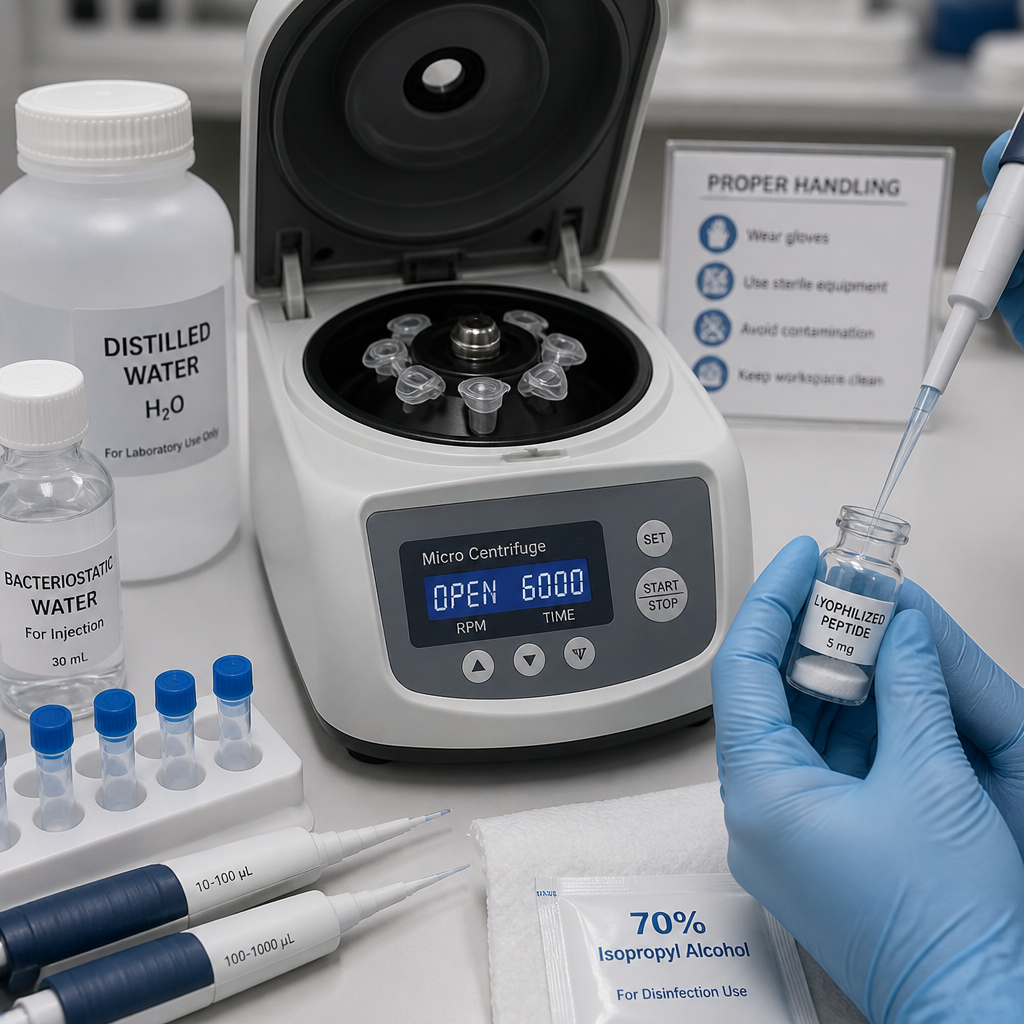
For Retatrutide intended for in vitro research, bacteriostatic water (containing benzyl alcohol) is the most commonly used reconstitution solvent. The benzyl alcohol provides antimicrobial activity that extends the usable window of the reconstituted solution. Sterile buffers at pH 5-6 are also appropriate; peptides in solution at pH above 8 are significantly less stable and should be avoided unless the experimental design specifically requires it.
Use sterile technique throughout. Pre-warm your solvent to room temperature before adding it to the vial. Adding cold solvent to a compound that may still be slightly below room temperature increases the risk of incomplete dissolution and localized concentration gradients that promote aggregation.
The Mechanical Step Most Researchers Get Wrong
Inject solvent slowly down the inner wall of the vial, not directly onto the powder cake. This allows the solvent to wet the lyophilized material gradually from the edges rather than creating a high-force impact point that can denature surface-exposed residues. After addition, swirl gently rather than shaking or vortexing. Mechanical shear from vortexing promotes aggregation in complex peptides, and for a triple agonist like Retatrutide, this is a real concern, not a theoretical one.
Allow complete dissolution before drawing up your working aliquot. Visual clarity does not always confirm complete dissolution with complex peptides, so allow 2-3 minutes of gentle swirling if the solution appears turbid after initial mixing.
Post-Reconstitution Storage
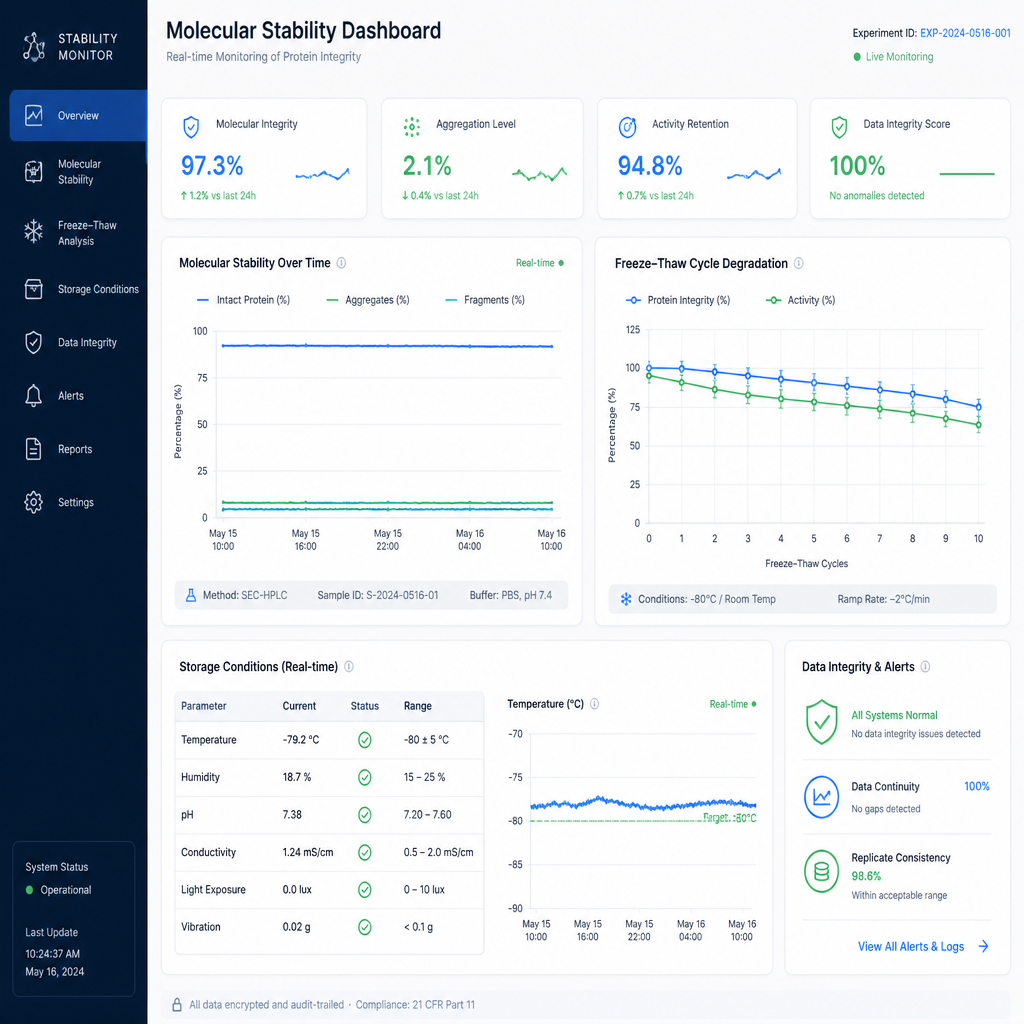
Store reconstituted Retatrutide at 2-8°C immediately after preparation. The conservative benchmark for reconstituted Retatrutide stability is 28 days at this temperature. This accounts for gradual potency loss and the fact that even bacteriostatic water's antimicrobial properties do not permanently sterilize the solution. Do not freeze a reconstituted solution unless your protocol explicitly requires it - the freeze-thaw cycle introduces mechanical stress to the dissolved molecule that accelerates aggregation compared to continuous cold storage.
Freeze-Thaw Cycles: The Most Common Cause of Gradual Degradation
Repeated freeze-thaw cycles are a leading cause of gradual peptide degradation in research labs, and they are also largely preventable. For lyophilized peptides, each freeze-thaw event introduces the risk of microcondensation - microscopic water droplets forming on the powder surface during the thaw phase that initiate localized hydrolysis before re-freezing.
The Aliquoting Solution
The correct response to the freeze-thaw problem is to aliquot before the first freeze. Determine the approximate quantity of Retatrutide needed per experimental session, and divide your stock into single-use vials of that size before placing anything in the freezer. Each aliquot is thawed once, used once, and discarded. The stock never gets repeatedly opened and re-frozen.
This requires a small investment of time at receipt but eliminates the most predictable source of gradual potency loss across a study. It also makes batch traceability cleaner: each aliquot can be labeled with the lot number, date of aliquoting, and intended use, creating a complete handling record for each experimental data point.
What Happens When You Skip Aliquoting
Researchers who return repeatedly to a single stock vial will typically see no obvious signs of degradation in the first few cycles. The problem accumulates quietly. By cycle five or six, purity may have declined enough to affect dose-response relationships in a subtle way that is difficult to distinguish from biological variability in the assay. This is the most dangerous form of degradation: invisible, gradual, and plausibly attributed to other causes. The discipline of aliquoting removes this confounding variable entirely.
Storage Method Comparison
The right storage approach depends on your experimental timeline and compound use frequency. The table below compares the three main storage states for research-grade Retatrutide to help you plan your inventory management.
| Storage State | Conditions Required | Expected Stability Window |
|---|---|---|
| Lyophilized, archival (-80°C) | -80°C, sealed desiccated container, dark, single-use aliquots | Multiple years when stored correctly; periodic purity verification recommended for archival stock held beyond 12 months |
| Lyophilized, working stock (-20°C) | -20°C, sealed container with desiccant, dark storage, minimal freeze-thaw events | 12-24 months at optimal conditions; stability declines faster if humidity control or temperature consistency is poor |
| Reconstituted solution (2-8°C) | 2-8°C continuous refrigeration, sealed amber vial, no re-freezing, bacteriostatic water solvent | 28 days (conservative benchmark); potency declines gradually rather than cliff-dropping at day 28, but experimental reliability decreases with time |
For most research applications, a hybrid approach works best: maintain archival stock at -80°C, keep a single working aliquot at -20°C for the current study phase, and reconstitute only what you need for the upcoming 2-3 week experimental window. This minimizes both freeze-thaw events and reconstituted solution age at point of use.
Signs of Degradation and When to Discard
Knowing when a sample is compromised is as important as knowing how to prevent compromise in the first place. For reconstituted Retatrutide, visible signs of degradation include opalescence, persistent cloudiness that does not resolve with gentle swirling, discoloration, or the presence of insoluble precipitates. Any of these observations means discard, not cautious use at reduced concentration.
For lyophilized powder, watch for discoloration of the cake (from white to yellow or brown), clumping that suggests moisture absorption has occurred, or an unusual odor on opening. A degraded lyophilized sample that got wet at some point may dissolve visually fine but will have compromised purity at the molecular level.
When Visual Inspection Is Not Enough
The practical limitation of visual inspection is that significant potency loss through deamidation or oxidation can occur without any visible change to the compound's appearance. For experiments where Retatrutide purity is directly relevant to the research outcome, HPLC verification of the working stock is the only reliable method of confirming that starting material meets the required purity threshold. Pepura Labs provides independently verified purity documentation for every batch, giving you a confirmed baseline from which to assess any subsequent changes in your own handling conditions.
If you have material that has been exposed to conditions outside the recommended storage parameters (a temperature excursion during transit, a freezer failure, or a vial left at bench temperature for an extended period), do not attempt to rescue it by re-freezing and hoping for the best. Order fresh material. The cost of a replacement vial is always less than the cost of repeating experiments driven by corrupted data.
Pro tip: Document every temperature excursion, even minor ones, in your batch handling log. If your results become anomalous weeks after a storage event, you need that record to identify the likely cause and report it accurately in your methods section.
Frequently Asked Questions
How long can lyophilized Retatrutide be stored at -20°C before purity is affected?
Under optimal conditions - sealed container, desiccant present, consistent -20°C, minimal freeze-thaw cycles - lyophilized Retatrutide can maintain its purity for 12-24 months. For archival storage beyond that window, -80°C is the recommended temperature. The key variable is not just temperature but whether humidity control and freeze-thaw discipline have been maintained throughout the storage period. Any breach of those conditions compresses the effective timeline.
Can I use regular sterile water instead of bacteriostatic water for reconstitution?
Yes, sterile water is chemically compatible with Retatrutide reconstitution. The practical difference is that sterile water provides no antimicrobial protection, which reduces the safe use window of your reconstituted solution significantly compared to bacteriostatic water. For single-use aliquots consumed within 24 hours, sterile water is acceptable. For solutions that will be used repeatedly over days or weeks, bacteriostatic water is the more appropriate choice for maintaining microbiological integrity of the working stock.
What is the correct way to warm a frozen Retatrutide vial before use?
Allow the vial to reach room temperature passively by leaving it on the bench for 15-20 minutes. Do not use a water bath, heat block, or warm your hands on the vial to speed the process. Localized heat application creates temperature gradients inside the vial that accelerate degradation unevenly. Do not open the vial until it has fully equilibrated to room temperature - opening while cold draws in warm humid air that condenses on the hygroscopic lyophilized powder.
How do I know if my Retatrutide has been compromised by a freezer temperature excursion?
Visual inspection is the first screen: check for discoloration, unusual cake texture, or clumping in the lyophilized form. For reconstituted material, look for cloudiness, opalescence, or precipitates. However, visual assessment cannot detect molecular-level degradation such as deamidation or oxidation. If the excursion was significant (above 0°C for lyophilized material, or above 8°C for reconstituted solution), treat the sample as potentially compromised and verify purity by HPLC before using it in a quantitative experiment. When in doubt, use fresh material.
Does the purity certification from Pepura Labs eliminate the need for in-lab quality checks?
The purity certificate documents the compound's condition at the point of manufacture and verification - it is your confirmed starting point, not a guarantee of what the compound will be in six months if stored incorrectly. Chain of Custody documentation tells you that the compound arrived at your lab meeting specification. What happens after arrival is your responsibility. For high-stakes experiments, use the supplier's purity data as the baseline and implement your own periodic verification for long-stored working stocks. Both documents together create a complete quality picture.
Is it safe to aliquot Retatrutide under normal bench conditions or does it require a biosafety cabinet?
Retatrutide is a research compound for in vitro applications. Aliquoting under clean bench conditions with appropriate personal protective equipment is standard practice. If your aliquoting involves reconstituted solution rather than dry powder, work quickly to minimize air exposure time, and use sterile technique for all liquid transfers. A laminar flow hood is appropriate for any liquid handling where microbiological contamination of the stock is a concern for experiments requiring extended reconstituted solution shelf life.
Have your own Retatrutide storage setup or a handling protocol that works well in your lab? We would like to hear what approaches your team has found most effective for maintaining peptide integrity across long study timelines.
References
- Sigma-Aldrich technical guidance on peptide handling, storage temperatures, and freeze-thaw best practices for research applications
- JPT Peptide Technologies: detailed guidance on lyophilized and reconstituted peptide storage conditions including humidity control and aliquoting protocols
- GenScript peptide storage and handling guidelines covering freeze-thaw cycles, pH effects, and solution stability for research-grade peptides
- Lone Star Peptide Co. storage best practices: humidity ranges, desiccant management, and temperature guidelines for lyophilized peptides
- Overview of Retatrutide stability in reconstituted solution: degradation kinetics, 28-day benchmark, and handling technique considerations