
Working with retatrutide 60mg means handling a large amount of material, and a single careless step can waste it. A rushed reconstitution, an unlabeled tube, or a freezer that cycles too often can erase the value of the fill before the first assay runs. Teams doing high dose peptide research tend to ask the same three questions: how to dissolve a lyophilized cake without damaging it, how to split the solution into usable portions, and how to keep each portion stable until it is needed. This guide answers those questions from the bench, covering the retatrutide vial handling steps we see go wrong most often. Everything here applies to in vitro laboratory research only.
Table of Contents
- Quick Takeaways
- What a 60mg Vial Actually Contains
- Reconstitution Math and Diluent Choice
- Aliquoting Strategy for Single-Use Portions
- Storage, Freeze-Thaw Limits, and Light Control
- Comparing Three Handling Workflows
- Documentation, COA, and Chain of Custody
- Common Handling Mistakes That Cost Experiments
- Frequently Asked Questions
- References
Quick Takeaways
| Key Insight | Explanation |
|---|---|
| Match the vial to its paperwork first | Confirm the batch number, compound name, and purity on the COA against the vial label before you open anything. |
| Choose diluent volume from your assay | A 60 mg fill in 3 mL gives 20 mg/mL. Pick the volume your working concentration requires, then write it on the label. |
| Plan aliquots from experiments, not the vial | Count the runs and the volume each one uses, then add dead volume. A 3 mL stock split into 150 µL portions yields about 18 usable tubes, not 20. |
| Use low-protein-binding tubes | Peptides can adsorb to ordinary plastic and glass, and that loss is invisible unless you measure for it. |
| Treat each thaw as a single event | Thaw one aliquot, use it, and discard the remainder rather than refreezing it. |
| Let lyophilized vials warm before opening | Opening a cold vial draws condensation into the cake, and moisture is an easy way to start degradation. |
| Log every step against the batch | Record the diluent lot, volume, final concentration, aliquot count, and freezer position so any tube can be traced back. |
What a 60mg Vial Actually Contains
A 60mg retatrutide vial holds a lyophilized (freeze-dried) cake, sealed under vacuum or inert headspace. Before anything else, read the label for the compound name, net fill weight, batch or lot number, and the date on the documentation. The fill weight drives every concentration calculation you will make, so any mismatch here is the first thing to resolve. Good retatrutide vial handling starts with a label you have actually checked.
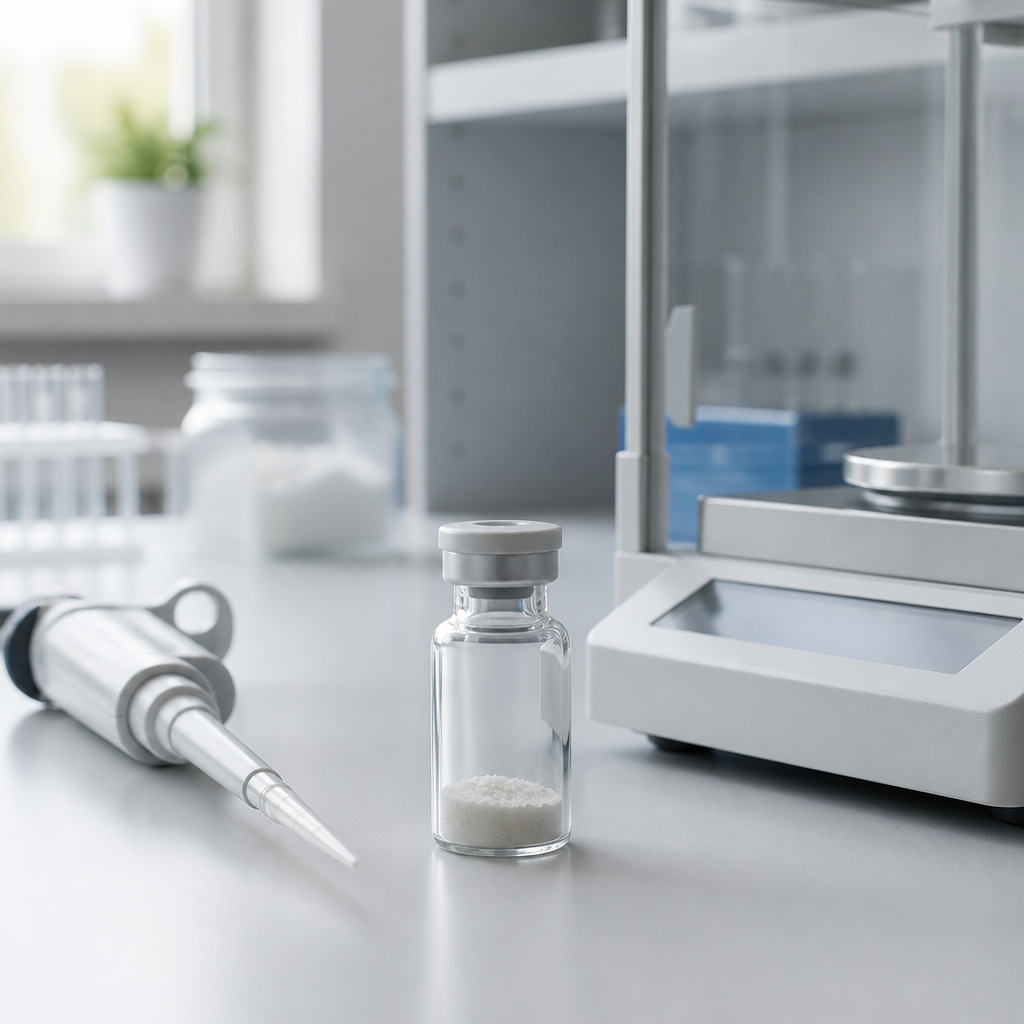
Our lyophilized products are supplied at 99% purity or higher and independently verified by Canadian laboratories. That figure is a claim you should check, not just accept. Purity is usually assessed by chromatography and identity by mass spectrometry, and the Certificate of Analysis (COA) should show both results for the specific batch in your hands.
Matching the label to the Certificate of Analysis
Pull the COA for the batch number printed on the vial, not the batch you ordered last quarter. Confirm the compound name, the nominal mass, the purity result, and the test date. If any one of those does not match the label, stop. A label that disagrees with its paperwork is a quarantine event, and that call is far cheaper before reconstitution than after.
A 99% purity figure also means roughly 1% of the material is something other than the target peptide. In a 60 mg fill, that is still a measurable amount, which is why we recommend recording the purity value in your own batch log rather than a simple checkmark that a COA exists.
Inspecting the cake before you add diluent
Look at the cake through the vial wall before you open it. An intact, evenly seated cake is what you want. Collapsed, discolored, or heavily fragmented material can result from poor handling in transit or storage, and it is worth a call to your supplier before you dissolve it. Do not try to rescue a damaged cake by changing the diluent or the mixing method. Those changes hide the problem instead of revealing it.
Pro tip: Photograph the vial label and the matching COA page together, then file the image with your batch log before you open the vial.
Reconstitution Math and Diluent Choice
Concentration is simple arithmetic: mass divided by volume. A 60 mg fill dissolved in 2 mL gives 30 mg/mL. The same fill in 3 mL gives 20 mg/mL, and in 6 mL gives 10 mg/mL. Choose your volume from the working concentration your assay requires, then confirm the stock is practical to dilute downstream. Very concentrated stocks force large dilution factors, and large dilution factors magnify pipetting error.
We supply bacteriostatic water as the diluent for reconstitution. It suits multi-draw work because it contains benzyl alcohol, a preservative that slows microbial growth after the vial has been punctured. That same preservative is the reason it is not always the right choice. Some cell-based and other sensitive applications call for a preservative-free diluent, so check your protocol before you open a vial.
Why diluent choice changes downstream results
Benzyl alcohol is not inert in every system. If your assay is sensitive to preservatives, the diluent becomes a variable, and an unexplained shift in your data can trace back to a diluent that was never part of the protocol. Write the diluent name, lot, and volume into the reconstitution record, the same way you record the peptide itself. If you need a preservative-free option, make that decision before the vial is open, not after the first readout looks odd.
Wetting the cake without foaming it
Run the diluent slowly down the inside wall of the vial rather than directly onto the cake. Let the liquid wet the cake from the edges, then roll or swirl the vial gently until the material dissolves. Hard vortexing introduces air and foam, which interferes with volume measurement and can stress the peptide at the air-liquid interface.
Give the solution time. Dissolution is not always instant, and a faint haze that clears within a reasonable window is different from a solution that stays cloudy. If the material is still cloudy after a patient, gentle process, stop and contact your supplier with the batch number instead of adding more diluent or applying heat.
Pro tip: Write the final concentration in mg/mL on the vial label, along with the reconstitution date and your initials, before you take the first draw. Labels written at the bench are more reliable than labels written from memory an hour later.
Aliquoting Strategy for Single-Use Portions
Plan your aliquots before you reconstitute. Start from the experiments, not the vial. List how many runs you expect, the volume each run consumes, and how many of those runs will happen in the same week. Then work backward to the aliquot size. A peptide aliquoting protocol built around real experiments is far less likely to end with a tube that is thawed, partly used, and refrozen.
We recommend aliquoting on day one for any program that will draw on the 60 mg fill across more than two sessions. Splitting later means the stock has already been opened, drawn, and re-chilled several times. Doing it at reconstitution, while the material is fresh and your technique is steady, is the cleaner path.
Calculating volumes and dead volume
Dead volume is the solution you cannot physically withdraw from the source vial, plus residue left on pipette tips and tube walls. Ignore it and your aliquot count will be wrong. As an example, a 3 mL stock split into 150 µL portions looks like 20 tubes on paper. Once you account for residue at the bottom of the vial and the final draw, plan on about 18 usable tubes and label them accordingly.
Keep the arithmetic on a single worksheet: total stock volume, target aliquot volume, expected dead volume, and resulting tube count. Anyone who picks up your stock later should be able to reconstruct the split without guessing.
Tube selection, pipetting, and labeling
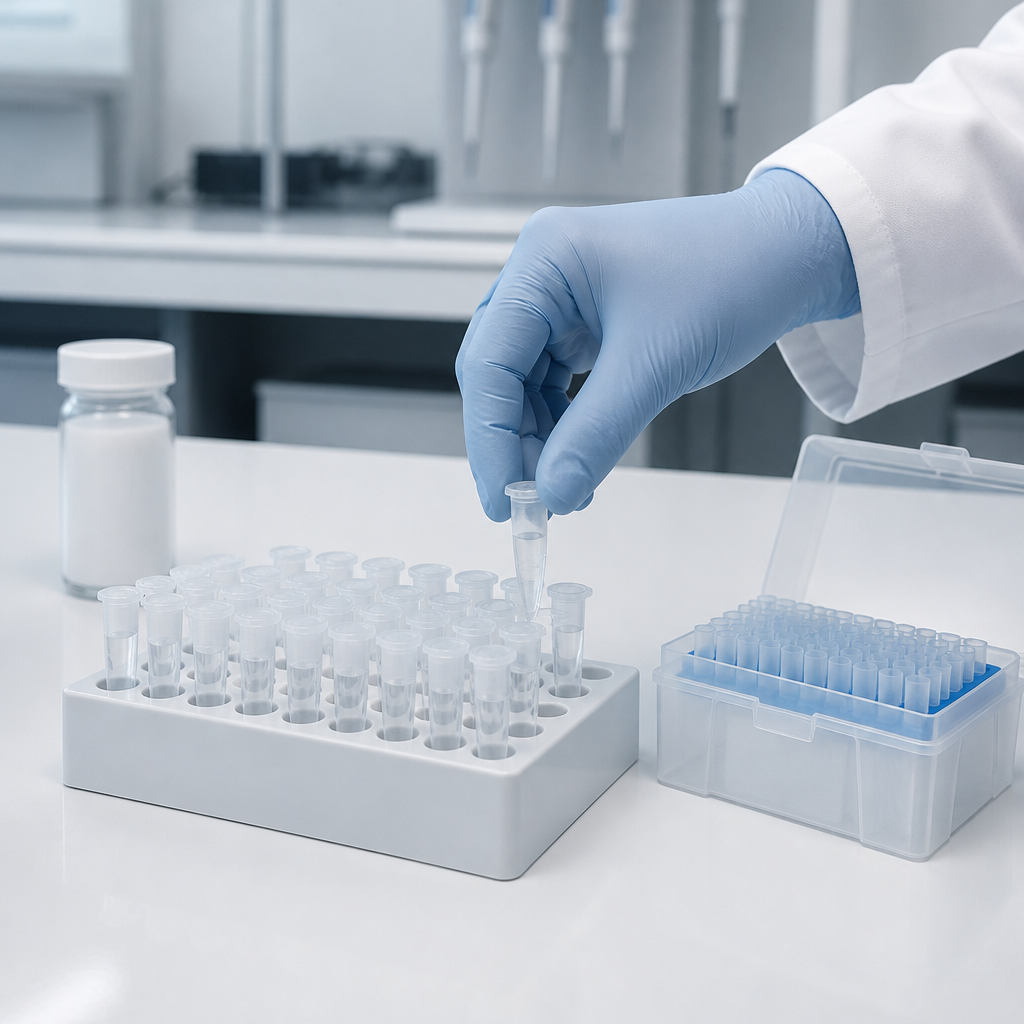
Use low-protein-binding tubes. Peptides can adsorb to ordinary polypropylene and glass surfaces, and that loss is invisible unless you measure for it. Use cryo-rated tubes if the aliquots will be frozen, and confirm the closures seal tightly at low temperature. Change tips between each aliquot, and never pipette from the reagent lid or the outside of a tube.
Label every tube with the compound, concentration, aliquot number, reconstitution date, and a reference to your batch log. Use a marker or label that holds up at low temperature. A tube with a smudged label is not a usable tube, no matter how good the material inside it is.
Storage, Freeze-Thaw Limits, and Light Control
Lyophilized vials are the most stable form of this material, but that stability is conditional. Keep sealed vials cold, dark, and dry, following the storage instructions on your product documentation. Before you open a cold vial, let it come to room temperature. Opening a cold vial pulls condensation into the cake, and moisture is one of the fastest ways to start a problem in a dry peptide.
Reconstituted stock behaves differently. Once the material is in solution, it is more exposed to degradation, adsorption, and microbial growth. Refrigerate or freeze according to the stability data your protocol relies on, and hold that condition constant. The fastest way to lose a stock is to move it between conditions informally.
Treating every thaw as a single event
Each freeze-thaw cycle stresses a peptide solution. Aggregation, adsorption, and concentration drift all become more likely with repeated cycling, which is exactly why aliquoting exists. Thaw one aliquot, use what you need, and discard the remainder rather than refreezing it. If keeping the leftover feels tempting, that feeling is a signal that your aliquot size is too large.
Light, temperature excursions, and freezer layout
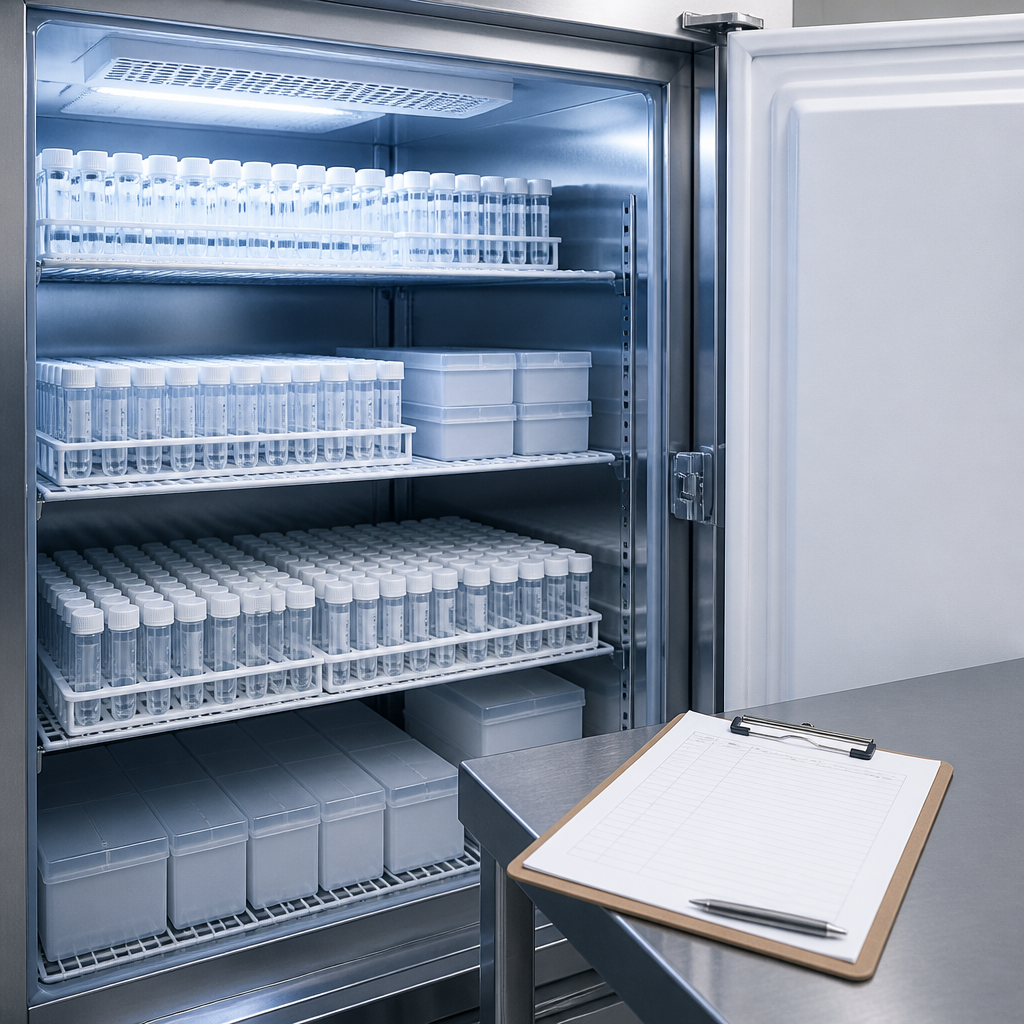
Store vials in their original packaging or in opaque secondary containers to limit light exposure. Keep your freezer shelf map current, and log door openings if your unit has a temperature record. A temperature excursion is not always obvious from the outside. If an alarm or logger shows an event, flag every affected tube in the batch log and do not assume a short excursion was harmless.
Shelf position matters too. Tubes stored in the door or near the front absorb more temperature swing than those on interior shelves. Keep the working aliquots where they are least disturbed, and keep reserve tubes deeper in the unit.
Comparing Three Handling Workflows
Most labs pick a handling workflow by habit rather than reasoning. These three approaches cover the realistic options for a 60 mg fill, and each one fails in a different way. The table compares them on the factors that cause the most trouble at the bench.
| Workflow | Best fit | Main risk |
|---|---|---|
| Full-vial reconstitution, draw as needed | One operator, short campaign, all runs within a few days | Repeated punctures and temperature cycling of the whole stock |
| Day-one single-use aliquoting | Multi-session programs or shared lab stock | Upfront time, and dead-volume loss if the split is poorly planned |
| Lyophilized reserve, reconstitute later | Uncertain future use or staggered study timelines | Losing track of the reconstitution date and adding extra handling steps |
Full-vial reconstitution is the fastest route to usable solution, but it asks the most of your bench discipline. Every draw is another puncture and another cold-warm cycle, which is why it suits a single operator running a short campaign. Day-one aliquoting costs time up front and gives you the cleanest record. A lyophilized reserve is the right call when future use is uncertain, but the clock on a reconstituted stock starts when the diluent goes in, so track that date carefully.
Our default recommendation is day-one aliquoting for any multi-session program. The up-front time pays back in fewer openings, fewer thaws, and a simpler batch record. Keep the reserve approach for material you genuinely cannot schedule, and leave the rest lyophilized until the experiment needs it.
Documentation, COA, and Chain of Custody
The Certificate of Analysis is the record that ties a vial to its test results. Pepura Labs batches are independently verified by Canadian laboratories and supplied with full chain of custody documentation and batch traceability. For a research lab, that chain matters because it answers the questions a reviewer or auditor will eventually ask: where the material came from, who handled it, and what testing showed.
Chain of custody is the record of each transfer a sample goes through, with the people and conditions involved at every step. Your own documentation should extend that chain past the courier's door. Once the vial arrives at your bench, the record of what happens next is yours to keep.
Most handling errors happen after the seal is broken. The paperwork tells you what you bought, but your bench habits decide what your data actually reflects.
Building a batch log that holds up under review
A useful batch log records the vial ID, batch number, COA reference, receipt date, cake inspection notes, diluent name and lot, reconstitution volume, final concentration, aliquot count, and freezer location. Keep one master entry per vial and link each aliquot to it. If you can reconstruct the full history of a single tube from the log within a few minutes, your records are doing their job.
What to do when the COA and the label disagree
Stop, quarantine the vial, and do not reconstitute it. Record the discrepancy with a photograph of the label and the COA page, then contact your supplier with the batch number. A mismatch can be a clerical error, but you cannot confirm that from the bench, and resolving it before use costs far less than discovering it after an invalid result.
Common Handling Mistakes That Cost Experiments
Most failed stocks trace back to a short list of habits, and they are rarely dramatic. The problems are small shortcuts repeated over many sessions. Below are the mistakes we see most often from research teams handling 60 mg fills, along with the fix for each.
Speed shortcuts that cost stability
Vortexing a vial hard to speed dissolution, warming a stock to hurry mixing, and leaving a vial open on the bench while you set up the rest of the run are all common. Each one trades a few minutes of convenience for a stability risk you cannot measure at the time. Build a short dissolution step into your protocol with a time window, so nobody feels pressure to force it.
Reusing a single pipette tip or syringe across several aliquots is another. It carries material between tubes and can introduce contamination from the stock into the next portion. The fix is inexpensive: one tip per draw, and never return unused solution to the source vial.
Labeling errors that corrupt data
A wrong concentration on a tube is worse than no label, because it looks trustworthy. Check every label against the batch log before the tube leaves the bench, and have a second person verify the concentration on the first aliquot from each new reconstitution. A few minutes of checking prevents a week of confused results.
Storing aliquots in the freezer door, using unlabeled racks, or mixing two reconstitutions in the same box are all avoidable. Keep each stock in its own marked box with a visible reconstitution date, and move tubes you are no longer using into a separate reserve area so the active box stays clean.
Pro tip: Run a small pilot aliquot against your assay controls before you commit the full stock. If the pilot behaves unexpectedly, only one tube's worth of material is at risk instead of the whole vial.
Frequently Asked Questions
Can I reconstitute the whole 60mg vial into a single stock?
Yes, and for a single-operator, short-term workflow that is often reasonable. The tradeoff is that every draw punctures the stock and exposes the remaining solution to temperature change. If your work spans several sessions, aliquot the stock on the day you reconstitute it.
Which diluent should I use for a retatrutide 60mg reconstitution?
Use the diluent your protocol specifies. Bacteriostatic water is the one we supply, and it suits multi-draw work because its benzyl alcohol preservative slows microbial growth. If your system is sensitive to preservatives, choose a preservative-free diluent before you open the vial, and record the choice.
How many aliquots should I make from a 60mg vial?
Work from your experiments, not from the vial. Count the runs, the volume each one uses, and the dead volume lost in splitting, then calculate the tube count. A 3 mL stock split into 150 µL portions gives roughly 18 usable tubes once residue is included, not the 20 the arithmetic suggests.
How many freeze-thaw cycles can an aliquot tolerate?
The safest answer is one. Each thaw adds stress through temperature change and handling, and repeated cycling is the most avoidable source of drift in a peptide solution. Thaw an aliquot only when you are ready to use it, and discard any remainder instead of refreezing it.
Does each Pepura Labs batch come with documentation?
Yes. Lyophilized products are independently verified by Canadian laboratories and supplied with full chain of custody documentation and batch traceability. Match the batch number on your vial to its COA before reconstitution, and contact us with the batch number if anything does not line up.
What handling step has caused the most trouble in your lab, and would you change your aliquoting approach after reading this?