
Research
When Will Retatrutide Be Approved? The FDA & Health Canada Timeline
September 5, 20266 min read
Retatrutide has posted the strongest weight-loss numbers ever recorded for a non-surgical therapy—up to 30.3% average body-weight reduction in its Phase 3 program. The obvious next question is the one almost nobody answers with any precision: when can you actually get it, and when can Canadians get it?
Most coverage stops at the US story. This article maps the full regulatory runway on both sides of the border: where the TRIUMPH program stands today, when Eli Lilly is expected to file with the FDA, how Health Canada's review process differs, and—critically—why Canadian approval and Canadian availability are two very different dates.
Where the Clinical Program Stands Today
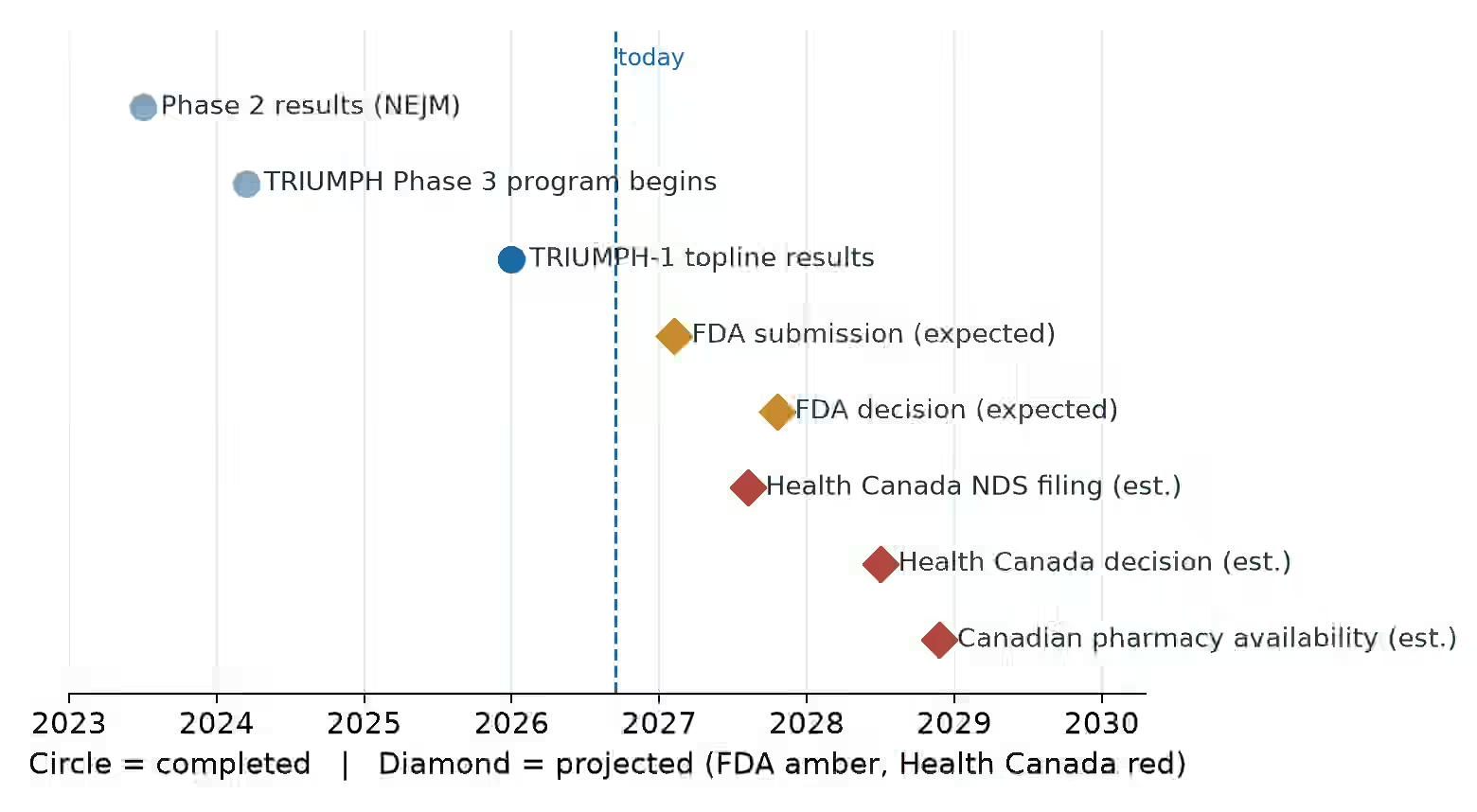
Retatrutide (formerly LY3437943) completed its landmark Phase 2 trial in 2023, published in the New England Journal of Medicine, showing up to 24.2% weight loss over just 48 weeks. That result triggered the TRIUMPH Phase 3 program—a family of large trials (TRIUMPH-1 through TRIUMPH-4) covering obesity, obstructive sleep apnea, knee osteoarthritis, and type-2 diabetes populations.
TRIUMPH-1 topline results landed in early 2026 and confirmed the Phase 2 signal at scale: 28.3% average weight loss at 80 weeks, extending to 30.3% at 104 weeks in higher-BMI cohorts. With pivotal efficacy data in hand, the program has shifted from “does it work?” to “regulatory package assembly.”
The Projected Timeline at a Glance
The FDA Path: Filing Expected Early 2027
Eli Lilly is expected to submit retatrutide for FDA review in early 2027, once the remaining TRIUMPH readouts complete the safety database. Obesity submissions with data of this magnitude are strong candidates for priority review, which targets a decision within roughly six months of acceptance instead of the standard ten.
That puts a plausible FDA decision in late 2027, with US market availability following weeks to months later depending on manufacturing scale-up—a genuine constraint, given that incretin therapies have repeatedly launched into shortage conditions.
The Health Canada Path: How It Actually Works
Health Canada runs its own independent review—there is no automatic recognition of an FDA approval. A manufacturer files a New Drug Submission (NDS) with the same clinical package, and Health Canada's target review clock is 300 calendar days for a standard submission, or 180 days if Priority Review status is granted.
Two Canada-specific realities shape the timeline:
- Filing lag: Manufacturers almost always file in the US first. For recent incretin drugs the Canadian filing followed the US submission by several months, putting a likely retatrutide NDS filing in mid-to-late 2027 and a Health Canada decision around mid-2028.
- Approval ≠ availability: This is the step most timelines ignore. After a Notice of Compliance is issued, the manufacturer still has to negotiate pricing with the PMPRB framework and provincial payers, and—decisively—allocate manufacturing supply to the Canadian market. Wegovy was approved by Health Canada in November 2021 but did not reach Canadian pharmacies until May 2024, almost three years later, because global supply was routed to larger markets first.
What History Says: US vs Canada for Recent Incretin Drugs
The precedent table below is the most honest forecasting tool available. It shows the FDA approval, Health Canada approval, and—the number that matters—actual Canadian pharmacy availability for the current generation of metabolic drugs:
| Drug | FDA approval | Health Canada approval | On Canadian shelves |
|---|---|---|---|
| Semaglutide (Wegovy) | June 2021 | November 2021 (~5 months later) | May 2024 — nearly 3 years after approval |
| Tirzepatide (Mounjaro) | May 2022 | November 2022 (~6 months later) | Late 2023 |
| Tirzepatide (Zepbound) | November 2023 | May 2025 (~18 months later) | 2025 |
Applying that pattern to retatrutide: even in the optimistic scenario—FDA approval late 2027, Health Canada mid-2028—routine Canadian pharmacy availability before 2029 would beat every precedent in the class. Supply allocation, not regulatory speed, has been the binding constraint every single time.
Could Anything Accelerate (or Delay) This?
- Acceleration: Priority Review in both jurisdictions, a near-simultaneous Canadian filing (Lilly has moved toward tighter global filing windows), or Health Canada leaning on foreign reviews under its reliance framework could compress the Canadian gap to under six months.
- Delay: Any safety signal in the remaining TRIUMPH readouts (the mild heart-rate increase is the item regulators will scrutinize most), manufacturing capacity shortfalls, or a decision to prioritize US and EU launch volumes would push Canadian availability toward 2029-2030.
What This Means for Researchers
Until a Notice of Compliance is issued, retatrutide remains an investigational compound in Canada—not available by prescription at any pharmacy, and any product marketed for human use is illegal. Research-grade retatrutide for in vitro laboratory study occupies a separate category: it is sold strictly for research purposes, is not for human or veterinary consumption, and its quality rests entirely on independent testing rather than regulatory oversight—which is why batch-specific Certificates of Analysis matter so much in this space.
For research planning purposes, the takeaway is simple: the compound's pharmacology is now extensively characterized in the published literature, while commercial availability in Canada remains years away. That window is precisely why in vitro research activity on triple-agonist peptides has accelerated.
References
- Eli Lilly and Company. (2026). Lilly's triple agonist, retatrutide, delivered powerful weight loss in pivotal Phase 3 obesity trial. Lilly Investor Relations.
- Rosenstock, J., et al. (2023). “Triple–Hormone-Receptor Agonist Retatrutide for Obesity — A Phase 2 Trial.” New England Journal of Medicine, 389(24), 2311-2322.
- Health Canada. (2025). Guidance Document: Management of Drug Submissions and Applications. Government of Canada, Ottawa.
- GoodRx Health. (2026). Retatrutide for Weight Loss: Availability, Dosage, and More. GoodRx Medical Reports.
Related reading
Comparison of Ozempic and Retatrutide
Ozempic (semaglutide) vs retatrutide: mechanism of action, weight-loss efficacy (15% vs 26–30%), pros and cons, side-effect profiles and clinical outlook.
Comparison of Tirzepatide and Retatrutide
Tirzepatide vs retatrutide compared: dual vs triple agonist mechanisms, weight-loss data (22.5% vs 30.3%), liver fat reduction, side effects and availability.
The “Triple-G” Miracle: Tracking Retatrutide's Record-Breaking TRIUMPH Trials
Tracking retatrutide's record-breaking TRIUMPH trials: 28-30% weight loss, results by trial (TRIUMPH-1 to 4), dose vs dropout data, side effects and approval timeline.
Battle of the Sexes: How Men and Women Respond Differently to Retatrutide
How men and women respond differently to retatrutide: women lose a higher percentage (25.3% vs 22.8%), men lose more absolute pounds, plus sex-specific side effects.
Taming the “Triple-G”: How to Minimize Side Effects on Retatrutide
How to minimize retatrutide side effects: dose titration data, nausea and constipation remedies, heart rate tips, and side-effect rates by maintenance dose.
A Complete Casual Guide to Retatrutide: Reconstitution, Dosing, and Math Made Easy
How to mix retatrutide with bacteriostatic water: step-by-step reconstitution, the peptide math formula, and a complete dosage chart with syringe units for 10mg-84mg vials.
What is “GLP-3”? The Next-Gen Weight Loss Nickname Explained
GLP-3 is the internet's nickname for triple-agonist drugs like retatrutide, which target GLP-1, GIP and glucagon at once. What it means, how it compares, and when it arrives.
What to Expect on Retatrutide: The Week-by-Week Results Timeline
What to expect on retatrutide week by week: -3.2% by week 4, -8.5% by week 12, -15% by week 24, -24.2% by week 48 and up to -30.3% by week 104, with the full trajectory graph.
Pepura Labs supplies independently lab-verified, research-grade retatrutide across Canada — for in vitro research use only.
Browse catalog