
When a phase 2 clinical trial reports up to 82% relative reduction in liver fat content measured by MRI-PDFF, the research community pays attention. Retatrutide liver fat reduction data, published in Nature Medicine in 2024, stands apart from anything previously seen in the NAFLD and MASLD peptide research pipeline. The mechanism driving those numbers is not simply weight loss. It is the glucagon receptor arm of retatrutide's triple agonism that appears to be doing heavy biochemical lifting inside hepatocytes. For researchers designing in vitro studies on hepatic lipid metabolism, understanding that distinction is not optional. It is the entire point.
Table of Contents
- What Makes Retatrutide Different from Other Incretin-Based Approaches
- The Glucagon Receptor and Hepatic Lipid Metabolism: Mechanisms Behind the Numbers
- Phase 2 MASLD Data: What the Trial Actually Showed
- Comparing Receptor Targeting Approaches in Hepatic Fat Research
- Designing In Vitro Research Around Retatrutide's Hepatic Pathway
- The NAFLD Peptide Research Landscape: Where Retatrutide Fits
- Frequently Asked Questions
- References
What Makes Retatrutide Different from Other Incretin-Based Approaches
Semaglutide and tirzepatide have earned their place in metabolic disease research, but their hepatic fat reduction effects are, in large part, downstream consequences of systemic weight loss. Retatrutide operates differently. As a triple agonist targeting the GIP, GLP-1, and glucagon receptors simultaneously, it introduces a direct hepatic signal that the dual agonists do not replicate at the same magnitude.
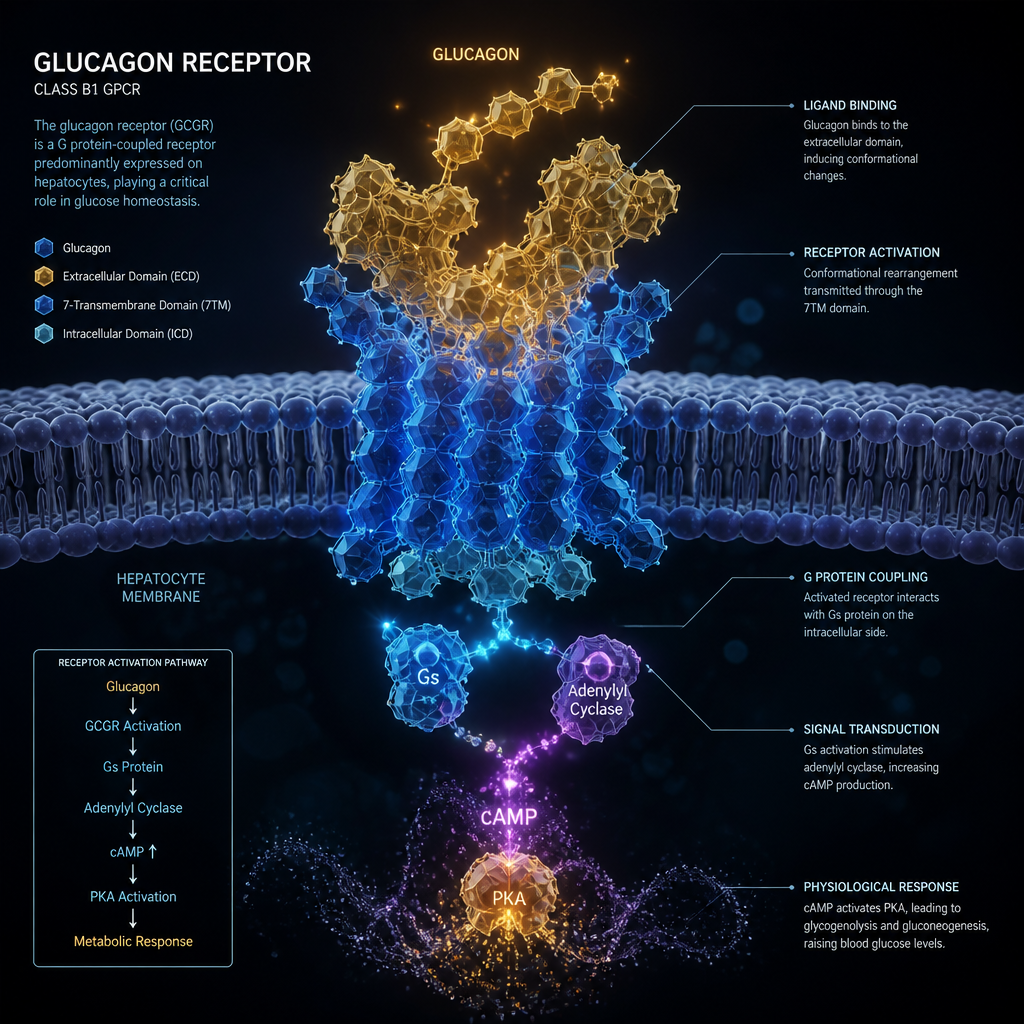
The glucagon receptor (GCGR) is expressed by hepatocytes. When activated, it reduces liver fat content by inducing lipid oxidation, augmenting metabolic enzyme activity, enhancing mitochondrial function, and increasing the liver-specific metabolic rate. That is not a downstream adipose effect. That is a direct conversation between the peptide and the liver cell. For researchers working in hepatic lipid metabolism, this makes retatrutide a structurally more interesting research compound than its GLP-1 mono-agonist predecessors.
What separates retatrutide further is the dose-dependency of its glucagon signal. At lower doses, the GLP-1 component dominates and the liver fat reductions largely track with weight loss. At higher doses, the glucagon agonism amplifies to a level that produces hepatic fat reductions well beyond what weight loss alone would predict. That dose-response relationship is exactly the kind of mechanistic signal that makes controlled in vitro experiments valuable.
Pro tip: When designing hepatocyte-based assays with retatrutide, consider running parallel arms that isolate the glucagon receptor pathway using selective GCGR agonists as controls. This lets you separate the glucagon-specific hepatic contribution from the combined triple-receptor effect.

The Glucagon Receptor and Hepatic Lipid Metabolism: Mechanisms Behind the Numbers
The GCGR's role in hepatic lipid metabolism has been studied in isolation for years, and the picture that has emerged is precise. GCGR agonism shifts hepatic metabolism toward fatty acid oxidation and ketogenesis. Glucagon signalling promotes lipid mobilisation and increases mitochondrial beta-oxidation and amino acid catabolism, expanding the hepatic acetyl-CoA pool. This is not subtle biochemistry. It is a fundamental metabolic reorientation at the cellular level.
How Glucagon Suppresses De Novo Lipogenesis
In the liver, glucagon reduces triglyceride accumulation and VLDL secretion by stimulating lipolysis and beta-oxidation, while simultaneously inhibiting hepatic lipogenesis. The inhibition of triglyceride synthesis is a separate action from the promotion of fat oxidation, meaning glucagon hits hepatic steatosis from two directions at once.
Knockout models have reinforced this picture clearly. In GCGR-deficient mouse livers, glycolysis increases, gluconeogenesis and citric acid cycle activity decrease, and the resulting acetyl-CoA accumulation in the cytosol directly fuels lipogenesis. The upstream enzymes involved in lipogenesis, including ATP citrate lyase and fatty acid synthase, are upregulated in GCGR knockout livers, while CPT-1, CPT-2, and other beta-oxidation enzymes are downregulated. Remove glucagon signaling, and the liver fattens. Restore it, and the liver shifts back toward oxidative metabolism.
FGF21 and the Hepatokine Connection
Glucagon action also drives the secretion of the hepatokine fibroblast growth factor 21 (FGF21), which further amplifies energy expenditure. The GCGR pathway has also been connected to farnesoid X receptor-mediated hepatic futile cycling and to increases in plasma bile acid species that influence energy homeostasis. These secondary signals expand the metabolic reach of glucagon receptor activation well beyond simple lipid oxidation and make it a mechanistically rich target for MASLD research.
A common mistake in NAFLD peptide research is treating all GLP-1-based reductions in liver fat as mechanistically equivalent. They are not. The glucagon receptor arm contributes a direct, hepatocyte-level signal that operates independently of systemic weight change. Failing to account for this when interpreting dose-response data leads to incomplete mechanistic conclusions.
The importance of the liver in mediating the anti-obesity and anti-steatotic action of glucagon is demonstrated in liver-specific knockout models, where the absence of the GCGR ablates glucagon's ability to induce these effects entirely. This is direct evidence that the hepatic GCGR is not incidental. It is the primary site of action.
Phase 2 MASLD Data: What the Trial Actually Showed
The 2024 Nature Medicine publication by Sanyal et al. reported results from a randomized, double-blind, placebo-controlled phase 2a substudy in 98 participants with metabolic dysfunction-associated steatotic liver disease (MASLD) and baseline liver fat content of 10% or greater, measured by MRI-PDFF. Participants received once-weekly subcutaneous retatrutide at doses of 1, 4, 8, or 12 mg, or placebo, over 48 weeks.
The primary outcome was mean relative change from baseline in liver fat at 24 weeks. The results were dose-dependent and statistically significant at all doses versus placebo. The mean relative liver fat changes were: 1 mg (-42.9%), 4 mg (-57.0%), 8 mg (-81.4%), and 12 mg (-82.4%). The placebo group showed +0.3%. All comparisons against placebo reached p < 0.001.
Biomarkers of Hepatic Injury and Fibrosis
Beyond the primary MRI-PDFF endpoint, the trial tracked biomarkers relevant to MASH progression. Higher doses of retatrutide reduced biomarkers of insulin resistance including fasting insulin, fasting C-peptide, and HOMA2-IR by up to 50% or more from baseline. The study also measured K-18, a marker of hepatocyte apoptosis, and Pro-C3, an epitope reflecting fibrogenic drive. The magnitude of K-18 decrease observed at 8 mg and 12 mg doses has been associated with greater odds of histological improvement in previous MASH studies.
Most of the reduction in liver fat occurred within the first 24 weeks. This rate of change is relevant for researchers timing their biomarker sampling windows and designing experiments around early-phase hepatic lipid mobilization. It also suggests that the glucagon receptor-mediated signal is rapid-onset rather than a slow accumulation effect.
Pro tip: When sourcing retatrutide for hepatocyte assay work, verify that the peptide has been independently tested for purity at 99%+ and carries batch-level documentation. Dose-response precision in GCGR pathway studies is entirely compromised by peptide impurity. This is not an area where "close enough" is acceptable.

Comparing Receptor Targeting Approaches in Hepatic Fat Research
For researchers evaluating which receptor targeting strategy best serves their hepatic lipid metabolism research objectives, the mechanistic distinctions between GLP-1 mono-agonism, GLP-1/GIP dual agonism, and triple agonism with glucagon are practically significant. The table below compares the three approaches across the dimensions that matter most for in vitro and translational hepatic research.
| Approach | Hepatic Fat Reduction Mechanism | Research Relevance for MASLD/NAFLD Studies |
|---|---|---|
| GLP-1 Mono-Agonism (e.g., Semaglutide) | Primarily indirect: weight loss, reduced caloric intake, improved insulin sensitivity. GLP-1 receptors are not consistently detected in human hepatocytes, so direct hepatic signaling is limited. | Useful for studying systemic metabolic improvement and liver fat as a downstream weight-loss marker. Less useful for isolating direct hepatocyte lipid metabolism pathways. |
| GLP-1/GIP Dual Agonism (e.g., Tirzepatide) | Indirect via greater weight loss magnitude than GLP-1 mono-agonism. GIP receptor presence in hepatocytes adds a layer of potential direct signaling. Clinical MASH data from a Phase 2 trial is ongoing. | Relevant for comparing incretin synergy effects on hepatic lipid biomarkers. The direct vs. indirect contribution remains an active research question. |
| GIP/GLP-1/Glucagon Triple Agonism (Retatrutide) | Direct GCGR activation in hepatocytes driving beta-oxidation, mitochondrial upregulation, lipogenesis inhibition, and FGF21 secretion, plus indirect effects via substantial weight loss and insulin sensitization. | Highest value for isolating direct hepatic GCGR signaling. Dose-dependent glucagon contribution makes it ideal for mechanistic dissection studies. Phase 2a data shows up to 82.4% relative liver fat reduction. |
Designing In Vitro Research Around Retatrutide's Hepatic Pathway
Phase 2 clinical data establishes that retatrutide reduces liver fat substantially. What it cannot tell you is which specific intracellular events in the hepatocyte are mediating that effect at a molecular level. That is the work that in vitro models exist to do, and it is where this research compound has significant untapped potential.
Selecting the Right Hepatocyte Model
Primary human hepatocytes remain the gold standard for hepatic lipid metabolism research, but their limited availability and short viability window make them impractical for high-throughput dose-response studies. Differentiated HepaRG cells maintain functional bile acid transport and some cytochrome P450 activity better than HepG2, making them a more appropriate model for GCGR pathway studies. HepG2 cells express glucagon receptors at relatively low levels, so any research team using them should validate GCGR expression in their specific cell stock before drawing conclusions.
Endpoints Worth Measuring
For researchers targeting the glucagon receptor axis specifically, the most informative endpoint panel includes: intracellular triglyceride content (Oil Red O or fluorometric), beta-oxidation rate (using radiolabeled palmitate or fluorescent fatty acid analogs), CPT-1 activity as a gatekeeper of mitochondrial fatty acid import, SREBP-1c and FAS expression as lipogenesis markers, and FGF21 secretion into the medium as a glucagon-specific hepatokine readout. That last one is particularly useful. FGF21 is a clean functional readout of GCGR activation that does not require disrupting the cells to measure it.
In practice, the greatest design challenge in retatrutide hepatocyte studies is separating the glucagon receptor contribution from the GLP-1 and GIP contributions in a single compound. Using selective receptor antagonists in parallel arms, rather than switching compounds, preserves the experimental context while allowing attribution of individual receptor effects.
The NAFLD Peptide Research Landscape: Where Retatrutide Fits
The treatment landscape for MASLD has shifted rapidly. Until 2024, no pharmacological agent had received regulatory approval specifically for fatty liver disease. That changed with approvals for resmetirom and semaglutide in MASH, but neither operates primarily through the glucagon receptor. Retatrutide's Phase 3 MASLD trial is expected to use liver biopsy endpoints including MASH resolution and fibrosis improvement, which will allow direct comparison with the resmetirom and semaglutide data sets.
For researchers in the NAFLD peptide research space, this creates a meaningful landscape question: what unique mechanistic territory does glucagon receptor agonism occupy relative to thyroid hormone receptor beta agonism (resmetirom's mechanism) or GLP-1 mono-agonism? The answer matters for understanding how these agents might eventually be combined, and for designing experiments that can detect the additive or synergistic hepatic effects. Retatrutide's triple receptor profile makes it the most structurally complex tool available for probing those interactions.
Adding to this context, the addition of glucagon agonist activity to GLP-1 agonism has shown promise for providing greater reduction of hepatic fat as an early marker of improvement in MASH, distinguishing it from agents whose liver effects are largely mediated through weight reduction alone. Efocipegtrutide, another GLP-1/GIP/GCG triple agonist, showed significant liver fat reduction after 12 weeks in MASLD participants before entering phase 2 development. The glucagon component appears to be the differentiating factor across this class.
Researchers sourcing research-grade retatrutide for in vitro hepatic lipid metabolism work should prioritize independently verified purity at 99%+, full batch traceability, and chain of custody documentation. For Canadian research institutions, Pepura Labs supplies lyophilized retatrutide peptide independently verified by Canadian laboratories with complete Chain of Custody records, designed specifically for the precision demands of research-grade biochemical work.
Frequently Asked Questions
What is the specific mechanism by which retatrutide reduces liver fat?
Retatrutide reduces liver fat through at least two distinct pathways. The glucagon receptor component activates GCGR in hepatocytes directly, driving mitochondrial beta-oxidation, suppressing de novo lipogenesis, reducing VLDL secretion, and stimulating FGF21 secretion. The GLP-1 and GIP components contribute through systemic weight reduction and improved insulin sensitivity, which reduce the flux of free fatty acids entering the liver from adipose tissue. At higher doses, the glucagon component becomes dominant enough to produce liver fat reductions that substantially exceed what weight loss alone would predict.
How does glucagon receptor agonism differ from GLP-1 agonism in hepatic lipid metabolism research?
GLP-1 receptors are not consistently expressed in human hepatocytes, so GLP-1 agonism achieves liver fat reduction primarily through indirect systemic effects. The glucagon receptor, by contrast, is robustly expressed on hepatocytes, making GCGR activation a direct hepatocyte-level intervention. This distinction is critical for researchers trying to attribute liver fat changes to specific receptor-mediated intracellular events rather than downstream metabolic improvements.
What does MASLD mean and how is it related to NAFLD in research contexts?
MASLD stands for metabolic dysfunction-associated steatotic liver disease. It is the updated nomenclature for what was previously called non-alcoholic fatty liver disease (NAFLD). The renaming, adopted by major hepatology societies, reflects a shift toward defining the condition by its underlying metabolic drivers rather than by exclusion criteria. For research purposes, the conditions are largely overlapping, and most peptide research literature published before 2023 uses the NAFLD terminology. The more severe inflammatory form, previously NASH, is now referred to as MASH (metabolic dysfunction-associated steatohepatitis).
What purity level is required for retatrutide used in hepatocyte in vitro assays?
Hepatocyte-based assays measuring sensitive endpoints like GCGR-mediated beta-oxidation, FGF21 secretion, or lipogenic gene expression require peptide purity of 99% or higher. Impurities in research-grade peptides can activate off-target receptors, introduce cytotoxicity artifacts, or produce inconsistent dose-response curves that obscure the receptor-specific signal being measured. Independent laboratory verification with batch-level documentation is the minimum acceptable standard for mechanistic research, not simply vendor-claimed purity.
At what dose does the glucagon receptor contribution become dominant in retatrutide's hepatic effect?
Based on the Phase 2a MASLD data, the dose-dependent shift toward glucagon-dominant hepatic effects appears to occur between the 4 mg and 8 mg doses. The jump from -57.0% liver fat reduction at 4 mg to -81.4% at 8 mg is substantially larger than the jump from 1 mg to 4 mg, suggesting a threshold effect where glucagon receptor agonism begins to amplify the hepatic response beyond what incretin-mediated weight loss accounts for. This is precisely the dose range where in vitro mechanistic experiments can yield the most informative data on GCGR-specific hepatocyte signaling.
How is liver fat measured in retatrutide clinical research, and why does that matter for translational studies?
The Phase 2a MASLD trial used MRI-based proton density fat fraction (MRI-PDFF) as the primary measurement tool. MRI-PDFF is a quantitative, non-invasive method that correlates well with histological liver fat content and is sensitive enough to detect changes in the 5-10% absolute range. For translational researchers, this means the clinical endpoint is quantitative and continuous rather than histological and semi-quantitative. In vitro endpoints using intracellular triglyceride assays or lipid droplet quantification are the appropriate cell-level analogues to MRI-PDFF in clinical studies.
If you are currently working with glucagon receptor agonists or MASLD peptide research models, we would like to hear what experimental designs or mechanistic questions are driving your work in this space.
References
- Nature Medicine Phase 2a randomized trial: Retatrutide triple receptor agonist for MASLD with up to 82% liver fat reduction data
- PubMed abstract: Sanyal et al. retatrutide MASLD substudy, 48-week phase 2 results in Nature Medicine 2024
- PubMed Central full text: MASLD substudy MRI-PDFF outcomes and participant randomization methodology for retatrutide Phase 2a
- PubMed review: GLP-1, GIP, and glucagon receptor pathways in MASLD pathogenesis and incretin-based therapy mechanisms
- Frontiers in Endocrinology review: Glucagon receptor hepatic mechanisms, FGF21, mitochondrial lipid oxidation, and anti-steatotic action