
The TRIUMPH-1 Phase 3 readout announced on May 21, 2026, changed the terms of the conversation around metabolic research. Participants on retatrutide's 12 mg dose lost an average of 25.0% of body weight over 80 weeks, with 45.3% achieving 30% or greater weight loss. Those numbers are not incremental. They represent a qualitative shift in what triple-receptor agonism can accomplish, and they open a set of research questions that will define the field for years. For laboratories engaged in retatrutide research 2026, understanding where the evidence stands now, and where the unanswered questions point, is not background reading. It is operational necessity.
Table of Contents
- TRIUMPH Phase 3 Results: What the Data Actually Show
- Quick Takeaways
- The Triple-Receptor Mechanism Under the Microscope
- Beyond Weight Loss: Liver, Cardiovascular, and Metabolic Research Frontiers
- The TRIUMPH Program Pipeline: What Is Still Coming
- Comparing Research Approaches to Triple Agonism
- What In Vitro Researchers Need to Know Right Now
- Frequently Asked Questions
- References
TRIUMPH Phase 3 Results: What the Data Actually Show
TRIUMPH-1 enrolled 2,339 adults with obesity or overweight and at least one weight-related comorbidity, excluding participants with diabetes. The 80-week, randomized, double-blind trial compared retatrutide at 4 mg, 9 mg, and 12 mg against placebo. Results announced in May 2026 showed mean weight loss of 17.6%, 23.7%, and 25.0% at those respective doses, against 3.9% in the placebo group.
The 12 mg figure in the Medscape/ADA 2026 presentation was reported slightly differently, at 28.3% mean body weight loss and approximately 70 lbs on average, because of differences in the analyzed subgroup. Either way, the signal is consistent and large. The key point for researchers is the dose-response relationship: it is steep, monotonic, and not yet clearly at a ceiling.
TRIUMPH-4, which reported in December 2025, was the first Phase 3 readout in the program. That trial focused on obesity with knee osteoarthritis and demonstrated weight loss of up to 28.7% at 68 weeks, averaging roughly 32.3 kg or 71.2 lbs. That result was the benchmark that made the field take notice before the TRIUMPH-1 data arrived.
A dose-response relationship that remains steep at the highest tested dose is one of the most important signals in metabolic pharmacology. It suggests that receptor saturation has not been reached and that the biology has not been fully mapped.
Pro tip: When reviewing TRIUMPH-1 raw data for in vitro experimental design, focus on the endpoint differentiation across doses rather than on the headline weight-loss percentage. The mechanistic implications of a steep dose-response curve matter more for receptor binding studies than the aggregate efficacy number.


Quick Takeaways
| Key Insight | Explanation |
|---|---|
| TRIUMPH-1 confirmed 25.0% mean weight loss at 12 mg over 80 weeks | This Phase 3 result, announced May 21, 2026, is the largest registrational weight-loss signal reported for any compound in this class to date |
| Glucagon receptor agonism is the mechanistic differentiator | The third receptor directly increases energy expenditure and hepatic fat oxidation beyond what GLP-1 and GIP engagement alone produce, making retatrutide biochemically distinct from dual agonists |
| Liver fat reduction is a major secondary research frontier | Phase 2 data showed the 12 mg dose reduced liver fat by over 80%, with the majority of participants reaching normal liver fat levels, driving the SYNERGY-OUTCOMES MASLD trial |
| Seven additional Phase 3 readouts are expected across 2026 | Trials covering type 2 diabetes, cardiovascular outcomes, sleep apnea, and MASLD are all in the pipeline, meaning the evidence base is expanding rapidly |
| FDA submission is estimated for Q4 2026 or Q1 2027 | Regulatory timelines mean in vitro research on retatrutide compounds remains the only way for laboratories to engage with the molecule before any clinical availability |
| TRANSCEND-T2D-1 results were published simultaneously in The Lancet at ADA 2026 | This Phase 3 trial in type 2 diabetes (537 participants, 40 weeks) provided peer-reviewed evidence on glycemic control alongside weight loss |
| Dose-response is steep and not clearly at ceiling | The Phase 2 and Phase 3 data together suggest that the 12 mg dose has not saturated the relevant receptors, which is a significant signal for mechanistic research programs |
The Triple-Receptor Mechanism Under the Microscope
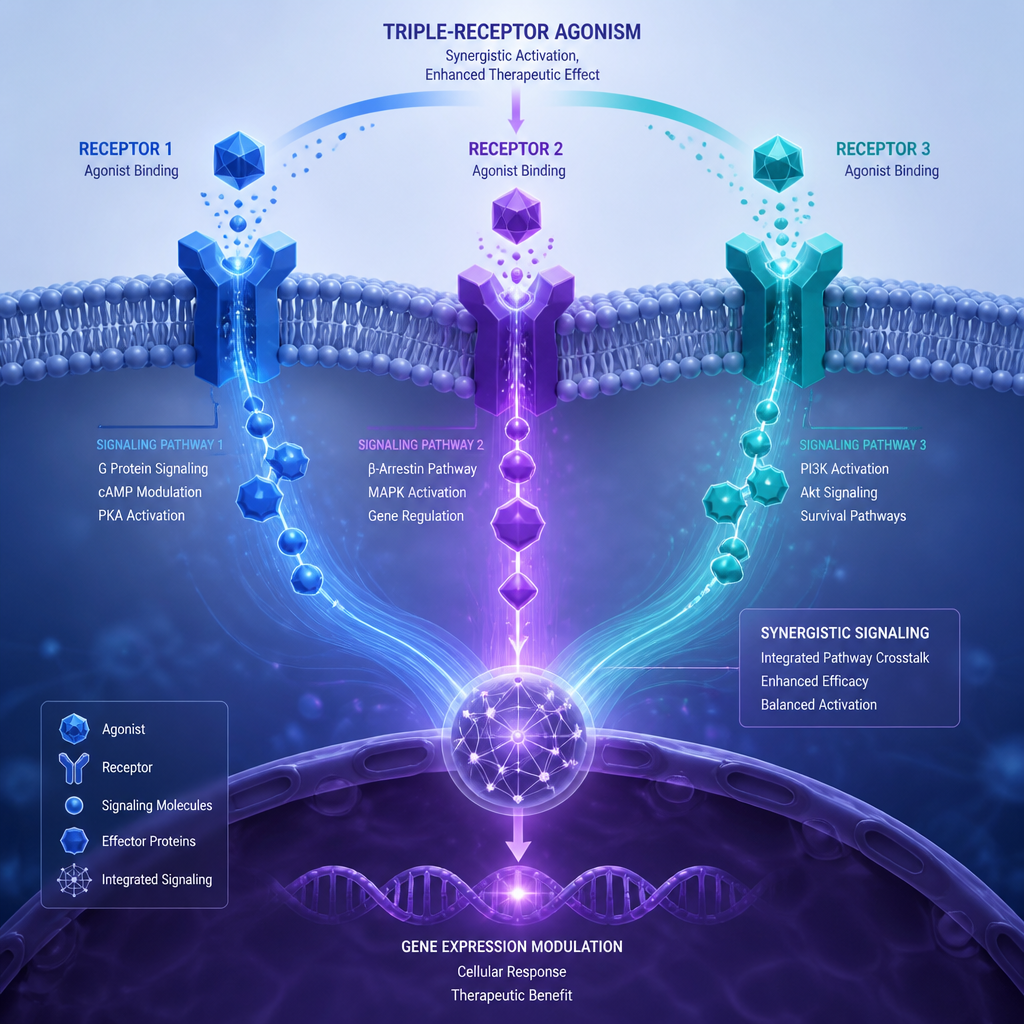
Retatrutide is a first-in-class triple hormone receptor agonist, activating receptors for glucagon-like peptide-1 (GLP-1), glucose-dependent insulinotropic polypeptide (GIP), and glucagon simultaneously. This is not simply adding a third target to a known scaffold. Each receptor mediates distinct downstream pathways, and the combined effect is not straightforwardly additive.
What Glucagon Receptor Activation Adds
The GLP-1 and GIP components reduce appetite and improve incretin signaling, mechanisms shared with other agents in this class. The glucagon receptor component is what makes retatrutide mechanistically unique. Glucagon receptor agonism directly increases energy expenditure and accelerates hepatic fat oxidation. In practice, this means retatrutide is not relying solely on caloric restriction through appetite suppression. It is also increasing the rate at which the body burns stored fuel.
For in vitro researchers, this creates a set of questions that cannot be answered with clinical trial data alone. How do the three receptor pathways interact at the intracellular signaling level? What is the relative contribution of each target across different cell types and tissues? These are the questions that preclinical and in vitro research programs are positioned to address right now, while clinical trials report aggregate outcomes.
Phase 2 Data as a Mechanistic Baseline
The Phase 2 trial published in the New England Journal of Medicine in 2023 enrolled 338 participants over 48 weeks. The 12 mg dose group achieved a mean weight loss of 24.2% versus 2.1% in the placebo group. At the 8 mg dose, mean weight loss was 22.8%. The Phase 2 data also showed dose-dependent liver fat reduction, with the 12 mg dose achieving an 82.4% mean relative reduction in liver fat at 24 weeks, and 86% of participants in that dose group reaching normal liver fat levels at 48 weeks. These figures come from the NCBI-published substudy on MASLD participants within the Phase 2 trial.
The Phase 2 to Phase 3 trajectory matters for researchers designing preclinical experiments. The consistency between Phase 2 and Phase 3 outcomes, both in the weight-loss magnitude and the dose-response shape, supports using Phase 2-era receptor binding data as a starting point for new in vitro work, while flagging that the full clinical picture at the highest doses is still developing.
Pro tip: In vitro work on retatrutide's glucagon receptor arm should account for the fact that glucagon receptor agonism carries both metabolic benefits and risks at the cellular level, particularly around hepatic glucose output. Designing assays that isolate glucagon receptor signaling from GLP-1 and GIP effects requires careful cell line selection and receptor expression profiling before drawing mechanistic conclusions.
Beyond Weight Loss: Liver, Cardiovascular, and Metabolic Research Frontiers
The headline efficacy data from TRIUMPH-1 captures attention, but the more consequential long-term research directions are in complication reduction. For research scientists, these are the areas where mechanistic work and translational studies will have the most impact over the next several years.
Metabolic Dysfunction-Associated Steatotic Liver Disease
The SYNERGY-OUTCOMES trial is specifically designed to evaluate whether retatrutide and tirzepatide can prevent major adverse liver outcomes (MALO) in people with high-risk metabolic dysfunction-associated steatotic liver disease (MASLD, formerly NAFLD/NASH). The trial plans to enroll approximately 4,500 adults and will run for roughly 224 weeks. This is a long-horizon outcomes trial, but the Phase 2 liver fat data, showing over 80% relative reduction at 12 mg, make the biological rationale strong. For in vitro researchers studying steatosis mechanisms, retatrutide's hepatic fat oxidation profile driven by glucagon receptor agonism is a direct line of investigation.
Cardiovascular and Renal Outcomes
TRIUMPH-3 is evaluating retatrutide in participants with severe obesity and established cardiovascular disease. The TRIUMPH-Outcomes trial, a separate study, is focused on cardiovascular outcomes and kidney outcomes in adults with obesity. These trials ask whether the metabolic improvements translate into hard endpoint reductions. They are also generating biomarker data that will be valuable for researchers modeling the relationship between GLP-1/GIP/glucagon receptor activity and cardiorenal pathways.
Type 2 Diabetes: TRANSCEND Program
The TRANSCEND-T2D-1 trial enrolled 537 people with type 2 diabetes and inadequate glycemic control on diet and exercise alone. The 40-week Phase 3 trial randomized participants to 4 mg, 9 mg, or 12 mg of retatrutide or placebo. Results were presented at ADA 2026 and simultaneously published in The Lancet. The TRANSCEND-T2D-2 trial compares retatrutide directly against semaglutide in type 2 diabetes patients on metformin, which will produce head-to-head mechanistic differentiation data that the field has been waiting for.
The TRIUMPH Program Pipeline: What Is Still Coming
As of mid-2026, the TRIUMPH Phase 3 program has multiple active and forthcoming readouts. Two trials reached primary completion in April 2026: TRIUMPH-1 (adults with obesity or overweight) and TRIUMPH-3 (severe obesity with established cardiovascular disease). Seven additional Phase 3 readouts are expected across 2026, covering obesity, type 2 diabetes, sleep apnea, MASLD, and cardiovascular outcomes.
The breadth of the program is not incidental. It reflects the fact that the three receptor pathways targeted by retatrutide are implicated in multiple disease processes beyond weight regulation. Each trial is simultaneously a registrational study and a source of mechanistic signal. For research programs, the practical implication is that the evidence base supporting in vitro work on GIP/GLP-1/glucagon receptor biology will expand substantially within the next 12 to 24 months.
A regulatory submission to the FDA is estimated for Q4 2026 or Q1 2027. Until that submission is reviewed and acted upon, retatrutide remains an investigational compound with no approved clinical indication, available exclusively through authorized clinical trial enrollment or as a research-grade compound for laboratory use.
Comparing Research Approaches to Triple Agonism
| Research Approach | Scope and Current Status | Key Limitation for In Vitro Work |
|---|---|---|
| Clinical trial data analysis (TRIUMPH program) | Provides aggregate efficacy and safety outcomes across thousands of participants; TRIUMPH-1 and TRIUMPH-4 fully reported, seven more readouts expected in 2026 | Clinical data shows what happens at the population level but cannot resolve receptor-level mechanisms, cell-type-specific signaling, or interaction effects between the three pathways |
| In vitro receptor binding and signaling studies | Directly characterizes GIP, GLP-1, and glucagon receptor activation; most mechanistic information currently available comes from Phase 1 and Phase 2 preclinical work | Requires verified high-purity compound with confirmed structural integrity; results are highly sensitive to compound quality and lot-to-lot consistency |
| Translational biomarker research | Links circulating markers (liver enzymes, inflammatory markers, metabolic panels) from clinical trials to in vitro pathway findings; growing dataset from TRANSCEND and TRIUMPH programs | Biomarker availability depends on trial design and publication timelines; many Phase 3 biomarker datasets from 2026 trials have not yet been published in peer-reviewed journals |
What In Vitro Researchers Need to Know Right Now
The gap between clinical data availability and mechanistic understanding is large. TRIUMPH-1 tells us that the 12 mg dose produces substantial weight loss in a Phase 3 population. It does not tell us how glucagon receptor agonism interacts with GLP-1 signaling in human hepatocytes under different glucose conditions, or what happens at the receptor level in adipose tissue versus pancreatic islets. That work is done in the laboratory, with research-grade compounds, not in clinical populations.
Compound Quality Is Not a Secondary Concern
In vitro retatrutide research depends entirely on the structural integrity and purity of the compound being used. A lyophilized peptide with 99%+ purity, independently verified by certified laboratory analysis with full batch traceability, is not a premium option for this kind of work. It is a baseline requirement. Studies using compounds of uncertain purity produce data that cannot be trusted and cannot be reproduced.
At Pepura Labs, every retatrutide compound is independently verified by Canadian laboratories with full Chain of Custody documentation. The batch traceability means that when a research team publishes findings, the compound used can be precisely characterized, which matters for peer review and reproducibility. For Canadian research institutions, the combination of Xpresspost delivery timelines and domestic laboratory verification removes the logistics and documentation uncertainties that come with sourcing from other channels.
What the Current Evidence Gap Means for Experimental Design
The seven additional Phase 3 readouts expected in 2026 will answer population-level questions. They will not answer mechanistic questions about receptor crosstalk, downstream signaling cascades, or tissue-specific effects. Research programs that design in vitro experiments now, grounded in the Phase 2 receptor binding data and the Phase 3 efficacy signals, will be positioned to publish ahead of the wave of clinical data interpretation papers that will follow FDA submission.
A common mistake in this space is designing in vitro assays around a single receptor pathway, treating retatrutide as a modified GLP-1 agonist. That approach misses the mechanistic point. The glucagon receptor component is not a minor addition. It is a distinct pharmacological dimension with its own signaling consequences, and isolating its contribution in cell-based systems is where some of the most productive mechanistic research will come from over the next two years.
Pro tip: When establishing a new in vitro retatrutide research protocol, obtain certificate of analysis documentation that includes not just purity percentage but also mass spectrometry confirmation of the peptide sequence and HPLC trace data. These details matter when submitting findings for peer review, and reviewers in this field will ask for them.
Frequently Asked Questions
What did TRIUMPH-1 actually demonstrate about retatrutide in 2026?
TRIUMPH-1 was an 80-week Phase 3 trial in 2,339 adults with obesity or overweight and at least one weight-related comorbidity, excluding people with diabetes. Results announced May 21, 2026 showed mean body weight loss of 17.6% at 4 mg, 23.7% at 9 mg, and 25.0% at 12 mg, versus 3.9% in the placebo group. On the 12 mg dose, 45.3% of participants achieved at least 30% weight loss. These are the highest weight-loss figures reported in any registrational Phase 3 trial for a compound in this class.
How does retatrutide differ mechanistically from dual GLP-1/GIP agonists?
Retatrutide adds glucagon receptor agonism as a third pharmacological target. While GLP-1 and GIP receptor activation primarily reduce appetite and improve incretin signaling, glucagon receptor agonism directly increases energy expenditure and accelerates hepatic fat oxidation. This means retatrutide produces weight loss through both caloric intake reduction and increased caloric burning, which is mechanistically distinct from dual agonists that rely more heavily on appetite suppression. The practical result in Phase 2 and Phase 3 data is a steeper dose-response curve and a larger absolute efficacy signal.
What Phase 3 trials in the TRIUMPH program are still reporting in 2026?
As of mid-2026, seven additional Phase 3 readouts are expected across the year. These include TRIUMPH-2 (obesity or overweight with type 2 diabetes), TRIUMPH-3 (severe obesity with established cardiovascular disease), trials in sleep apnea and metabolic dysfunction-associated steatotic liver disease (MASLD), and maintenance dosing strategy studies. The TRANSCEND-T2D-1 results in type 2 diabetes were already presented at ADA 2026 and published in The Lancet. The SYNERGY-OUTCOMES trial for MASLD liver outcomes is a longer-running study expected to enroll approximately 4,500 adults over roughly 224 weeks.
What is the current regulatory status of retatrutide?
As of 2026, retatrutide is not approved by the FDA or any other major regulatory authority for any indication. It remains an investigational compound in Phase 3 clinical development. FDA regulatory submission is estimated for Q4 2026 or Q1 2027, based on the expected timeline of Phase 3 data completion and filing preparation. Until approval is granted, access is limited to authorized clinical trial enrollment or, for preclinical purposes, research-grade compound supply through verified channels.
Why does compound purity matter so much for in vitro retatrutide research?
Retatrutide is a multi-receptor agonist with complex downstream signaling. Any structural impurity or degraded peptide fraction in the compound being tested will produce artifacts in receptor binding assays, off-target effects in cell culture, and results that cannot be replicated. For mechanistic research, where the goal is to understand which receptor pathway drives which biological effect, compound impurity can completely confound the interpretation. Research-grade retatrutide should carry independently verified purity of 99% or greater, with mass spectrometry sequence confirmation and HPLC data, and full batch traceability documentation for reproducibility and peer review purposes.
What in vitro research questions does clinical trial data leave unanswered?
The TRIUMPH program answers population-level efficacy and safety questions. It does not resolve the mechanisms driving those outcomes at the cellular and molecular level. Key open questions include how glucagon receptor signaling interacts with GLP-1 receptor signaling within the same cell type, what the relative receptor contribution is across hepatocytes, adipocytes, and pancreatic beta cells, how the triple-agonist profile affects downstream cAMP and MAPK signaling cascades, and what the long-term receptor expression changes are under continuous triple agonism. These are the questions that justify a dedicated in vitro research program on retatrutide in 2026.
If you are designing in vitro protocols around the 2026 retatrutide evidence base or have questions about compound sourcing for your research program, we would like to hear about the specific mechanistic questions your laboratory is pursuing.
References
- AJMC: TRIUMPH-1 Phase 3 trial results and retatrutide weight loss data analysis
- The Pharmaceutical Journal: Phase 3 retatrutide study dose-response findings and clinical outcomes
- Eli Lilly Investor Relations: Official TRIUMPH-1 topline results announcement May 2026
- Lola Health: Full TRIUMPH Phase 3 clinical trial program overview and regulatory timeline
- NCBI/PubMed: Retatrutide Phase 2 liver fat reduction substudy in MASLD participants