
The question of retatrutide vs tirzepatide is no longer a theoretical one for metabolic research teams. These two peptides occupy different rungs on the incretin pharmacology ladder, and understanding exactly where they diverge, mechanistically and empirically, determines which compound belongs in a given experimental protocol. For researchers sourcing high-purity lyophilized peptides for in vitro applications, the distinction matters as much as purity specifications do. This guide cuts through the noise and delivers a direct mechanistic and data-driven comparison for laboratory use.
Table of Contents
- Quick Takeaways
- Mechanistic Foundations: Dual vs Triple Receptor Agonism
- Clinical and Preclinical Data: What the Numbers Show
- Metabolic Pathway Differences Relevant to In Vitro Research
- Side-by-Side Compound Comparison
- Selecting the Right Compound for Your Research Model
- Frequently Asked Questions
- References
Quick Takeaways
| Key Insight | Explanation |
|---|---|
| Retatrutide is a triple agonist; tirzepatide is a dual agonist | Retatrutide activates GLP-1, GIP, and glucagon receptors. Tirzepatide activates only GLP-1 and GIP receptors. The added glucagon axis is the primary differentiator for hepatic and energy-expenditure research models. |
| Glucagon receptor engagement drives hepatic fat reduction | In a Phase 2 trial published in Nature Medicine, retatrutide produced up to 82% reduction in liver fat, a finding directly attributable to its glucagon receptor activity stimulating hepatic fatty acid oxidation. |
| Retatrutide's Phase 3 data shows 28.3% average body weight reduction | At 80 weeks in TRIUMPH-phase data, retatrutide at the highest dose showed 28.3% mean weight reduction (approximately 70 lbs). Tirzepatide's SURMOUNT trials reached up to 21% at 72 weeks. |
| Neither compound has been compared head-to-head in a controlled trial | All comparisons between retatrutide and tirzepatide are cross-study inferences. Researchers should treat comparative claims carefully and design assays with this epistemic gap in mind. |
| Both compounds share a gastrointestinal adverse-effect profile | Because both activate GLP-1 and GIP receptors, nausea, diarrhea, and vomiting appear in the safety data for each. Retatrutide may carry an additional signal tied to glucagon receptor activity that requires further characterization in long-term studies. |
| Tirzepatide carries an established long-term safety dataset; retatrutide does not | Tirzepatide's FDA approvals (2022 for diabetes, 2023 for obesity) generated years of post-marketing surveillance. Retatrutide remains investigational, meaning its long-term renal, hepatic, and cardiometabolic safety parameters are still being defined. |
| Purity and documentation standards are non-negotiable for receptor-binding assays | For in vitro work, impurities above trace levels can produce off-target receptor signals that corrupt data. Research-grade peptides verified at 99%+ purity with full batch traceability are the minimum acceptable specification for either compound. |
Mechanistic Foundations: Dual vs Triple Receptor Agonism
Tirzepatide is classified as a GLP-1/GIP dual agonist. It was engineered to act as a GIP-receptor-biased molecule that secondarily activates the GLP-1 receptor, a design that produces complementary insulinotropic and appetite-suppressing signals. The GIP component enhances glucose-dependent insulin secretion and improves beta-cell function, while the GLP-1 component reduces gastric emptying and promotes satiety signaling in the hypothalamus. In cell-based assays, this translates to measurable cAMP elevation in cells expressing either receptor.
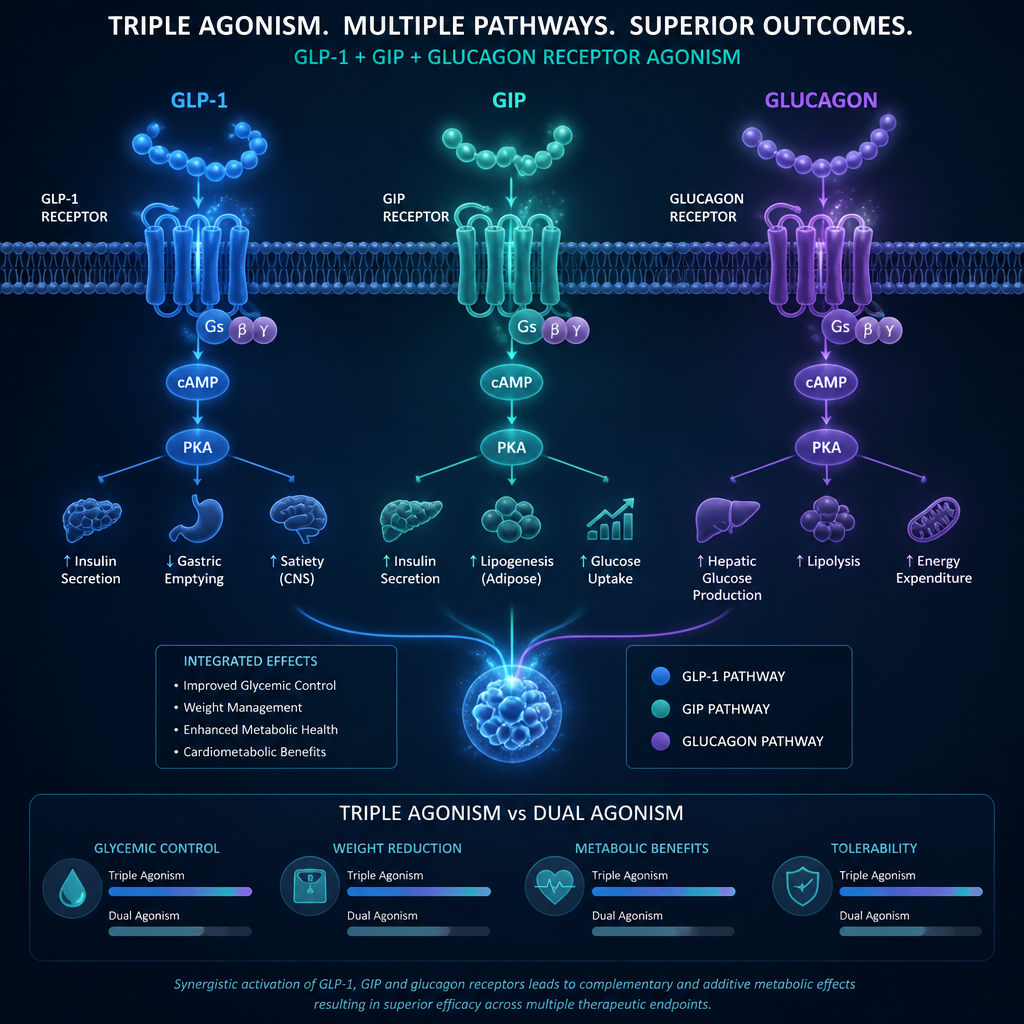
Retatrutide adds a third axis: the glucagon receptor (GCGR). Preclinical studies described in The Lancet indicated that the ratio of glucagon versus GLP-1 activity is a critical determinant of efficacy and safety for this class of compound. The glucagon component accelerates hepatic fatty acid oxidation, increases thermogenesis, and contributes to energy expenditure above what GLP-1 and GIP agonism alone produces. In preclinical models, retatrutide reduced food intake and simultaneously increased energy expenditure relative to calorie-intake-matched control animals, a dual mechanism that tirzepatide does not replicate to the same degree.
Receptor Binding Selectivity in Research Models
For in vitro research, the practical consequence of triple agonism is signal complexity. When designing assays using retatrutide, researchers must account for concurrent activation of all three receptor pathways. A cell line that co-expresses GLP-1R and GCGR will produce a combined signal that cannot be cleanly deconvoluted without receptor-specific antagonists in parallel wells. Tirzepatide assays in cells expressing only GLP-1R or GIPR are more interpretively straightforward, which is part of why tirzepatide has accumulated a richer preclinical mechanistic literature in a shorter time.
This is not a limitation of retatrutide, it is a research design challenge that requires more sophisticated experimental setups. Labs investigating hepatic lipid metabolism, thermogenic fat cell differentiation, or combined glycemic and energy-expenditure phenotypes stand to gain substantially from using retatrutide precisely because of its broader receptor profile.
Pro tip: When running receptor-binding competition assays with retatrutide, include GCGR-null cell lines as a control condition in parallel with your primary experimental line. This allows you to isolate the GLP-1/GIP contribution and attribute any signal differential to glucagon receptor engagement specifically.

Clinical and Preclinical Data: What the Numbers Show
The most cited figure in the retatrutide literature comes from Phase 2 obesity trial data presented at the 83rd Scientific Sessions of the American Diabetes Association and simultaneously published in major medical journals: participants receiving the highest retatrutide dose achieved a mean body weight reduction of 24.2% over approximately 11 months, with weight plateau not yet reached at study end. More recently, TRIUMPH-phase data has shown an average weight reduction of 28.3% (roughly 70 lbs) at 80 weeks. Crucially, these data come from a different study population and design than the tirzepatide SURMOUNT trials, so cross-study comparisons require caution.
Tirzepatide's SURMOUNT-1 trial established that the dual agonist could produce up to 21% mean weight reduction at 72 weeks. The SURMOUNT-3 trial extended this, showing that tirzepatide continued to produce clinically meaningful weight loss even after participants had already achieved at least 5% weight reduction through intensive lifestyle intervention. A 2024 real-world study analyzing electronic health records from more than 41,000 U.S. adults confirmed that tirzepatide consistently outperformed semaglutide on weight loss milestones in non-trial populations.
Hepatic Fat Reduction: Where Retatrutide's Glucagon Component Stands Out
A Phase 2 trial published in Nature Medicine reported that retatrutide produced up to 82% reduction in liver fat in participants with MASLD (metabolic dysfunction-associated steatotic liver disease). The mechanism is consistent with preclinical findings: glucagon receptor activation stimulates hepatic fatty acid oxidation, reducing triglyceride accumulation in hepatocytes. Tirzepatide has also demonstrated meaningful liver fat reduction and improvements in MASH biomarkers in patients with type 2 diabetes, and a dedicated Phase 2 MASH trial is ongoing, but no published data currently matches retatrutide's 82% liver fat reduction figure.
For research laboratories focusing on non-alcoholic fatty liver disease models, hepatocyte lipid metabolism, or steatosis-linked inflammation pathways, this difference is operationally significant. Retatrutide's triple-receptor profile makes it a more targeted experimental tool for dissecting the glucagon-dependent component of hepatic lipid clearance.
The addition of glucagon receptor agonism to GLP-1 and GIP agonism drives hepatic fat reduction through a distinct mechanistic pathway, offering researchers a tool that no dual agonist can fully replicate in liver-focused assay designs.
Glycemic and HbA1c Effects in Type 2 Diabetes Models
In Phase 1 and Phase 2 single-dose and multiple-dose studies in participants with type 2 diabetes, retatrutide was well tolerated and improved overall cardiometabolic risk measures including HbA1c reduction and lipid profiles. Tirzepatide's glycemic data is more extensive, including its 2022 FDA approval for type 2 diabetes under the brand name Mounjaro, with a strong body of trial data showing meaningful HbA1c reductions across dose levels. For in vitro assay work modeling insulin secretion or glucose-dependent signaling, tirzepatide's larger body of published receptor pharmacology provides more reference points for result benchmarking.
Metabolic Pathway Differences Relevant to In Vitro Research
From a pure biochemistry standpoint, the GLP-1/GIP dual agonist vs triple agonist distinction maps onto separable downstream signaling cascades that matter for specific assay designs. GLP-1 receptor activation primarily drives cAMP-PKA signaling in pancreatic beta cells and activates hypothalamic satiety circuits. GIP receptor co-activation amplifies the insulinotropic response in a glucose-dependent fashion and may also promote adipocyte lipid storage in certain cell line models. Adding GCGR activation introduces a counter-regulatory element: glucagon classically raises blood glucose by promoting glycogenolysis and gluconeogenesis, but at the balanced agonist ratios engineered into retatrutide, the net metabolic effect is weight reduction and hepatic fat clearance rather than hyperglycemia.
This pharmacodynamic balance is not guaranteed to translate identically into every cell culture system. In isolated hepatocyte assays, GCGR activation without the attenuating context of GLP-1 co-stimulation could produce different results than what is observed in whole-organism models. Researchers using retatrutide in primary hepatocyte cultures or hepatocellular carcinoma-derived lines should pilot dose-response experiments that map the cAMP response across a wide concentration range before committing to a fixed assay concentration.
Pro tip: For adipocyte differentiation assays comparing retatrutide and tirzepatide side-by-side, control your passage number tightly. Both GIP receptor activation and GCGR activation influence lipid accumulation in preadipocytes, and passage-related receptor expression drift will introduce variability that is routinely misattributed to the peptide's concentration, rather than the cell line's state.

Side-by-Side Compound Comparison
The table below summarizes the key parameters that research laboratories should evaluate when deciding between retatrutide and tirzepatide for a specific experimental application. These parameters reflect both the published pharmacological literature and practical in vitro handling considerations.
| Parameter | Retatrutide (GLP-1/GIP/GCGR Triple Agonist) | Tirzepatide (GLP-1/GIP Dual Agonist) |
|---|---|---|
| Receptor targets | GLP-1R, GIPR, GCGR (glucagon receptor) | GLP-1R, GIPR |
| Regulatory status | Investigational; Phase 3 trials ongoing (TRIUMPH program, Eli Lilly) | FDA-approved (Mounjaro 2022, Zepbound 2023); extensive post-marketing data |
| Peak weight reduction in trials | Up to 28.3% at 80 weeks (TRIUMPH Phase 3 data) | Up to 21% at 72 weeks (SURMOUNT-1) |
| Hepatic fat reduction (Phase 2) | Up to 82% liver fat reduction (Nature Medicine, Phase 2 MASLD substudy) | Meaningful reduction in MASH biomarkers; dedicated Phase 2 MASH trial ongoing |
| In vitro signal complexity | Higher: concurrent GLP-1R, GIPR, and GCGR signaling requires additional controls | Lower: dual-receptor assays are more interpretively straightforward |
| Best-fit research application | Hepatic lipid metabolism, thermogenesis, energy expenditure, MASLD/MASH models, triple-receptor pharmacology studies | Glycemic control models, insulin secretion assays, GIP/GLP-1 pathway mechanistic studies, benchmarking against approved-compound data |
| Long-term safety characterization | Incomplete; Phase 3 ongoing; renal and hepatic safety in chronic dosing not yet fully defined | Established; years of real-world pharmacovigilance data available |
| Purity requirement for valid assays | 99%+ lyophilized, batch-verified; GCGR signals are sensitive to impurity-driven receptor cross-reactivity | 99%+ lyophilized, batch-verified; dual-receptor assays still compromised by sub-spec purity |
Selecting the Right Compound for Your Research Model
The decision between retatrutide and tirzepatide for a given study protocol is not a matter of which is "better." It is a question of which receptor pharmacology matches your experimental question. If your primary readout involves hepatic lipid clearance, energy expenditure in thermogenic fat depots, or the mechanistic contribution of glucagon receptor activation to metabolic outcomes, retatrutide is the appropriate tool. Its triple-receptor profile gives you a lever that tirzepatide simply does not provide.
If your primary readout involves insulin secretion kinetics, GLP-1 or GIP receptor desensitization, glucose-dependent signaling, or you need to benchmark your assay results against an extensive existing literature, tirzepatide's data density is an advantage. The published SURMOUNT trial data and FDA pharmacokinetic filings provide a richer reference framework for validating assay behavior than anything currently available for retatrutide.
Purity and Chain of Custody: A Practical Prerequisite
For either compound, receptor-binding assay integrity depends fundamentally on peptide purity. In a triple-agonist system like retatrutide, low-level impurities that carry partial agonist activity at any of the three receptor subtypes will corrupt the signal in ways that are difficult to detect without orthogonal purity documentation. A supplier providing independent Canadian laboratory verification, full batch traceability, and Chain of Custody documentation is not offering a bureaucratic formality. It is offering the evidentiary record that distinguishes publishable data from unreproducible noise.
At Pepura Labs, research-grade retatrutide is supplied at 99%+ purity in lyophilized form, independently verified by Canadian laboratories with batch-specific documentation. For Canadian research institutions, this also means rapid domestic delivery without the customs delays and cold-chain integrity questions that accompany cross-border peptide procurement.
Reconstitution and Storage Considerations
Both retatrutide and tirzepatide are supplied in lyophilized form for research applications, which confers stability advantages over aqueous formulations during storage and shipping. Upon reconstitution, both peptides should be handled in low-protein-binding tubes, stored at the recommended temperature, and used within validated timeframes. A common mistake is reconstituting with standard phosphate-buffered saline without accounting for peptide aggregation tendencies, particularly at higher concentration ranges. Using sterile water or a dilute acetic acid solution as the reconstitution vehicle, followed by further dilution in assay buffer, reduces aggregation and improves dose-response linearity across the full concentration curve.
Pro tip: Prepare single-use aliquots of reconstituted peptide and store at -80°C rather than repeatedly freezing and thawing the same stock. Multiple freeze-thaw cycles degrade both retatrutide and tirzepatide at a measurable rate, introducing a confounding variable that accumulates over a study's duration and is frequently overlooked during data review.
Frequently Asked Questions
What is the core pharmacological difference between retatrutide and tirzepatide?
Tirzepatide is a dual GLP-1/GIP receptor agonist, targeting two incretin hormone pathways. Retatrutide is a triple agonist that activates GLP-1, GIP, and glucagon receptors simultaneously. The addition of glucagon receptor activity in retatrutide drives distinct downstream effects, particularly on hepatic fatty acid oxidation and energy expenditure, that the dual-agonist profile of tirzepatide does not produce to the same degree.
Have retatrutide and tirzepatide been directly compared in a head-to-head clinical trial?
No. As of current published literature, retatrutide and tirzepatide have not been compared in a head-to-head randomized controlled trial. All comparative efficacy claims are cross-study inferences drawn from separate trial programs with different populations, endpoints, and dosing schedules. Research teams should interpret comparative data accordingly and avoid treating cross-study numbers as equivalent to direct experimental comparison.
Which compound is better suited for in vitro hepatic fat metabolism research?
Retatrutide is the more targeted choice for hepatic lipid metabolism research. Its glucagon receptor activity drives hepatic fatty acid oxidation through a pathway that tirzepatide does not engage. Phase 2 published data in Nature Medicine documented up to 82% liver fat reduction with retatrutide, a finding directly attributable to its GCGR component. For hepatocyte assays modeling MASLD or steatosis-linked inflammation, retatrutide provides a pharmacological tool with a mechanism that tirzepatide cannot replicate.
What purity specification is required for retatrutide and tirzepatide in receptor-binding assays?
For receptor-binding and cell-based functional assays, 99%+ purity is the minimum acceptable specification for either compound. In a triple-receptor system like retatrutide, impurities carrying partial agonist or antagonist activity at GLP-1R, GIPR, or GCGR can produce spurious signals that are indistinguishable from genuine compound effects without additional orthogonal controls. Independent laboratory verification and batch-specific documentation are essential, not optional, for data that will support publication or regulatory submission.
Is tirzepatide a more practical starting compound for labs new to incretin peptide research?
In practice, yes. Tirzepatide's dual-receptor profile is mechanistically simpler to design assays around, and its extensive published clinical and preclinical pharmacology provides a dense reference framework for benchmarking new assay results. The SURMOUNT trial series and post-approval pharmacovigilance data give new research teams a well-characterized baseline. Retatrutide offers unique experimental access to glucagon receptor co-activation, but it requires more sophisticated experimental controls and a smaller published reference literature to work against.
What is the significance of the GLP-1 GIP dual agonist vs triple agonist distinction for glycemic research models?
The distinction is significant because glucagon normally raises blood glucose through glycogenolysis and gluconeogenesis, counter to the insulin-sensitizing effects of GLP-1 and GIP. In retatrutide's engineered balance, this counter-regulatory signal is attenuated in the whole-organism context, producing net metabolic benefit. However, in isolated cell culture systems, particularly in hepatocytes or glucose-producing cell lines, the GCGR activation component of retatrutide may produce a distinct glycemic signal that does not appear in tirzepatide assays. Researchers designing glucose flux or glycogenolysis assays should pilot both compounds to characterize this differential before committing to a full study design.
Where can Canadian research labs source research-grade retatrutide with batch verification?
Canadian research institutions sourcing retatrutide for in vitro applications should prioritize suppliers providing independent Canadian laboratory verification, full Chain of Custody documentation, and batch-specific purity records at 99%+ specification. Domestic Canadian sourcing also eliminates cross-border cold-chain integrity risks and customs delays that affect peptide quality in international shipments. Pepura Labs supplies research-grade lyophilized retatrutide meeting these specifications with Xpresspost delivery across Canada.
If your laboratory is currently working with incretin peptide models or planning a study protocol that involves either compound, we would be glad to hear what research questions you are pursuing. Share your experience or questions in the comments.
References
- Phase 2 clinical trial results for retatrutide showing up to 82% liver fat reduction, published in Nature Medicine
- Comprehensive review of retatrutide mechanisms, preclinical and clinical efficacy, and ongoing Phase 3 TRIUMPH trials
- Preclinical evidence for GIP, GLP-1, and glucagon receptor agonism of retatrutide in The Lancet, covering metabolic and hepatic outcomes
- American Diabetes Association highlights on Phase 2 retatrutide trial results for obesity, type 2 diabetes, and NAFLD
- Clinical comparison of retatrutide and tirzepatide covering regulatory status, weight loss trial data, and safety profiles