
Single-target compounds have dominated incretin research for years, and semaglutide's commercial success made it easy to assume one receptor was enough. It is not. Triple receptor agonist research has fundamentally reframed that assumption, and Retatrutide sits at the center of that shift. By simultaneously engaging GLP-1R, GIPR, and GCGR, Retatrutide activates metabolic pathways that single and dual agonists structurally cannot reach. Understanding exactly why that matters, at the receptor level, is what separates rigorous in vitro research from incretin folklore.
Table of Contents
- Quick Takeaways
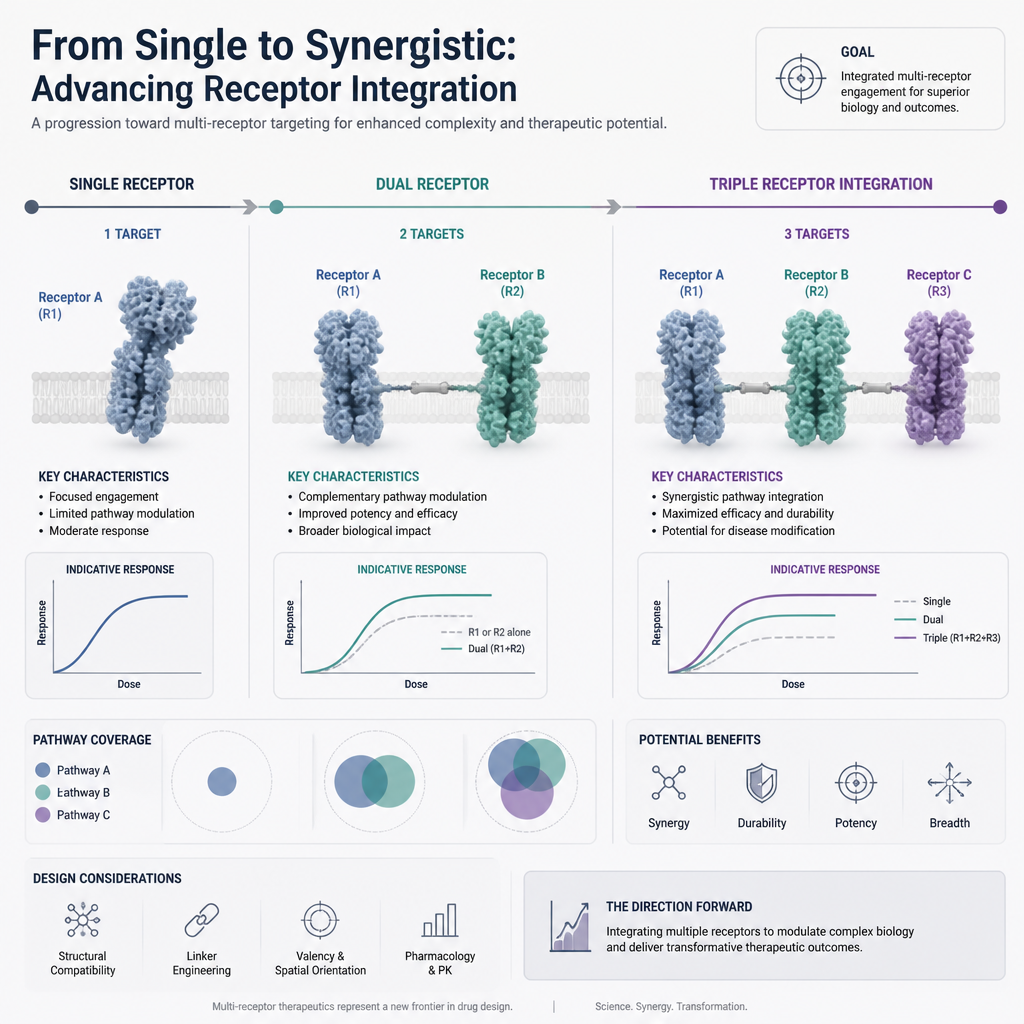
- From Single to Triple: How the Receptor Landscape Evolved
- GLP-1R, GIPR, and GCGR: What Each Receptor Actually Does
- Retatrutide's Structural Design: Built for Three Receptors at Once
- Retatrutide vs Semaglutide vs Tirzepatide: A Research Comparison
- What the Clinical Data Shows: Phase 2 Trial Results
- In Vitro Research Applications for Triple Agonism
- Frequently Asked Questions
- References
Quick Takeaways
| Key Insight | Explanation |
|---|---|
| Retatrutide targets three distinct receptors | It simultaneously activates GLP-1R, GIPR, and GCGR, covering metabolic pathways that semaglutide (GLP-1R only) and tirzepatide (GLP-1R + GIPR) cannot reach. |
| Glucagon receptor activation increases energy expenditure | GCGR agonism drives hepatic fat oxidation, thermogenesis, and lipid mobilization, adding an output-side mechanism that incretin-only compounds lack entirely. |
| GIPR potency is a key differentiator even from tirzepatide | Retatrutide demonstrates strong GIPR agonistic effect, with the increased potency at GIPR considered a meaningful differentiator from other incretin-based therapies. |
| Phase 2 results showed 24.2% mean weight reduction at 48 weeks | In the published NEJM Phase 2 trial, the 12 mg dose group achieved 24.2% mean body weight reduction versus 2.1% for placebo, establishing a new benchmark in this class. |
| Structural backbone is derived from GIP and GCG sequences | Retatrutide is engineered from GIP and GCG peptide backbones, using conserved residue segments to enable simultaneous activation of all three pivotal receptors. |
| Liver fat research shows dramatic reductions | A Phase 2a substudy published in Nature Medicine found up to 82% reduction in liver fat content at 24 weeks, pointing to significant hepatic research applications. |
| In vitro researchers need high-purity, verified Retatrutide | Receptor binding and signaling assays require 99%+ purity peptide with confirmed batch identity to produce reproducible, publishable data. Impure compounds introduce confounding variables. |
From Single to Triple: How the Receptor Landscape Evolved
The progression from single to triple receptor agonism is not a story of incremental refinement. It is a story of recognizing that metabolic dysfunction is a multi-pathway problem that single-target compounds address incompletely. Semaglutide, a selective GLP-1 receptor agonist, became one of the most commercially successful drugs in pharmaceutical history, generating roughly $19.9 billion in sales in 2023 alone. That commercial success is real. But from a mechanistic standpoint, activating one of the three pivotal receptors regulating glucose homeostasis leaves a substantial portion of the metabolic picture untouched.
Tirzepatide added GIPR to the equation, demonstrating that dual agonism outperforms single agonism on multiple metabolic endpoints. The logic was sound: GIP receptor activation contributes to glucose-dependent insulin secretion and lipid metabolism in ways that GLP-1R agonism alone does not cover. But neither semaglutide nor tirzepatide targets the glucagon receptor. That omission matters because GCGR activation is the primary lever for directly increasing energy expenditure, not just reducing energy intake.
Retatrutide was designed to close that gap. The compound activates all three receptors simultaneously, which means it addresses appetite and satiety signaling (GLP-1R), incretin-mediated insulin secretion and lipid metabolism (GIPR), and hepatic fat oxidation with increased thermogenesis (GCGR) within a single molecular entity. For researchers studying metabolic disease pathways in vitro, that convergence makes Retatrutide a uniquely powerful tool for dissecting how each receptor contributes to downstream effects.
Pro tip: When designing in vitro assays to study triple agonism, run parallel single-receptor control experiments using selective agonists for GLP-1R, GIPR, and GCGR individually. Comparing those results against Retatrutide's triple-agonist response allows you to identify synergistic receptor interactions that would be invisible with any single-compound design.


GLP-1R, GIPR, and GCGR: What Each Receptor Actually Does
Understanding why triple agonism produces qualitatively different results requires understanding what each receptor does independently, and where the interactions between them create effects that no single receptor produces alone.
GLP-1 Receptor: The Appetite and Insulin Axis
GLP-1R activation is the most studied mechanism in this class. It drives glucose-dependent insulin secretion, suppresses glucagon release from pancreatic alpha cells, slows gastric emptying, and reduces appetite through central nervous system signaling. These effects are well-characterized and reproducible across a wide range of in vitro and in vivo models. GLP-1R agonism is also associated with cardioprotective effects that continue to attract significant research interest.
The limitation of GLP-1R agonism alone is that it operates primarily on the intake side of the energy balance equation. It reduces how much substrate enters the system but does relatively little to increase how quickly the system burns what is already there.
GIP Receptor: Incretin Potentiation and Lipid Metabolism
GIPR activation facilitates insulin secretion in a glucose-dependent manner and plays an important role in lipid metabolism, contributing to reductions in fat deposition and improvements in overall energy balance. Retatrutide's strong agonistic effect at the GIP receptor is considered one of its defining characteristics, with increased potency at GIPR believed to be a key differentiator from other incretin-based therapies, enhancing its metabolic benefits beyond the standard GLP-1 mechanism.
One active area of mechanistic research concerns whether GIP receptor agonism or antagonism produces superior outcomes depending on the metabolic context. Retatrutide's approach treats GIPR as a positive target, a position supported by the clinical data to date, but the underlying signaling dynamics continue to attract scrutiny in receptor pharmacology research.
Glucagon Receptor: The Energy Expenditure Mechanism
GCGR is the receptor that most sharply distinguishes Retatrutide from its predecessors. Glucagon receptor activation drives thermogenesis and lipid mobilization, contributing to increased resting energy expenditure and hepatic fat oxidation. At the cellular level, GCGR agonism promotes fatty acid breakdown in the liver through direct lipolytic signaling. This mechanism operates on the output side of the energy equation rather than the intake side, which is why adding GCGR agonism to a GLP-1R/GIPR backbone produces a qualitatively different metabolic profile.
There is a long-established body of evidence that glucagon negatively influences energy balance, enhances satiety, and increases energy expenditure. Retatrutide's molecular design is built to activate this mechanism in a controlled, balanced manner alongside the incretin receptors, rather than triggering the hyperglycemic effects that would come from isolated, unbalanced glucagon receptor stimulation.
Retatrutide's Structural Design: Built for Three Receptors at Once
Achieving simultaneous agonism at three pharmacologically distinct receptors within a single peptide is not a trivial design challenge. Structural research published in Cell Discovery (Nature portfolio) has provided detailed insight into how Retatrutide accomplishes this at the molecular level.
Retatrutide is developed from the GIP and GCG peptide backbones, using two conserved segment regions to allow simultaneous agonism at all three pivotal receptors. The GIP receptor's ECL1 (extracellular loop 1) displays notable flexibility, accommodating a variety of conformations to recognize peptides and allowing for sequence variability. This structural flexibility is exploited in Retatrutide's design to enable a single compound to engage GIPR without precluding binding at GLP-1R and GCGR.
What this means for in vitro research is that Retatrutide does not behave as three separate receptor signals summed together. The simultaneous engagement of all three receptors through a single peptide creates a specific conformational and signaling context that differs from applying selective agonists in combination. Researchers studying receptor crosstalk, biased agonism, or downstream cAMP and beta-arrestin recruitment pathways will find that Retatrutide's native triple-agonist profile cannot be fully replicated by mixing monoselective compounds.
The structural requirement for simultaneous recognition across three pharmacologically distinct receptors drives a distinct peptide design strategy, developed from the GIP and GCG backbones, to allow simultaneous agonism at GLP-1R, GIPR, and GCGR. Findings from structural receptor research underscore the potential for peptide sequence optimization to fine-tune receptor selectivity or balanced activation, providing tailored approaches for metabolic intervention.
Pro tip: When sourcing Retatrutide for structural or binding assays, batch-to-batch consistency matters more than for lower-resolution functional assays. Any truncation or oxidative modification at the peptide termini will alter receptor engagement profiles in ways that are difficult to detect without mass spectrometry confirmation. Always request lot-specific analytical data from your supplier before beginning a binding study series.
Retatrutide vs Semaglutide vs Tirzepatide: A Research Comparison
For researchers making compound selection decisions, the differences between these three agents are not just quantitative (how much weight loss) but mechanistic (which pathways are engaged, which are not, and what that means for your specific research question). The table below summarizes the key distinctions relevant to in vitro and translational research contexts.
| Feature | Semaglutide (GLP-1R) | Tirzepatide (GLP-1R + GIPR) | Retatrutide (GLP-1R + GIPR + GCGR) |
|---|---|---|---|
| Receptor targets | GLP-1R only | GLP-1R and GIPR | GLP-1R, GIPR, and GCGR |
| Peptide backbone origin | GLP-1 analogue | GIP analogue with GLP-1R activity | GIP and GCG backbones combined |
| Energy expenditure mechanism | Indirect (via weight loss) | Indirect (via incretin potentiation) | Direct thermogenesis and lipolysis via GCGR |
| Hepatic fat oxidation pathway | Not directly targeted | Partial, via GIPR lipid signaling | Direct, via GCGR-driven fatty acid breakdown |
| Key in vitro research use | GLP-1R signaling, beta-cell models, CV endpoints | Incretin synergy, biased GLP-1R agonism studies | Triple receptor crosstalk, NASH models, energy expenditure assays |
| Regulatory status (as of publication) | FDA approved | FDA approved | Investigational, Phase 3 ongoing |
| Phase 2 weight reduction (48 weeks, highest dose) | Approximately 14.9% (2.4 mg/week) | Approximately 20.9% (15 mg/week) | 24.2% (12 mg/week) |
The Tirzepatide vs Retatrutide research comparison reveals a meaningful mechanistic step change rather than marginal improvement. Tirzepatide's biased GLP-1R agonism (favoring cAMP generation over beta-arrestin recruitment) is itself a notable pharmacological property that has attracted considerable research interest. Retatrutide adds GCGR agonism on top of that, introducing a third distinct signaling pathway. From a research design standpoint, that additional pathway makes Retatrutide more complex to study but also more informative for understanding how the full receptor triad contributes to metabolic outcomes.
What the Clinical Data Shows: Phase 2 Trial Results
The NEJM Phase 2 trial, published on June 26, 2023, provides the most rigorously controlled efficacy data available for Retatrutide in humans. In a randomized, double-blind design, once-weekly Retatrutide across multiple dose groups produced dose-dependent weight reduction: approximately 8.7% at 1 mg, 17.1% in the combined 4 mg group, 22.8% in the combined 8 mg group, and 24.2% at 12 mg, compared to 2.1% for placebo at 48 weeks. The 12 mg result translates to a mean absolute weight reduction of approximately 58 pounds, or roughly 26 kg, over the 48-week treatment period.
The liver fat substudy, published in Nature Medicine in 2024, extended these findings into a highly relevant disease model. At 24 weeks, mean relative reductions in liver fat content reached approximately 42.9% at 1 mg, 57.0% at 4 mg, 81.4% at 8 mg, and 82.4% at 12 mg, versus a slight increase of 0.3% in the placebo group. Normal liver fat content, defined as below 5%, was achieved in 86% of participants in the 12 mg group. For researchers working on metabolic dysfunction-associated steatotic liver disease models, these numbers establish Retatrutide as one of the most potent hepatic intervention tools currently under investigation.
Phase 3 registrational trials are ongoing under Eli Lilly's TRIUMPH program. Results from these longer-duration studies are anticipated to further characterize Retatrutide's durability profile, as well as its behavior after discontinuation, which remains an area where all agents in this class require additional characterization.
In Vitro Research Applications for Triple Agonism
The clinical trial results frame the biological relevance of Retatrutide, but the in vitro research use cases are distinct from the translational endpoints being studied in Phase 3. Researchers sourcing Retatrutide for laboratory work are typically investigating receptor pharmacology, intracellular signaling cascades, or cell-type specific responses, not body weight per se.
Receptor Binding and Competitive Displacement Assays
Retatrutide's defined affinity profile across GLP-1R, GIPR, and GCGR makes it a useful reference compound for competitive binding studies. Its GIP and GCG backbone-derived structure means it engages these receptors via native-like binding modes, making it more physiologically relevant for displacement assays than purely synthetic, non-peptide tool compounds.
cAMP Signaling and Arrestin Recruitment Studies
Biased agonism research is one of the more technically demanding but scientifically valuable applications for this compound class. Because Retatrutide activates all three receptors simultaneously, it allows researchers to examine how concurrent receptor activation modifies individual signaling pathway outputs, including cAMP generation, beta-arrestin recruitment, and receptor internalization kinetics. Comparing Retatrutide's signaling fingerprint against tirzepatide (which shows biased GLP-1R agonism favoring cAMP over beta-arrestin recruitment) in matched cell systems is a research design that directly addresses mechanistic questions about incretin pharmacology that remain unresolved.
Hepatocyte and Adipocyte Models
The GCGR component of Retatrutide's activity makes it particularly relevant for hepatocyte-based research. Primary human hepatocytes or hepatocyte-like cell lines expressing functional GCGR allow researchers to study fatty acid oxidation, lipid droplet reduction, and gluconeogenic gene expression changes in response to triple receptor stimulation. These models directly connect to the liver fat findings from the clinical substudy and provide a mechanistic framework for understanding how GCGR-driven signals contribute to the hepatic outcomes observed in vivo.
For any of these applications to produce reproducible, publication-grade data, the compound quality requirements are non-negotiable. Peptide purity at 99% or above, confirmed by independent analytical methods, is the baseline. Lyophilized format with documented storage conditions ensures stability between reconstitution cycles. And chain of custody documentation from synthesis through delivery protects the researcher's ability to trace any anomalous results back to the compound source, rather than leaving that variable open. At Pepura Labs, every batch of Retatrutide is independently verified by Canadian laboratories with full chain of custody documentation, delivering exactly the compound integrity that rigorous in vitro research demands.
Pro tip: Retatrutide should be reconstituted in sterile water or an appropriate aqueous buffer and used promptly after reconstitution. Avoid repeated freeze-thaw cycles with the reconstituted peptide. Store lyophilized powder at the temperature specified on your certificate of analysis and verify peptide integrity by HPLC or mass spectrometry if the compound has been in storage for an extended period before a new experiment series begins.
Frequently Asked Questions
What makes Retatrutide a triple receptor agonist rather than a dual agonist like tirzepatide?
Retatrutide activates three distinct receptors: GLP-1R, GIPR, and GCGR. Tirzepatide activates only GLP-1R and GIPR. The addition of glucagon receptor agonism is what distinguishes Retatrutide, introducing a direct energy expenditure mechanism through GCGR that neither semaglutide nor tirzepatide engages. Structurally, Retatrutide is developed from GIP and GCG peptide backbones, which gives it the binding geometry to engage all three receptors simultaneously.
How does the GLP-1 GIP glucagon triple agonist mechanism differ from simply combining three separate compounds?
A single triple agonist molecule like Retatrutide produces simultaneous receptor engagement that generates a specific conformational and signaling context at each receptor. Mixing three separate monoselective agonists in a cell assay produces three independent receptor activations that do not share a molecular binding event. This distinction is relevant for receptor crosstalk studies and for any assay where the kinetics of concurrent receptor engagement matter, as they would in studying downstream signaling synergies between the three pathways.
What were the key findings of the Retatrutide Phase 2 NEJM trial?
The Phase 2 trial published in the New England Journal of Medicine in 2023 showed dose-dependent weight reduction at 48 weeks. The highest dose group (12 mg, once weekly) achieved a mean body weight reduction of 24.2%, compared to 2.1% in the placebo group. The 8 mg group achieved 22.8%. These results were characterized by the investigators as warranting further investigation in Phase 3 trials, which are now ongoing under the TRIUMPH program.
Why does purity matter for Retatrutide in in vitro research?
In receptor binding and signaling assays, impurities in a peptide preparation are active contaminants, not inert background material. Truncated peptide fragments from incomplete synthesis can act as partial agonists or competitive antagonists at one or more of the three receptors, distorting the observed potency and efficacy of the main compound. Oxidized methionine residues alter binding affinity. These effects introduce confounding variables that are extremely difficult to control for after the fact. Using a compound verified at 99%+ purity with lot-specific analytical data is the only reliable way to attribute observed results to Retatrutide itself.
What is the current regulatory status of Retatrutide?
As of the time of publication, Retatrutide is an investigational compound being studied in Phase 3 clinical trials. It is not FDA or Health Canada approved for any therapeutic use. It is available for in vitro research applications through qualified research compound suppliers, and its use is restricted to laboratory research contexts outside of approved clinical trial settings.
How does tirzepatide vs Retatrutide research compare in terms of hepatic endpoints?
The hepatic data for Retatrutide, from the Phase 2a substudy published in Nature Medicine, shows liver fat reductions of up to 82% at 24 weeks with the higher dose groups. Tirzepatide has demonstrated meaningful hepatic benefits via its GIPR and GLP-1R mechanisms, but the addition of direct GCGR-driven hepatic fat oxidation in Retatrutide's mechanism provides a distinct and complementary pathway. For researchers specifically studying liver disease models in vitro, GCGR expression on hepatocytes makes Retatrutide particularly relevant as a research tool.
If you are working with triple receptor agonist compounds in your laboratory, we would like to hear how you are approaching receptor selectivity controls in your experimental design. Share your methodology in the comments or reach out to the Pepura Labs team directly.
References
- Phase 2 clinical trial of Retatrutide for obesity published in the New England Journal of Medicine, showing 24.2% mean weight reduction at 48 weeks
- Phase 2a substudy on Retatrutide and metabolic dysfunction-associated steatotic liver disease in Nature Medicine, reporting up to 82% liver fat reduction
- Structural analysis of triple agonism at GLP-1R, GIPR, and GCGR by Retatrutide published in Cell Discovery
- Review of the road toward GLP-1, GIP, and glucagon receptor triple agonists, including Retatrutide's 24.2% weight loss findings
- Research on glucagon, GLP-1, and thermogenesis mechanisms relevant to the glucagon receptor's role in energy expenditure