If your endocrine dataset tracks GLP-1 signaling in one panel, GIP in another, and glucagon in a third, you are probably studying three hormones that never acted alone. Endocrine crosstalk in obesity research is the study of how these incretin and counter-regulatory signals interact, amplify, or blunt one another, and it is where many promising findings either become clearer or quietly fall apart. Groups that integrate these data streams early avoid the common trap of crediting one receptor when a second pathway was doing much of the work. This guide explains how to structure that integration, where it tends to break down, and what a research-grade compound supply has to deliver for the results to hold up. All compounds discussed here are for research use only.
Table of Contents
- Quick Takeaways
- Why the Three Hormones Cannot Be Studied in Isolation
- GLP-1 Signaling: The Anchor Your Data Depends On
- GIP Data: The Stream Most Panels Leave Out
- Glucagon: The Counterweight Most Models Underweight
- Building One Dataset From Three Hormone Streams
- Comparing Three Integration Approaches
- Retatrutide as a Research Tool for Triple-Receptor Work
- Lab Verification and COA Documentation for Endocrine Studies
- Common Mistakes That Break Crosstalk Studies
- Frequently Asked Questions
- References
Quick Takeaways
| Key Insight | Explanation |
|---|---|
| Treat the three pathways as one system | Single-receptor readouts routinely miss the interactions that determine net metabolic effect, so model the pathways together from the start. |
| Log glucagon with the same rigor as GLP-1 | Glucagon action can offset glucose lowering, so a glucagon-blind dataset can misread both glycemic and weight outcomes. |
| Align sampling windows across hormones | Insulin, glucagon, and incretin responses peak at different times after a stimulus, so mismatched timepoints produce false conclusions. |
| Separate direct effects from downstream effects | Weight change can follow from appetite, glucose, or insulin shifts, so map the causal chain before crediting a single receptor. |
| Include receptor-null controls where feasible | Some effects persist without the canonical receptor, so a knockout arm is often the only way to tell direct action from background biology. |
| Document compound identity and purity per batch | An integrated dataset is only as trustworthy as the material behind it, so COA records and batch traceability belong in the methods section. |
Why the Three Hormones Cannot Be Studied in Isolation
Most incretin research still begins with a simple question: what does this receptor do? That question is reasonable, but it assumes the hormones act in separate lanes. The evidence says otherwise. GLP-1, by activating its receptor, increases insulin secretion and reduces glucagon secretion, which is one of the main reasons it lowers blood sugar. A single receptor action is already changing another hormone's output.
A 2024 review in the journal Endocrine Connections describes the overlapping action of glucagon, insulin, and GLP-1 as a set of cross-interactions rather than a clean opposition of signals. In practice, that means a result that looks like a GLP-1 effect may partly reflect a shift in glucagon tone or insulin secretion. Labs that treat these as independent variables get internally consistent datasets that point in the wrong direction.
The Classical Antagonism Model and Its Limits
The textbook picture is familiar. Insulin lowers glucose, glucagon raises it, and the body balances the two. That model is useful for teaching, but it is too narrow for obesity work, where energy intake, energy expenditure, hepatic glucose output, and insulin sensitivity all move at once. If your analysis stops at the glucose axis, you will miss effects on body weight that happen through appetite or energy balance.
The practical fix is to record more than one axis per animal or per cell model. Even a modest panel that pairs glucose with insulin and glucagon readouts will catch many of the cases where a simple antagonism model predicts the wrong sign.
What Multi-Agonist Designs Changed
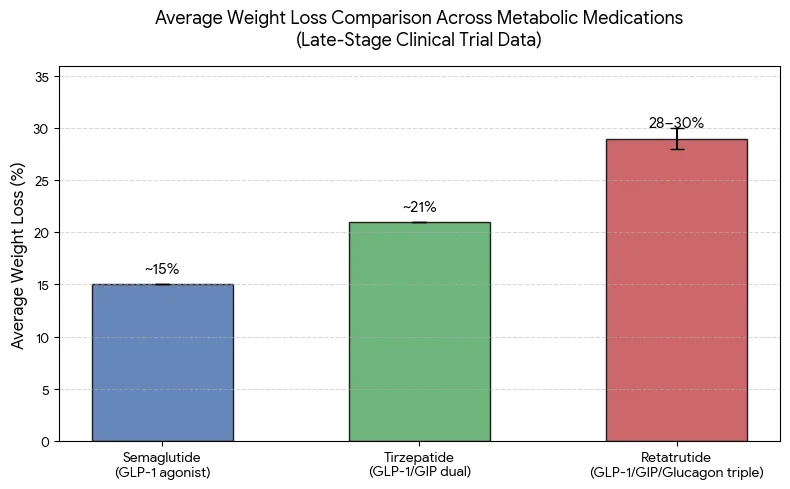
The field moved past single-target thinking when dual and triple agonists entered the literature. A 2024 review in the journal Endocrinology and Metabolism evaluated the evidence for GLP-1 receptor agonists alongside dual GLP-1/GIP co-agonists and GLP-1/GIP/glucagon triple agonists. A 2025 review of next-generation dual and triple incretins reported preliminary findings that complementary action of these combinations produced greater reductions in HbA1c and weight loss than single-target approaches. Those findings are preliminary, but they make the case for designing studies that measure all the pathways a multi-agonist compound touches.
GLP-1 Signaling: The Anchor Your Data Depends On
GLP-1 is the reference point for most obesity and metabolic work, which makes it both useful and dangerous. Useful, because its effects are well characterized. Dangerous, because teams often assume the GLP-1 readout already explains the whole system. It rarely does. Treat the GLP-1 arm as the anchor for your model, then build the other streams around it.
Insulin Secretion Readouts Worth Standardizing
In most incretin protocols, the most common source of noise is sampling. Glucose-stimulated insulin secretion depends heavily on the glucose challenge dose, the timing of blood draws, and whether the animal or cell model was fasted. If two groups in a study used different challenge protocols, their insulin curves are not comparable, regardless of what the GLP-1 agonist did.
Standardize the challenge, log the exact time of each draw, and report insulin at the same intervals across every arm. This sounds obvious, yet it is the most frequent reason integrated datasets fail to reconcile later.
Weight Outcomes Versus Glycemic Outcomes
Glycemic and weight endpoints do not always move together. A 2024 comparative effectiveness analysis published in the BMJ found that GLP-1 receptor agonists improved weight management in people with type 2 diabetes, and that CagriSema performed best for weight loss among the agents compared. A separate 2024 summary from the University of Chicago Medicine described an analysis of 15 GLP-1 receptor agonists in which different drugs performed better in different areas, even though all were very successful at lowering blood glucose.
The lesson for crosstalk research is direct. If you pool glycemic and weight endpoints into one composite score, you can hide the very divergence that reveals how the pathways interact. Keep the endpoints separate until you have a reason to combine them.
GIP Data: The Stream Most Panels Leave Out
GIP is the incretin that gets the least attention in many obesity protocols, which is a problem because it is part of the signal that dual and triple agonists are designed to use. If your panel captures GLP-1 but not GIP, you are measuring half of an incretin conversation. The result can look like a clean GLP-1 effect when the real story is a combination of effects.
Dual GLP-1/GIP Designs as a Test Case
Dual GLP-1/GIP co-agonists give you a useful test bed for understanding the GIP contribution. Because the compound engages both receptors, a comparison against a GLP-1-only agonist isolates what the GIP arm adds. The 2024 review in Endocrinology and Metabolism treats dual co-agonists as a distinct class for exactly this reason, and it is a sensible framing for study design.
In practice, run GLP-1-only, dual, and vehicle arms in parallel when your budget allows. Two arms cannot tell you what the third adds, and that gap is where many interpretations go wrong.
Sampling GIP Without Confounding the Readout
GIP and GLP-1 are both incretins, and both are subject to rapid enzymatic degradation, so sample handling matters more than most teams expect. Delays between collection and processing can change the measured signal. Use the same collection tubes, the same inhibitor protocol, and the same processing time for every hormone you plan to compare.
Pro tip: Before you run a full study, do a pilot in which you collect and process a single set of samples under two handling conditions. If your GIP and GLP-1 values shift in different directions, fix the handling protocol before you commit to the main dataset.
Glucagon: The Counterweight Most Models Underweight
Glucagon is the hormone most likely to be dropped from a secondary panel, and the one most likely to cause surprise later. Its main job in the classic model is to raise blood glucose through hepatic glucose output. GLP-1 suppresses glucagon secretion, which is part of why GLP-1 agonists lower glucose so effectively. When your compound also engages the glucagon receptor, you have to account for a signal that pushes against the glucose-lowering effect.
This is why glucagon cannot be an afterthought in triple-agonist work. A dataset that reports only glucose and insulin may show a neat improvement that masks a glucagon-driven shift in energy handling. The reverse also happens: a glucagon effect can look like a weight effect if you do not track energy expenditure separately.

Why Glucagon Action Can Look Paradoxical in Weight Studies
Glucagon is often described as a glucose-raising hormone, yet it also influences energy expenditure and lipid handling. Those actions can run in the opposite direction from the glucose-lowering effects of GLP-1 and GIP. The result is a compound whose glycemic readout looks modest while its energy readout looks strong, or the reverse. Neither pattern is an error. Both are signals that the pathways are interacting.
When you see a paradox like this, resist the urge to pick the most convenient endpoint. Report each axis separately, and state in the methods how each was measured. Reviewers and future readers will trust the dataset more if the tension is visible.
Logging Glucagon Without Overinterpreting It
Glucagon assays have their own sensitivity and cross-reactivity issues, and the fed versus fasted state changes the signal substantially. Log the feeding state at every draw, use an assay validated for your species or cell model, and avoid comparing glucagon values across kits without a bridging experiment. A single glucagon number with no context is more likely to mislead than to inform.
Building One Dataset From Three Hormone Streams
Once you have reliable GLP-1, GIP, and glucagon readouts, the hard part begins: putting them into one analysis without flattening the interactions you were trying to measure. The goal is a dataset where each hormone keeps its own timeline and metadata, linked by a common subject or sample identifier.
Aligning Timepoints Across Assays
The most common integration failure is a timing mismatch. Insulin, glucagon, and incretin responses do not peak at the same moment after a stimulus, so sampling every hormone at one timepoint can make a fast response look flat and a slow response look strong. Build a sampling schedule that covers the rise and fall of each hormone, then interpolate only where the design justifies it.
Store raw timestamps, not just rounded time labels. When two arms drift out of schedule, the raw timestamps let you correct the analysis instead of discarding the data.
Mapping Direct Versus Downstream Effects
Causality is the hardest part of crosstalk research. A useful reference point comes from a 2019 review of GLP-1 biology that described studies in GLP-1 receptor knockout mice. In that work, obese mice lacking the GLP-1 receptor showed weight loss and improved glucose metabolism comparable to wild-type controls after vertical sleeve gastrectomy. The finding tells you that some metabolic benefits do not depend on the canonical receptor, and that a surgical or systemic effect can produce results that look like receptor action.
For your own design, that means including a receptor-null or receptor-blocked arm wherever feasible. Without it, you cannot separate a direct receptor effect from a downstream consequence of changes in intake, glucose, or insulin.
A receptor-level result is a hypothesis about one pathway. It becomes a conclusion about the system only after the other pathways have been measured under the same conditions.
Pro tip: Assign every sample a single master identifier and link each hormone assay to it in one table. When a reviewer asks how a glucagon value matches a given GLP-1 timepoint, you should be able to answer in under a minute without reconstructing the schedule from lab notebooks.
Comparing Three Integration Approaches
Teams usually reach one of three integration strategies, and each has a clear use case and a clear weakness. The table below compares them on the points that matter most when you are trying to explain an obesity result to someone who was not in the room.
| Approach | Best Use | Main Limitation |
|---|---|---|
| Parallel single-pathway assays | Early screening, when you need to know which receptor drives a response | Cannot capture interactions between pathways, so combined effects are inferred rather than measured |
| Unified multi-receptor panel using a triple agonist | Studies that need to measure the net effect of GLP-1, GIP, and glucagon engagement in one model | Harder to attribute a result to a single pathway, so you need the single-pathway arms as controls |
| Pooled analysis of published incretin studies | Hypothesis generation and cross-study comparison of endpoints | Protocols, assays, and populations vary, so pooled effects can mix biology with methodological noise |
In practice, most strong programs combine the first two. Use parallel assays to identify what each receptor contributes, then run a unified panel to test whether the combined effect matches the sum of the parts. The pooled approach is useful for framing questions but rarely settles them on its own.
Retatrutide as a Research Tool for Triple-Receptor Work
Retatrutide is a triple agonist that engages the GIP, GLP-1, and glucagon receptors, which makes it a natural tool for the integrated designs described above. Instead of stacking three separate compounds, a single molecule lets you ask whether the combined receptor engagement produces an effect that the individual pathways do not predict. Pepura Labs supplies retatrutide as a lyophilized research compound for in vitro applications, with presentations of 10mg, 20mg, 40mg, 60mg, and 84mg. The material is research use only and is not intended for human consumption.

Dose Presentation and Experimental Design
Choose your vial size based on the design, not on the unit price. A dose-response study across several concentrations needs enough material to run every arm, including replicates and controls, without reconstituting a fresh vial partway through the series. Running out mid-study and switching to a new batch is one of the quickest ways to introduce uncontrolled variation into an integrated dataset.
Reconstitution should be documented in full. If you use bacteriostatic water as the diluent, record its lot number, the volume added, and the resulting concentration, and keep those records alongside the assay data. Small errors in reconstitution propagate into every hormone readout downstream.
Reading Results When All Three Receptors Are Engaged
With a triple agonist, the usual control logic changes. You can no longer assume that a GLP-1-only result is the baseline for the combined effect, because the compound is also engaging GIP and glucagon receptors at the same time. Build your comparison arms so each receptor contribution can be estimated, even if only approximately, and state clearly which conclusions depend on that estimate.
A common mistake is to report a triple-agonist result as if it proved a mechanism. A single compound can show a combined effect without showing which receptor produced it. Be explicit about that limit in your write-up.
Lab Verification and COA Documentation for Endocrine Studies
An integrated endocrine dataset depends on the identity and quality of the compound at every stage. If the material varies from batch to batch, a shift in GIP or glucagon readouts may reflect the compound rather than the biology. That is why certificate of analysis documentation and independent verification are not paperwork you file once and forget. They are part of the experiment.
Pepura Labs independently verifies its lyophilized compounds through Canadian laboratories, maintains Chain of Custody documentation, and supports batch traceability for research buyers across Canada. Orders ship by Xpresspost for rapid delivery within the country, which helps keep time-sensitive study schedules on track.
What a Certificate of Analysis Should Show
A useful COA lists the compound identity, the batch or lot number, the purity result, the testing laboratory, and the date of analysis. Check that the batch number on the COA matches the vial you are using, and that the purity figure comes from a named method rather than a general claim. If any of those elements are missing, ask for them before the material enters your study.
Chain of Custody When Results Go to Review
Reviewers and collaborators will ask where the material came from and how it was handled. Keep the Chain of Custody record with the study file, along with storage conditions, receipt dates, and reconstitution logs. This is the documentation that lets a reader trust the link between a compound batch and a hormone result, which is the link integrated crosstalk studies depend on most.
Pro tip: Create a batch-to-assay map before you start data collection. List every vial, its COA reference, and every assay run that used it. If a batch later shows an anomaly, you can identify exactly which results to re-examine instead of re-running the whole study.
Common Mistakes That Break Crosstalk Studies
Most failed integrations trace back to a small set of avoidable errors. The first is measuring too few hormones and then drawing conclusions about the system. A GLP-1 and glucose dataset cannot speak to glucagon effects, and it is tempting to fill the gap with an assumption. Resist that temptation and either measure the missing stream or state the gap plainly.
The second mistake is combining endpoints too early. Weight, glucose, insulin, and glucagon are different kinds of measurement, and averaging them into a single index can hide the divergence that reveals crosstalk. Keep the raw endpoints visible through the main analysis and use composites only as summaries.
The third mistake is ignoring compound variability. Teams often check the purity of their first batch and assume later batches match. Every new lot should carry its own COA, and any change in material should trigger a bridging comparison before new data is added to an existing series. Skipping that step is how a clean-looking dataset becomes impossible to reconcile.
Frequently Asked Questions
What does endocrine crosstalk mean in obesity research?
Endocrine crosstalk refers to the way hormones such as GLP-1, GIP, glucagon, and insulin influence one another's secretion and action. In obesity research, it matters because a result attributed to one receptor may partly reflect changes in another hormone's signal.
Why is glucagon included when the goal is weight research?
Glucagon affects hepatic glucose output and energy handling, and it can push against the glucose-lowering effects of GLP-1. Leaving it out can make a dataset look cleaner than the underlying biology actually is.
Do I need a receptor-null control for every study?
Not every study can include one, but where feasible it is the strongest way to separate direct receptor effects from downstream consequences. If you cannot include it, state the limitation clearly in the methods and avoid causal language in the conclusions.
How should I handle batch differences in research compounds?
Record the batch number, COA, and reconstitution details for every vial, and run a bridging comparison whenever the material changes during a study. Consistent documentation is what allows you to tell a compound effect from a biological one.
Is retatrutide suitable for human use based on this research?
No. Retatrutide supplied by Pepura Labs is a research-grade compound for in vitro laboratory applications only. It is not intended for human consumption, and nothing in this article should be read as guidance for personal use.
Have you run a multi-hormone study that produced results you could not reconcile, or found an integration method that worked well in your lab? Share your experience in the comments so other researchers can learn from it.
References
- Review of GLP-1 biology, including knockout mouse studies after vertical sleeve gastrectomy
- Review of GLP-1 receptor mechanisms and advances in therapy
- Review of GLP-1 receptor agonists, dual GLP-1/GIP co-agonists, and triple agonists
- Review of cross-interactions between insulin, glucagon, and GLP-1
- Comparative effectiveness analysis of GLP-1 receptor agonists on weight and glycemic outcomes