With about 62 days left in 2026, most research teams in Canada are past the point where a fresh start makes sense. The real question for Q4 2026 research planning is not whether you can run a retatrutide study before year-end, but whether your vials, testing paperwork, and bench time line up before the calendar runs out. Labs that wait until November to order often find that a verified lot, a complete certificate of analysis, and an open week at the bench are hard to secure at the same time. This guide explains how we would build a fall research peptide pipeline backward from your deadline, and which decisions stall projects most often.
Table of Contents
- Quick Takeaways
- Why Q4 Is a Different Planning Problem
- Mapping the Pipeline Backward From Your Deadlines
- Choosing Compound Strengths for Your Assay Design
- Bacteriostatic Water and Reconstitution Logistics
- Verifying Quality Before the Vial Reaches the Bench
- Year-End Budgeting and Order Scheduling
- Common Mistakes That Stall Q4 Studies
- Frequently Asked Questions
- References
Quick Takeaways
| Key Insight | Explanation |
|---|---|
| Work backward from a fixed end date | Set your last usable data date first, then subtract analysis, verification, and reconstitution time from it. |
| Lock the protocol before ordering | Changing vial strength after the order is placed forces new calculations, new logs, and new documentation. |
| Match vial size to stock concentration | Pick from the 10mg, 20mg, 40mg, 60mg, and 84mg compounds based on the concentration your assay needs, not the lowest price per milligram. |
| Check the COA against the vial label | Confirm the lot number, identity, and purity data match before any material goes near a bench. |
| Order in two tranches | A pilot order protects you if early runs fail, and a second order covers the confirmed study. |
| Plan around the late December slowdown | Holiday volume and the Boxing Day closure can stretch transit times, so request delivery estimates before the order is placed. |
| Keep a reconstitution log from day one | Record the bacteriostatic water lot, date, volume, and storage location for every vial so your results can be audited later. |
Why Q4 Is a Different Planning Problem
Retatrutide is a triple agonist that acts on GIP, GLP-1, and glucagon receptors, as described in the 2023 New England Journal of Medicine report on the compound. For a laboratory, that pharmacology matters less in the fall than the calendar does. A study that starts in January needs its materials, documentation, and bench slots locked in before the holiday slowdown begins. In practice, the bottleneck is rarely the science. It is an order sitting in an approval queue until December, then arriving in the same week carriers are busiest.

The Three Dates That Set Your Schedule
Every fall pipeline depends on three dates: the last day you can place an order, the last day you can collect usable data, and the day your write-up is due. Most teams track only the third one. The first two are where projects quietly fail. If your last ordering date is November 20 and your verification takes ten days, the schedule has almost no slack left before the bench work can even begin.
Write these three dates on the first page of your plan. Everything else, including protocol sign-off, purchasing, and reconstitution, gets scheduled against them.
Where Year-End Budgets Get Stuck
Many institutions run approval cycles that slow down in the last quarter. A purchase order that needs three signatures in early November can easily slip past the point where a shipment can arrive before the holidays. Start the paperwork before the science is final, and attach a clear budget line so the approver is not guessing what the money buys.
A pipeline is only as fast as its slowest approval, and in the fourth quarter that is almost never the bench.
Pro tip: Submit purchase requests with a target delivery date and a fallback date. Approvers respond faster when they can see what happens if they wait another week.
Mapping the Pipeline Backward From Your Deadlines
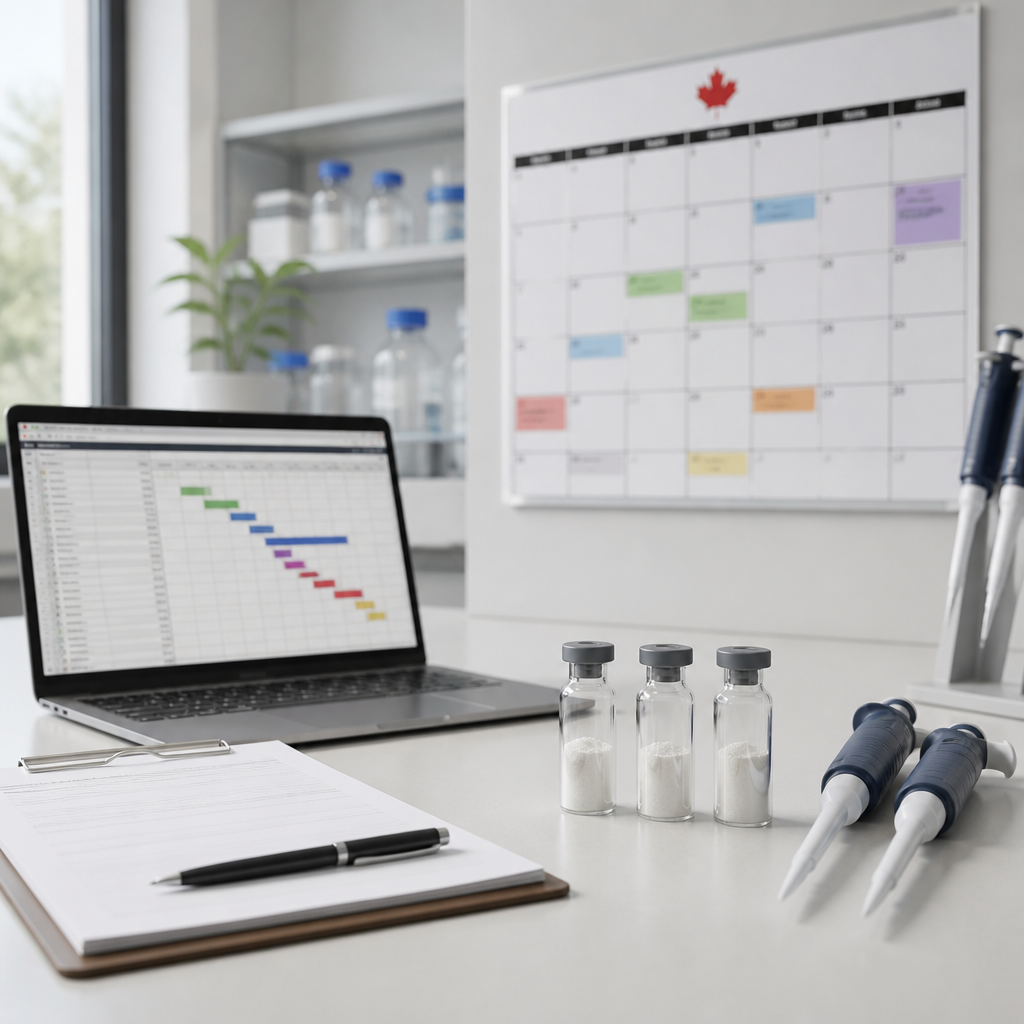
Start with the deliverable, whether that is a internal report, a grant milestone, or a manuscript draft, and work backward through every stage. A typical retatrutide in vitro workflow includes protocol sign-off, material ordering, documentation review, reconstitution, bench work, data capture, and analysis. Each stage has a realistic duration, and most teams underestimate the two stages that involve other people: purchasing and documentation.
Building a Stage-Gate Calendar
Give each stage a go or no-go gate with a date attached. If verification is not in hand by the gate date, the study moves into January rather than running on unverified material. That rule feels harsh in October, but it saves you from repeating experiments in February.
Keep the gates visible to everyone on the project. A shared calendar works, but a one-page printed checklist on the bench works better, because it gets read.
Buffer Time You Actually Need
We recommend building at least two weeks of buffer between the date you expect material to arrive and the date you need it on the bench. That buffer covers transit variation, a documentation check, and the inevitable meeting that moves a start date. In December, add more. The cost of an idle week is small compared with the cost of a bench that sits empty while waiting for a missing lot record.
Pro tip: Ask your team to name one person who owns each gate. Projects without a named owner for verification usually discover the problem on the day the bench was supposed to start.
Choosing Compound Strengths for Your Assay Design
Pepura Labs supplies retatrutide compounds in 10mg, 20mg, 40mg, 60mg, and 84mg vials for in vitro research. The right vial size depends on your assay design, your reconstitution plan, and how many separate preparations you expect to make over the study period. Choosing a size only by price per milligram often creates waste, extra handling, and more opportunities for error.
Matching Vial Size to Stock Concentration
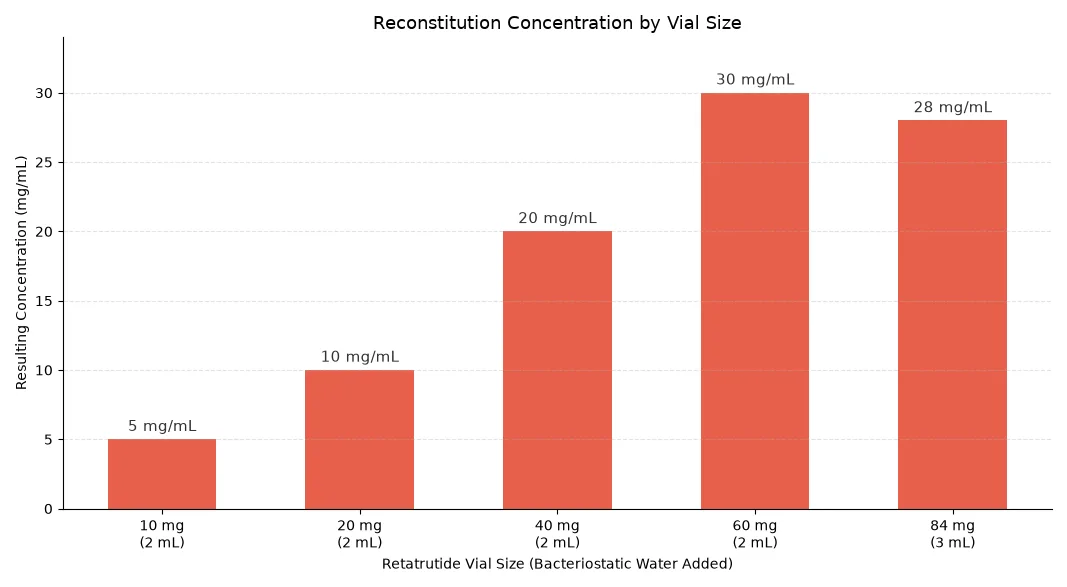
Stock concentration is simply mass divided by volume. A 10mg vial reconstituted in 1 mL gives a stock of 10 mg/mL, while an 84mg vial reconstituted in 2 mL gives 42 mg/mL. Before you order, write down the stock concentration your protocol needs, the working concentrations for each assay arm, and the total volume you expect to use. Then choose the vial size that delivers those numbers with the least leftover material.
Avoiding Mid-Study Strength Changes
Switching from a 20mg vial to a 60mg vial halfway through a project is not a small change. It means new concentration calculations, a new cross-check against the certificate of analysis, and new log entries. In a fall schedule, that rework can consume the buffer you planned for shipping. Commit to one strength for the confirmed study, and use a separate pilot quantity if you need to test a different concentration first.
Pro tip: Calculate the expected number of reconstitutions for the full study, then round up by one. Running out of material on day 40 of a 45-day window is a more common problem than most teams expect.
Bacteriostatic Water and Reconstitution Logistics
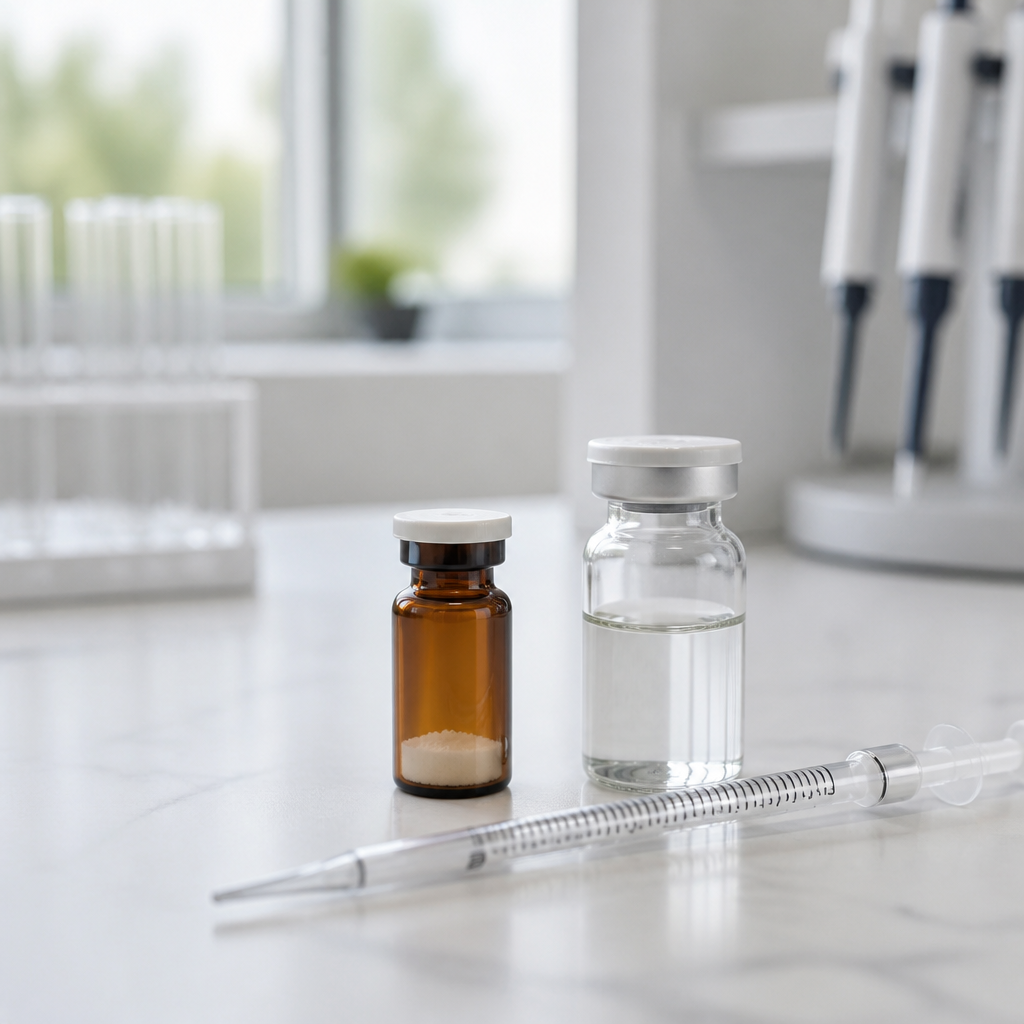
Bacteriostatic water is a standard diluent in many research workflows, and we offer it alongside our retatrutide compounds. Ordering it with the peptide in the same shipment removes one of the most avoidable Q4 delays. A lab that has the compound but not the diluent is stuck for a full week, and that week is often the one that pushes a study into the new year.

Ordering Diluent With the Peptide
Treat diluent as part of the compound order, not as a supply to be picked up later. Confirm the quantity you need for every planned reconstitution, add a spare volume, and check that the lot information is recorded when the shipment arrives. If you are placing a tranche order, include diluent in the first tranche so that pilot runs can begin on schedule.
Logging Each Reconstitution Event
A reconstitution log is the simplest way to make your results reproducible. For each event, record the date, the peptide lot number, the diluent lot number, the volume added, the operator, and the storage location. When a reviewer or collaborator asks how a stock solution was prepared, you should be able to answer in under a minute.
Storage Between Preparation and Use
Follow the storage conditions listed on the product documentation, and minimize repeated temperature changes once a vial has been opened. Aliquot where your protocol allows, label every aliquot with the lot and date, and avoid leaving prepared material on a bench through a long afternoon of other work. Small habits like these are what keep a late-year dataset clean.
Pro tip: Print labels before the material arrives. Labeling in a rush during a busy December week is where transcription errors happen.
Verifying Quality Before the Vial Reaches the Bench
Every batch we ship is independently verified by Canadian laboratories and comes with chain of custody documentation and batch traceability. Verification does not replace your own checks. It gives you a documented starting point, and it lets you trace any question back to a specific batch. In a fall schedule, that traceability matters because it is much harder to reconstruct records after the holidays.
Reading a Certificate of Analysis Line by Line
Read the certificate of analysis as a checklist, not a summary. Confirm that the lot number matches the vial label exactly, that the identity method is listed, and that the purity result meets your protocol requirement. Our research-grade specification is 99% or higher, but your study may need tighter criteria for a specific assay, so decide those criteria before the order is placed.
Chain of Custody and Batch Traceability
Chain of custody documentation shows who handled the material and when, from testing through shipment. Batch traceability links each vial back to its production record. Together, they answer the questions a principal investigator, an ethics or compliance reviewer, or a journal editor is likely to ask. Store the documentation with your study files, not in an email thread that someone will delete in January.
Pro tip: Compare the COA lot number with the vial label and the shipping paperwork on the day of arrival. A mismatch caught on day one costs a phone call, while one caught in February can cost the whole dataset.
Year-End Budgeting and Order Scheduling
Budget timing is the part of Q4 planning that most scientists handle reluctantly, and it is also where the easiest gains are. Funds that are not committed by the close of a budget period may disappear or require a formal carry-forward request. Plan your order sizes around the approval calendar you actually have, not the one you wish you had.
Choosing Between the Three Approaches
Most of the teams we work with use one of three ordering patterns. Each one trades cost, risk, and flexibility in a different way, and the right choice depends on how certain your protocol is. The table below summarizes the trade-offs we see most often.
| Approach | Best For | Main Risk |
|---|---|---|
| Single upfront order | Fully confirmed protocols with a fixed vial strength and a fixed timeline | All funds are committed at once, and a single shipping delay affects the whole study |
| Two-tranche order | Projects that need a pilot run before the main study begins | The second tranche may land during the holiday slowdown if it is ordered late |
| Rolling monthly reserve | Ongoing laboratory programs with variable demand across the year | Lot matching across orders becomes harder, so logging discipline must be strict |
For most fall projects, the two-tranche approach is the safest default. It keeps the pilot cheap, protects the confirmed study from early protocol surprises, and gives you a clear reason to place the second order on a set date. Rolling reserves make sense for longer programs, but they are a poor fit for a single fall sprint.
Pro tip: If your budget office closes before your shipment window, ask whether a purchase commitment can be recorded by the deadline with delivery after it. Many offices allow this when the paperwork is clear.
Common Mistakes That Stall Q4 Studies
Most stalled fall studies do not fail because of a dramatic error. They stall because of small decisions that looked reasonable in October and became expensive by December. The three mistakes below appear again and again in our experience with research buyers, and each one is easy to prevent.
Ordering Before the Protocol Is Final
Teams often place an order to hold a place in the schedule, then change the protocol two weeks later. The result is either a vial that no longer fits the design or a second order that arrives after the first pilot is complete. If the protocol is not signed, put the order on hold and use that time to finish the calculations. A delayed order is recoverable, but a wrong one usually is not.
Treating the Certificate as a Formality
A certificate of analysis that goes unread until the paper is in review is a risk. Read it when it arrives, compare it with the vial label, and file it with the study records. The few minutes this takes on delivery day save hours of document searching later.
Forgetting the Holiday Calendar
Canadian statutory holidays in late December affect when carriers can deliver and when staff can receive material. A shipment that looks like a three-day transit in October can take considerably longer in the final two weeks of the year. Build the holiday calendar into your gate dates, and treat any delivery expected after December 18 as a planning risk rather than a certainty.
Frequently Asked Questions
What does Q4 2026 research planning look like for a lab that starts in January?
A January start still needs fall preparation. Lock the protocol, confirm vial strength, place the order, and complete documentation review before the holiday slowdown, so the lab can begin on the first working day of the new year without waiting for material.
How many weeks should I allow between ordering and first bench use?
Allow at least three weeks in November and four weeks in December. That range covers shipping, the documentation check, and a buffer for internal approvals. Shorter timelines work only when the order is already approved and the paperwork is complete.
Which retatrutide compound size should I order for a first pilot?
Choose the smallest size that covers your pilot assay with a spare reconstitution. The 10mg compound is often the most practical starting point for a pilot, because it limits waste if the protocol changes after early results.
Do you provide dosing guidance for human use?
No. Our retatrutide compounds are sold for in vitro research use only by laboratories. We do not provide dosing guidance for human use, and our documentation is written for research applications.
What should a certificate of analysis include before I accept a batch?
Check that the lot number matches the vial, that the identity and purity results are listed, and that the documentation includes chain of custody information. If any of these items are missing or unclear, contact us before the material enters your study workflow.
Can I order bacteriostatic water with my compound order?
We offer bacteriostatic water alongside our retatrutide compounds, and we recommend ordering it in the same shipment. Confirm current availability and quantities before you finalize your plan, especially for a December delivery window.
What was the single biggest bottleneck in your last year-end study, and did it come from ordering, verification, or bench time?
References
- Meta-analysis of retatrutide efficacy and safety for body weight and metabolic outcomes
- New England Journal of Medicine report on the triple hormone receptor agonist retatrutide for obesity
- ClinicalTrials.gov registry entry for a retatrutide study in participants with obesity and established cardiovascular disease