Most retatrutide 84mg planning mistakes do not show up on day one. They show up in week four, when a vial that seemed generous runs short, a second lot arrives with a slightly different COA, or a stock solution has been through more freeze-thaw cycles than anyone logged. Long-duration in vitro work punishes loose planning. This guide is written for research scientists and laboratory teams who need a multi-week experiment to produce data they can defend, and it covers how to size the material, prepare it, store it, and document it from the first aliquot to the final readout. Everything here concerns laboratory research use only, not human use.
Table of Contents
- Quick Takeaways
- What Retatrutide 84mg Means for Research Planning
- Why Multi-Week Designs Need a Different Stock Plan
- Vial Capacity and Aliquot Planning
- Reconstitution with Bacteriostatic Water
- Storage, Stability, and Freeze-Thaw Control
- Verification: COA, Chain of Custody, and Batch Traceability
- Comparing Vial Strategies for Multi-Week Work
- Documentation That Keeps a Long Study Defensible
- Frequently Asked Questions
- References
Quick Takeaways
| Key Insight | Explanation |
|---|---|
| Plan the vial count before the first pipette | Work backward from total assays, replicates, and controls, then add a reserve for repeats and quality checks. |
| Match one lot to the full study window | A single batch with one COA keeps material variables fixed across weeks, so later differences are easier to interpret. |
| Log the concentration math at reconstitution | Record the diluent volume, the resulting concentration, and the date. Recalculation errors are the most common silent failure. |
| Limit freeze-thaw cycles with single-use aliquots | Divide stock into portions sized to one assay day so each run starts from an untouched tube. |
| Read the COA before opening anything | Confirm the batch number, purity, and analytical methods match the paperwork your protocol will cite. |
| Treat shipping as part of the timeline | Reorder with enough lead time that a transit delay never forces a lot change in the middle of a study. |
What Retatrutide 84mg Means for Research Planning
Retatrutide is an investigational compound, not an approved medicine, and the 84mg designation on a Pepura Labs vial refers only to the quantity of lyophilized material supplied for laboratory research. Before you build a protocol around it, it helps to understand what the published literature covers. A 2025 study indexed on PubMed Central reports significant improvements in body weight and metabolic outcomes among adults with obesity, which tells you the molecule acts across several incretin-related receptors.
The clinical trial registry entry hosted by Lilly describes studies of different dose escalation schemes in participants without type 2 diabetes. For a laboratory, that detail matters for one reason: it shows that dose escalation over time is part of the question being asked. If your in vitro model is meant to address duration, your design should reflect that from the start rather than treating a long run as several short runs stitched together.
In practice, the number 84mg tells you about capacity, not about how long material stays usable once opened. A high capacity peptide vial research setup gives you more total material, but it also adds responsibility for aliquoting, labeling, and storage. Most teams that run into trouble had enough material on paper and not enough organization on the bench.
Capacity only buys flexibility if the material is divided, labeled, and stored in a way that keeps each portion as close to the original as possible.
Why Multi-Week Designs Need a Different Stock Plan
Counting the full timeline before the first draw
Start with a timeline in your notebook, not a vial count. List every assay day, control, replicate, and stability checkpoint across the study window, and only then translate that into total volume. The timeline sets the quantity, not the other way around.
A common mistake is counting only the primary readout days. Calibration runs, method validation, and repeat assays for failed plates consume material too. Add a reserve equal to at least one full repeat cycle, and write that reserve down so nobody draws on it for routine work.
Keeping one lot across the whole study
Lot-to-lot variation is the hidden variable in long experiments. If week one uses one batch and week six uses another, a difference in your data could come from the material rather than the biology. Plan to order enough of one batch number to cover the entire study window, reserve included.
Pepura Labs supplies batch-traceable lyophilized compounds with documentation, so the lot number on the vial should match the lot on the COA you file. If you must buy more material mid-study, treat it as a new lot and run a bridging comparison before you merge the data.
Pro tip: When you can, order the full study quantity in one purchase, then check the lot number on the packing slip against your records the day the package arrives.
Vial Capacity and Aliquot Planning
Working out the total draw from an 84mg vial
Divide your planned total draw by the volume each assay consumes, then add your reserve. An 84mg vial is large enough that the arithmetic can look comfortable, but several assays each taking small volumes add up quickly. Write the calculation into the protocol so a second person can check it without asking you.
Track consumption as you go. Compare the amount left in the stock against the amount your remaining plan requires at each checkpoint. A gap that appears in week two is a scheduling problem you can fix, while the same gap in week six is a failed study.
Aliquot size and the freeze-thaw budget
Aliquoting is the single most effective habit for protecting a long study. Each time a stock solution is taken out, warmed, and returned, you add exposure you cannot undo. Divide the reconstituted stock into single-use portions sized to one assay day, so no tube is opened more than once.
Aliquot size should follow your assay's needs, not the size of the vial. Very small aliquots mean more pipetting error and more labels to keep straight. Very large aliquots bring you back to repeated thawing. Most teams settle on a volume that covers one full assay plate with a small margin.
Reconstitution with Bacteriostatic Water
Choosing the diluent volume
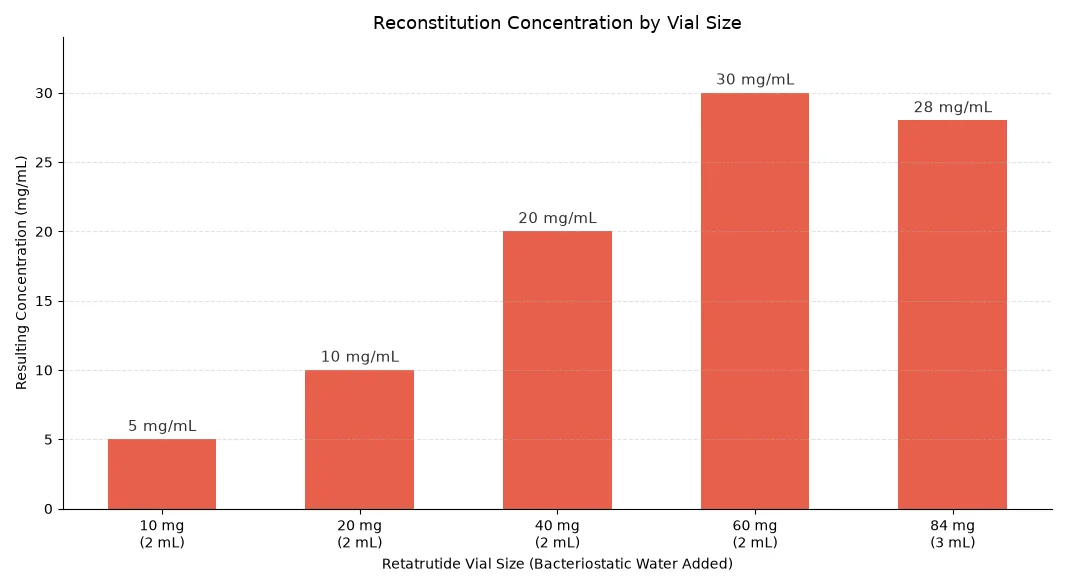
The volume of bacteriostatic water you add sets the working concentration, and that concentration then governs every downstream pipetting step. Decide the target concentration first, based on your assay's dynamic range, and work backward to the diluent volume. Do not reverse that logic and pick a convenient volume that happens to produce an awkward concentration.

Bacteriostatic water is widely used as a laboratory diluent because it contains a preservative, which helps with repeated draws from a reconstituted stock. It does not make the material stable indefinitely. Treat the reconstituted stock as a time-limited reagent and assign it an expiry date in your records.
Logging the concentration math
Record four values at the moment of reconstitution: the labeled vial content, the diluent volume, the resulting concentration, and the time. For example, if an 84mg vial is brought up in 2 mL, the nominal stock is 42 mg/mL before any correction for the content information on the COA. Check that documentation before you finalize the number, because labeled quantity and usable peptide content are not always identical.
Recalculation mistakes are the most common silent failure. A transposed digit in a dilution step can shift every result in a series without triggering any obvious alarm. That is why the calculation belongs in the protocol, initialed, and checked by a second person.
Pro tip: Label each aliquot with the concentration, the reconstitution date, and the lot number. A tube labeled only with a compound name becomes unusable the moment someone needs to prove which batch produced a result.
Storage, Stability, and Freeze-Thaw Control
Lyophilized storage before opening
Unopened lyophilized material should stay under the storage condition stated on its documentation, kept sealed, protected from light, and shielded from repeated temperature swings. Do not move vials between a freezer and a benchtop for one day's convenience. Each swing is a small risk you cannot audit later.
Let sealed vials equilibrate to room temperature before opening to reduce condensation. Moisture is the enemy of a lyophilized cake, and a cold vial opened immediately can draw water in from the air. Open the vial, draw what you need, and reseal promptly.
Stability after reconstitution
Once reconstituted, the clock starts. Stability depends on storage temperature, aliquot handling, and the diluent, so it is unsafe to assume a generic shelf life. Set an internal expiry based on your own stability checks, and retire any stock that passes it, even if it still looks clear.
A practical habit is to run a simple check near the start and near the end of a multi-week study, comparing a control response against the earlier baseline. If the drift is larger than your assay's normal variation, you have a stability question to answer before you interpret the later data.
Verification: COA, Chain of Custody, and Batch Traceability
Reading a COA before your first aliquot
The Certificate of Analysis is the document your protocol will rely on, so read it before the vial leaves the box. Confirm that the batch number matches the label, that the stated purity meets your requirement, and that the analytical methods listed are ones your lab trusts. A COA that does not match the vial is a stop-work event, not a paperwork detail.
Pepura Labs supplies material with independent Canadian laboratory verification and Chain of Custody documentation. In practice, that lets you connect a specific vial to a specific batch and a specific testing record, which is the link reviewers and collaborators will ask about first.
Chain of custody for multi-site work
If material moves between a receiving area, a storage location, and a bench, each transfer needs a name, a date, and a condition note. Chain of custody is only useful if it is continuous. One unsigned transfer can make an otherwise clean dataset hard to defend.
Pro tip: Scan or photograph the COA and file it with the experiment record on the day the vial arrives, not at the end of the study when batch details can be harder to retrieve.
Comparing Vial Strategies for Multi-Week Work
No single vial format fits every study. The right choice depends on how many independent runs you need and how tightly you need to control lot consistency. The three approaches below cover most of the decisions research teams face when they plan a long run.
| Strategy | Where It Works Best | Main Risk |
|---|---|---|
| One 84mg vial, fully aliquoted | Long single-lot studies with a stable assay design and a clearly calculated total draw | Sloppy aliquoting or one storage failure can affect the entire dataset |
| Several 40mg or 60mg vials from one lot | Studies that run in separate blocks or that split material between two locations | Each vial needs its own reconstitution record, which multiplies documentation work |
| 10mg or 20mg vials for pilot runs | Method development, short calibration series, and checking a new assay before committing a large volume | Smaller totals mean a pilot that grows into the main study can force a reorder mid-run |
In practice, many teams begin with smaller vials for method development and then move to one large lot for the main run. That sequence works only if the pilot and the main study share a batch, or if you run a bridging comparison before combining the results. Otherwise, the pilot data may describe a different material than the one you actually report.
Documentation That Keeps a Long Study Defensible
Building the lot-level record
Keep one document per lot that lists the COA reference, every aliquot created, every freeze-thaw event, and every assay that used the material. When a result looks off in week five, this record tells you within minutes whether the material changed or the biology did. Without it, you are left guessing.
Update the record on the day of each event, not in a batch at the end of the week. Memory is unreliable across a six-week run, and retrospective entries are the first thing a reviewer will question.
Planning reorders around transit time
Shipping is part of the experiment timeline. Pepura Labs offers Xpresspost delivery across Canada, but transit still takes time, and a reorder placed on the day you run out will leave a gap. Set a reorder trigger at the point where remaining stock covers your current plan, your reserve, and the expected delivery window, whichever requires more.
File the shipping records with the lot file. If a package is delayed or arrives with a condition concern, you will want the timestamps and carrier details ready when you decide whether the material is still fit for use.
Frequently Asked Questions
Is retatrutide approved for use?
No. Retatrutide is an investigational compound, and the material supplied by Pepura Labs is intended for laboratory research only. It is not a medicine, and this article does not address human use.
Why does a multi-week in vitro study need a single lot?
A single lot keeps material variables fixed across the study, so differences in your data are more likely to reflect the biology you are testing. If you must switch lots, run a bridging comparison and document it before combining the datasets.
How much reserve should I plan for a retatrutide 84mg study?
There is no universal number, but a practical starting point is one full repeat of your longest assay cycle plus a margin for quality checks. Write the reserve into the protocol so it is protected from routine use.
What should I check on a COA before I use the material?
Confirm that the batch number matches the vial label, that the purity meets your requirement, that the analytical methods are ones your lab accepts, and that the document is dated and complete. A mismatch on any of these points should stop the work until it is resolved.
How long can reconstituted stock be kept?
There is no safe universal shelf life for reconstituted material. Set an internal expiry based on your own stability checks and storage conditions, and discard any stock that passes that date, even if it looks unchanged.
If you have run a multi-week in vitro study with a high capacity vial, we would like to hear which stock planning step caught you off guard, so please share your experience with our team.