Most BPC-157 vials sold for research in Canada look identical on the shelf, and the label rarely tells you what is inside. A peptide with an unclear purity figure, or one whose identity was never confirmed, can produce data that looks reasonable and then fails on replication. If you run a lab or manage research procurement, the useful question is not whether BPC-157 is available. The useful question is which documents prove what you received, and whether custody holds from synthesis to your bench. This guide covers how to read purity claims, what a certificate of analysis should contain, and where sourcing usually goes wrong.
Table of Contents
- Quick Takeaways
- What BPC-157 Is and Why Labs Buy It
- Canadian Legal Status for Research Use
- Purity Specifications: What HPLC Numbers Tell You
- COA Documentation: What to Demand
- Chain of Custody From Synthesis to Your Bench
- Comparing Sourcing Approaches
- Oral Versus Injectable Claims and the Evidence Gap
- Storage, Reconstitution, and Diluent Choice
- Frequently Asked Questions
- References
Quick Takeaways
| Key Insight | Explanation |
|---|---|
| A purity percentage needs a lot number and a method | A figure such as 99% with no batch link or test method is a sales claim. Ask for the chromatogram tied to the specific lot you are receiving. |
| Purity does not confirm identity | A clean main peak can still be the wrong molecule or contain closely related fragments. Require mass spectrometry data that matches the expected molecular weight of BPC-157. |
| Check every field on the certificate | Confirm the lot number, test date, testing laboratory, method, and result for each parameter. Missing fields usually mean missing testing. |
| Custody gaps cannot be fixed later | Every handoff should be logged with a date and condition. If you cannot prove the vial you tested is the vial you received, the data is weaker than it looks. |
| Research use is the only lawful frame in Canada | BPC-157 is not an approved drug and is not sold for human use. Any seller who discusses dosing for people or personal recovery is a red flag. |
| Preclinical data is not human data | Most published BPC-157 work is animal or laboratory research. Build protocols around the evidence you can cite, not around marketing claims about human results. |
What BPC-157 Is and Why Labs Buy It
BPC-157 is a 15-amino-acid peptide. Most of the research so far has been done in preclinical models, where investigators have looked at tissue repair, inflammatory signaling, blood vessel pathways, and gastrointestinal protection. That is why it appears in so many procurement requests from labs studying injury models and tissue biology.
The scale of the evidence matters for how you buy. A 2025 systematic review focused on orthopaedic sports medicine included 36 studies, and 35 of them were preclinical. Only one was a small human study. The animal data for muscle, tendon, ligament, and bone injury models is encouraging enough to justify research, but it is not a clinical evidence base.
Why the Human Evidence Gap Changes Your Sourcing Standard
If your work is entirely in vitro or in animal models, the human evidence gap does not make your research pointless. It does mean that the consistency of your material carries more weight. When your readout depends on a dose-response curve, a lot that varies in purity or net peptide content can shift your results in ways that look like biology.
In practice, labs that run BPC-157 studies for more than one cycle tend to find that their hardest problems are not biological. They are batch problems that were never documented. Setting a stricter sourcing standard at the start is far cheaper than explaining an inconsistent series later.
Pro tip: Write your purity acceptance threshold and required documents into the study protocol before you place the order. Labs that decide after the vial arrives tend to accept whatever came in the box.
Canadian Legal Status for Research Use
In Canada, BPC-157 is not an approved drug and it is not sold for human use. It is handled as a research compound for laboratory use. That framing should shape every part of your purchase, from the vendor you choose to the wording on the invoice and the way the material is described in your own records.
The McGill Office for Science and Society has published a critical review of BPC-157 claims. Its argument is that human evidence does not show the peptide is effective or safe, even though it is widely promoted for muscle, tendon, and ligament repair. That gap between promotion and evidence is exactly what a careful buyer should keep in mind when reading supplier pages.
Red Flags in Supplier Marketing
Watch for language that describes dosing schedules, athletic recovery, or personal use. A supplier that talks about the product as if it were meant for people is telling you something about its compliance culture, and that culture will show up in its paperwork too. Legitimate research suppliers describe their material in terms of laboratory specifications, lot data, and intended research applications.
Your own institutional rules matter more than any supplier page. Check your ethics and biosafety requirements before ordering, and make sure the purchasing office knows what the material is for. In most institutions, that paper trail is what protects the study if an audit or publication review asks questions later.
Purity Specifications: What HPLC Numbers Tell You
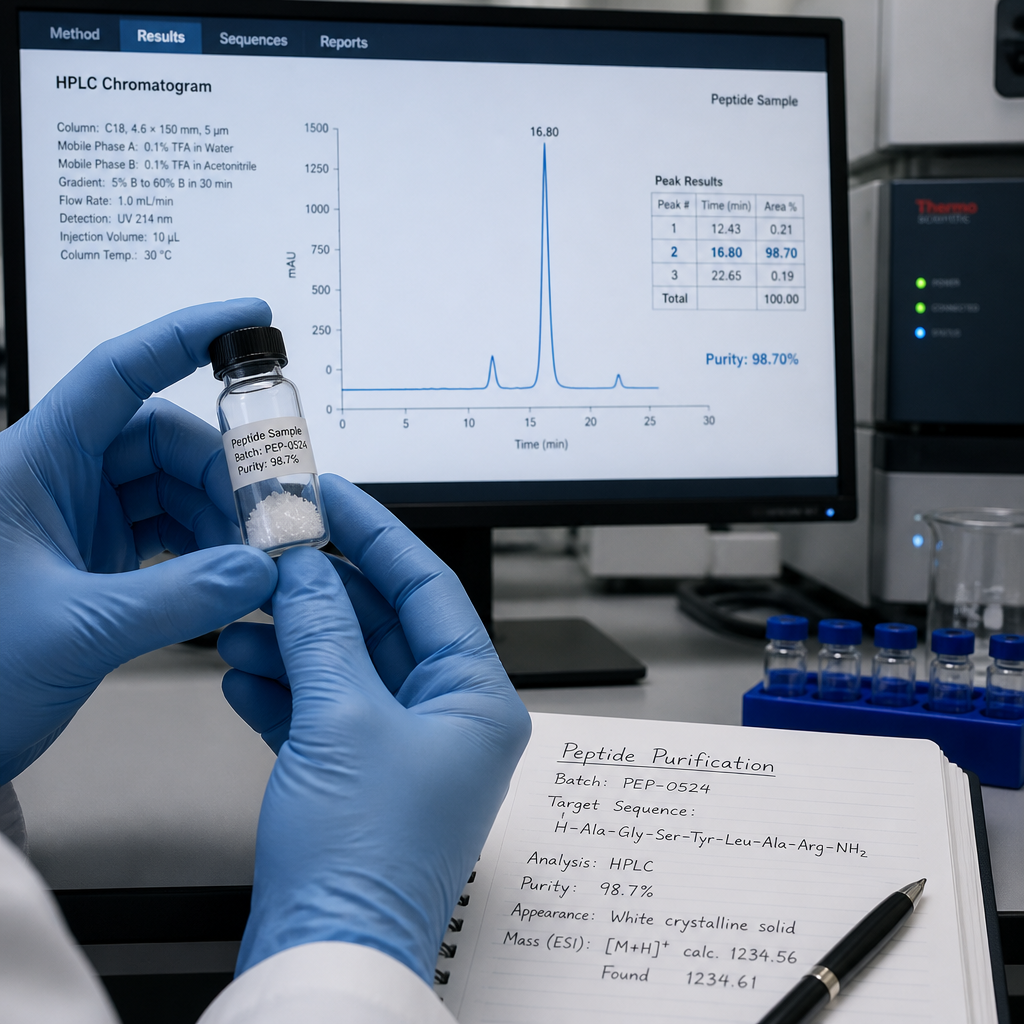
Most purity claims for peptides come from high-performance liquid chromatography, usually abbreviated HPLC. The instrument separates the components of a sample and records how much signal each one produces. A reported purity of 99% typically means that 99% of the detected signal at the chosen wavelength falls under the main peak, under that specific method.
That number is useful, but it answers a narrower question than most buyers assume. It tells you about the relative composition of what was detected. It does not tell you how much peptide is in the vial, and it does not tell you whether a shoulder or co-eluting impurity is hiding under the main peak.
Reading the Chromatogram Instead of the Summary
Ask for the chromatogram itself, not only the purity number on a summary page. Look for a clearly defined main peak, a stated detection wavelength, and a method description that names the column and gradient. A sharp, clean trace with a well-described method is far more credible than a single percentage with nothing behind it.
Pay attention to peak shape. Shoulders, tailing, or small peaks clustered near the main one can indicate truncated or modified sequences that a simple purity figure will not reveal. If the supplier cannot provide the raw trace, treat the purity number as unverified.
Net Peptide Content and Counterions
Lyophilized peptides are not pure peptide by weight. They carry water and counterions, such as acetate or trifluoroacetate, left over from synthesis and purification. Two vials that both report 99% purity can contain different amounts of actual peptide per milligram.
If your concentration calculations or dosing series depend on accurate mass, ask for net peptide content. A lab that skips this step can end up with a dose-response curve that is internally consistent but shifted in a way nobody can explain.
COA Documentation: What to Demand
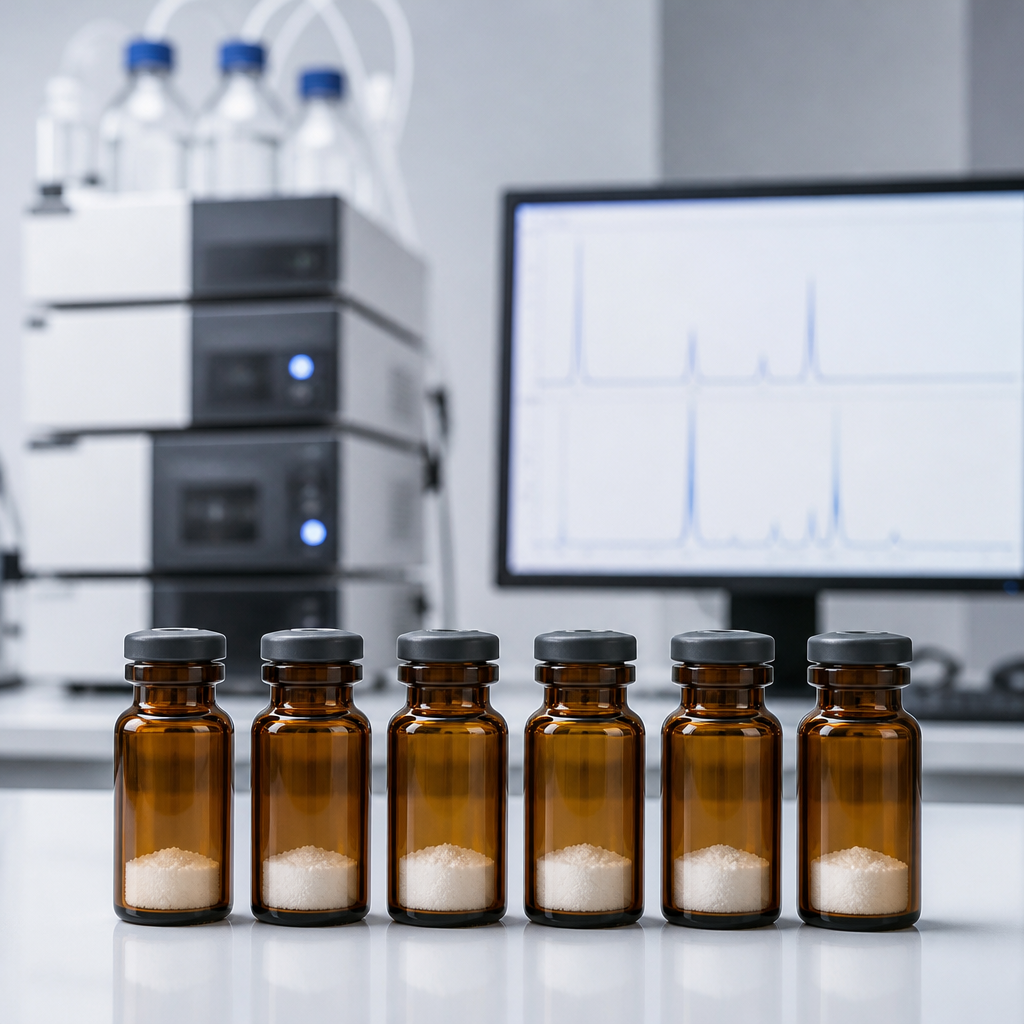
A certificate of analysis is only as good as its traceability. The minimum you should expect is a lot or batch number that matches the label on your vial, the date the sample was tested, the name of the testing laboratory, the method used for each test, and the result. Summary pages with no linked data are not enough for a serious research program.
In practice, most BPC-157 certificates focus on purity and very little else. That is a gap worth naming in your procurement file. Identity, water content, and contaminant testing should be asked for explicitly, because they are not guaranteed by a purity figure.

Lot Matching and Batch Traceability
The most common documentation failure is a certificate that describes a different lot than the one that shipped. Compare the lot number on the COA with the number printed on the vial before you accept the delivery. Photograph both, and store the images with your receiving record.
This is the standard Pepura Labs applies to its own Retatrutide compounds: batch-level documentation, independent verification by Canadian laboratories, and a Chain of Custody file that accompanies the product. Whatever supplier you use, the test is the same. Can you connect this vial, through a number, to a dated test result from a named lab?
Independent Testing Versus Supplier-Written Summaries
A certificate written by the supplier is a statement, not an independent measurement. That does not make it false, but it does mean the supplier is grading its own work. Independent testing by a third-party laboratory gives you a second set of eyes and a clearer chain of responsibility.
If a supplier offers only its own summary, ask whether the underlying raw data can be shared with your team. A reputable supplier will answer that question directly. Vague answers are usually the answer.
Chain of Custody From Synthesis to Your Bench
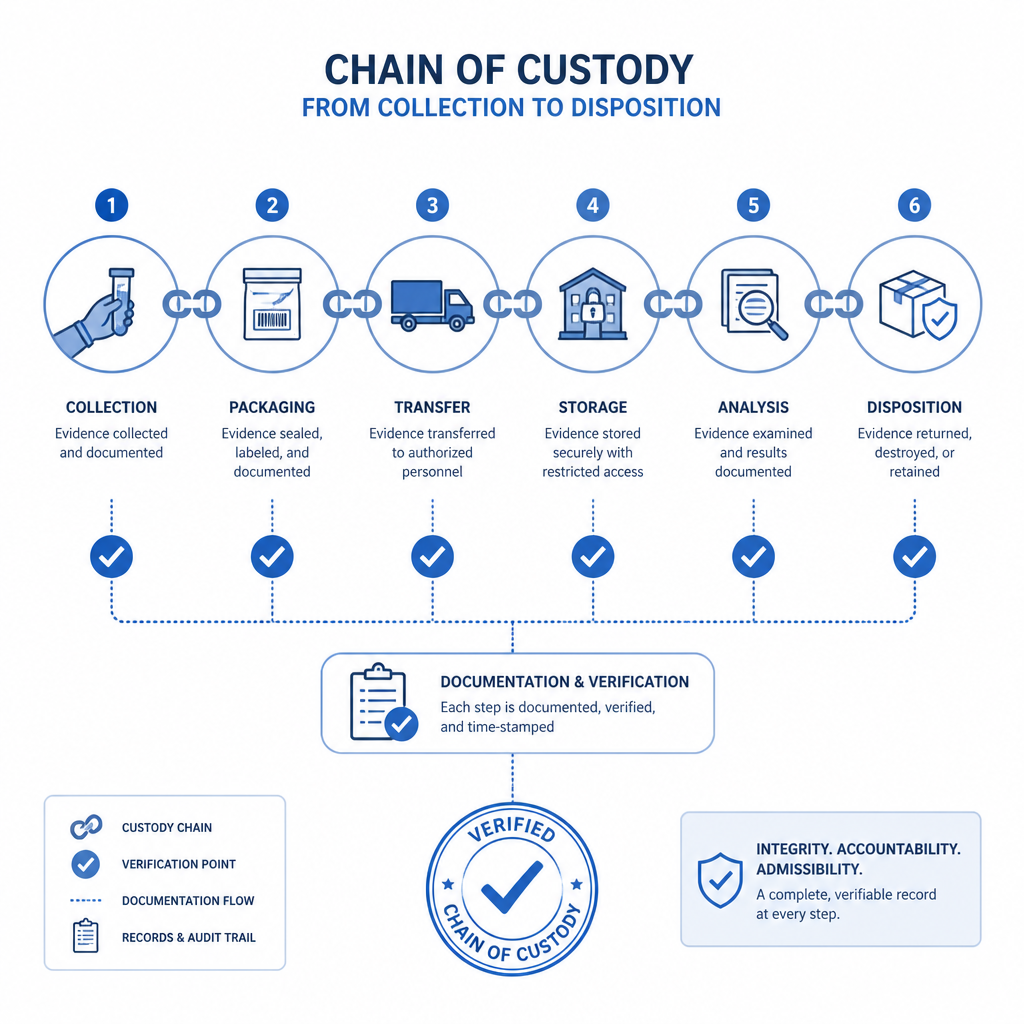
Chain of custody is the documented record of who handled the material, where it was stored, how it was shipped, and when it was received. For a research peptide, it covers synthesis, purification, lyophilization, sampling for testing, packaging, courier transit, and receipt at your facility. Each step should carry a date, a responsible party, and a storage condition.
Gaps tend to appear at the edges of that chain. A batch can be tested correctly and then sit at an unrecorded temperature in a warehouse, or get split into smaller vials without a new label. Once those gaps exist, no certificate can close them retroactively.
Receiving Inspection Checklist
When a package arrives, confirm that the outer packaging is intact, the seal on the vial is undamaged, and the label matches the paperwork. Check the lot number on the vial against the COA, and log the arrival date and condition. If anything is off, document it before you open the package further.
Canadian winter shipments can spend time in cold vehicles or cargo areas. Ask your supplier how packages are protected in transit and what the expected conditions are. Lyophilized material is generally more stable than reconstituted solution, but temperature history still belongs in your records.
Where Custody Gaps Usually Hide
The most common gaps are internal. A lab splits a vial for two projects, relabels the aliquots by hand, and then cannot match them back to the original COA. Build a rule that every aliquot gets a new label that references the parent lot number, and keep a simple log of who made each split.
Comparing Sourcing Approaches
Labs usually encounter three kinds of documentation when they buy BPC-157. The table below compares them by what they let you prove and what risk they leave in your study. The difference is not subtle once you put the three side by side.
| Sourcing Approach | What You Get | Risk for Your Lab |
|---|---|---|
| Lot-linked COA from an independent Canadian laboratory | Lot number, test dates, named lab, method for each test, and HPLC and mass spectrometry data | Lowest risk. You still need to confirm the lot number on arrival and keep custody records. |
| Supplier-written purity summary | A single purity figure, often without a lot link or raw chromatogram | You cannot confirm what was tested, when it was tested, or whether it matches your vial. |
| "Research grade" label with no documentation | A product name and marketing language only | Unverifiable. Results built on this material are hard to defend in a manuscript or an audit. |
The middle row is where most labs end up by default, because it looks like documentation. The question to ask is simple: if a reviewer asked you to show the test that corresponds to this exact vial, could you do it in ten minutes? If the answer is no, the sourcing approach is not finished.
Pro tip: Keep a single sourcing file per compound that contains the COA, the lot-matched label photo, the receiving log, and the aliquot records. Reviewers and auditors usually ask for these together.
Oral Versus Injectable Claims and the Evidence Gap
Many supplier and wellness pages make confident statements about which route of BPC-157 is more absorbed or more effective. Those statements usually cite numbers that look precise, such as oral absorption ranges or near-complete injection bioavailability. Those figures are not validated human facts, and they should not appear in a study design as if they were.
The evidence on route comparisons is mostly preclinical, and there is no meaningful head-to-head human comparison of oral and injectable forms. The US Food and Drug Administration has also stated that there is no approved BPC-157 product, no standardized human dose, and that clinical safety information remains insufficient. For a research lab, that is a clear signal to treat route differences as a question you must measure yourself.
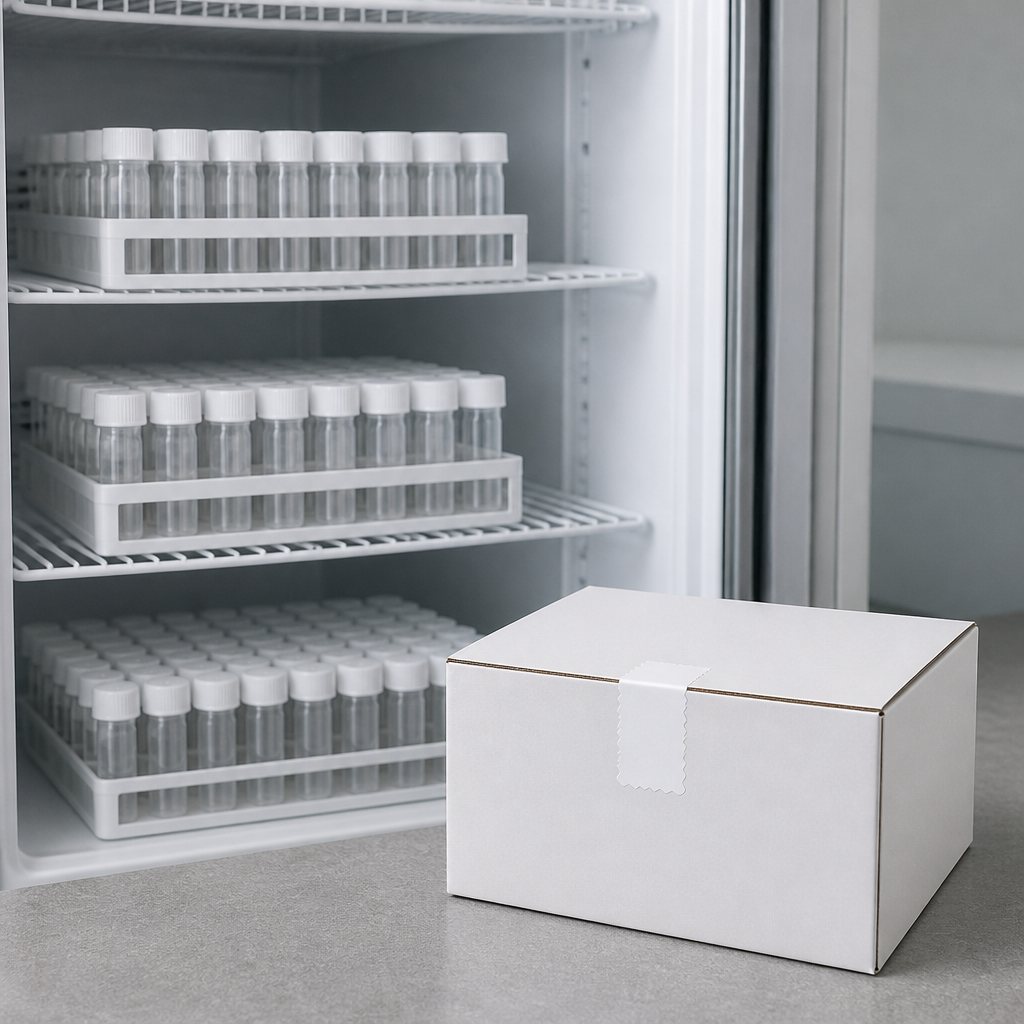
Route Claims Versus Measured Data
If a route comparison matters to your study, it has to be measured in your own system with proper controls. That means defined sampling times, validated analytical methods, and a clear statement of what you are comparing. A marketing claim that one route is better absorbed is a hypothesis, not a result.
Designing a Route Comparison Correctly
Use the same lot of material across both arms whenever you can, and document any differences in formulation or diluent. Otherwise you may be measuring the lot or the vehicle instead of the route. This is one of the most common confounds in peptide studies, and it is easy to avoid if you plan for it.
Storage, Reconstitution, and Diluent Choice
Storage problems often start after the material passes inspection. Lyophilized peptide should be stored cold, dry, and protected from light, according to the storage instructions on the COA or product sheet. Repeated freeze-thaw cycles degrade peptide solutions, so reconstituted material should be divided into single-use aliquots soon after it is prepared.
Diluent choice is an assay decision, not a convenience decision. Bacteriostatic water contains a preservative that makes it suitable for multi-use reconstitution, and Pepura Labs offers bacteriostatic water for laboratory use. Whether it is appropriate for your work depends on your assay, because preservatives can interfere with some cell-based or animal readouts.
Reconstitution Records
Record the date, the diluent lot, the volume added, the calculated concentration, and the storage location for every reconstitution. Without those details, a concentration error discovered months later cannot be traced back to its source. That record is part of your chain of custody, even though it is created in your own lab.
Diluent Compatibility With Your Assay
Before you use any preserved diluent, check that the preservative does not affect your readout. If your assay is sensitive to it, switch to an appropriate unpreserved option and document the change. A small validation run is cheaper than discovering interference in the middle of a study series.
Pro tip: Aliquot reconstituted peptide immediately after mixing, label each aliquot with the parent lot number, and log the freezer position. A vial that is opened and refrozen repeatedly is one you can no longer defend.
Frequently Asked Questions
Is BPC-157 legal to buy for research in Canada?
BPC-157 is not an approved drug in Canada and is not sold for human use. It is handled as a research compound for laboratory use, so your purchase should be framed and documented that way. Check your institution's ethics and biosafety rules before ordering.
Does a 99% purity figure mean the vial is 99% peptide by weight?
No. A purity percentage from HPLC describes the relative signal of the main peak under a specific method. It does not account for water or counterions, which is why net peptide content is a separate measurement.
What should a BPC-157 certificate of analysis include?
At minimum, it should list the lot number, test dates, the testing laboratory, the method for each test, and the results. For serious research use, ask for identity confirmation by mass spectrometry and the raw chromatogram or spectra behind the summary.
Why does chain of custody matter if the COA looks correct?
A certificate only proves something about the lot that was tested. Chain of custody shows that the vial in your freezer is the same material, handled under known conditions, from that test to your bench. Without it, a correct certificate can still describe the wrong vial.
Can oral and injectable BPC-157 be compared using published human data?
Not in a meaningful way. Human data is very limited, and there is no direct head-to-head comparison of oral and injectable forms. Route differences need to be measured in your own study design with controlled material.
What is the most common sourcing mistake labs make?
Accepting a purity summary that cannot be linked to the specific vial on the bench. The fix is simple: match the lot number on arrival, keep the COA in your sourcing file, and log every aliquot against the parent lot.
Share your own experience with BPC-157 documentation, whether you have found a certificate format that makes lot matching easy or a supplier practice that caused you problems, because real lab workflows are the best test of any sourcing checklist.
References
- McGill Office for Science and Society critique of the human evidence for BPC-157
- Guide to buying BPC-157 in Canada and what certificates typically test