Ask a research lab when its retatrutide timeline results will be ready, and you will often get a shrug or a date that assumes nothing goes wrong. Timelines for peptide work are set by documentation as much as by bench time. A lot that arrives without a clean certificate of analysis, or a batch record with a gap in it, can stall a study for weeks. This guide covers what labs should expect this fall, what the published retatrutide data can and cannot tell you, and which records to capture at every step so your results hold up when someone asks how they were produced.
Table of Contents
- Quick Takeaways
- What the Published Retatrutide Data Actually Shows
- Mapping a Realistic Retatrutide Timeline
- Documentation That Holds Up Under Review
- Reconstitution, Storage and Stability Checkpoints
- Comparing Three Ways to Track Results
- Common Documentation Mistakes That Delay Results
- Frequently Asked Questions
- References
Quick Takeaways
| Key Insight | Explanation |
|---|---|
| Plan around milestones, not calendar dates | Set internal checkpoints for receipt, verification, reconstitution and assay readiness. A date tied to a milestone moves for a reason you can document, while a calendar date just slips silently. |
| Verify the certificate before you open the vial | Match the lot number on the vial to the lot number on the certificate of analysis and your batch record before any work begins. |
| Log the diluent lot with every preparation | Record the bacteriostatic water lot, volume added, time, and operator for each prep so the stock can be traced later. |
| Start stability tracking on day one | Note storage temperature, time out of storage, and freeze-thaw events. These are the variables that quietly change results. |
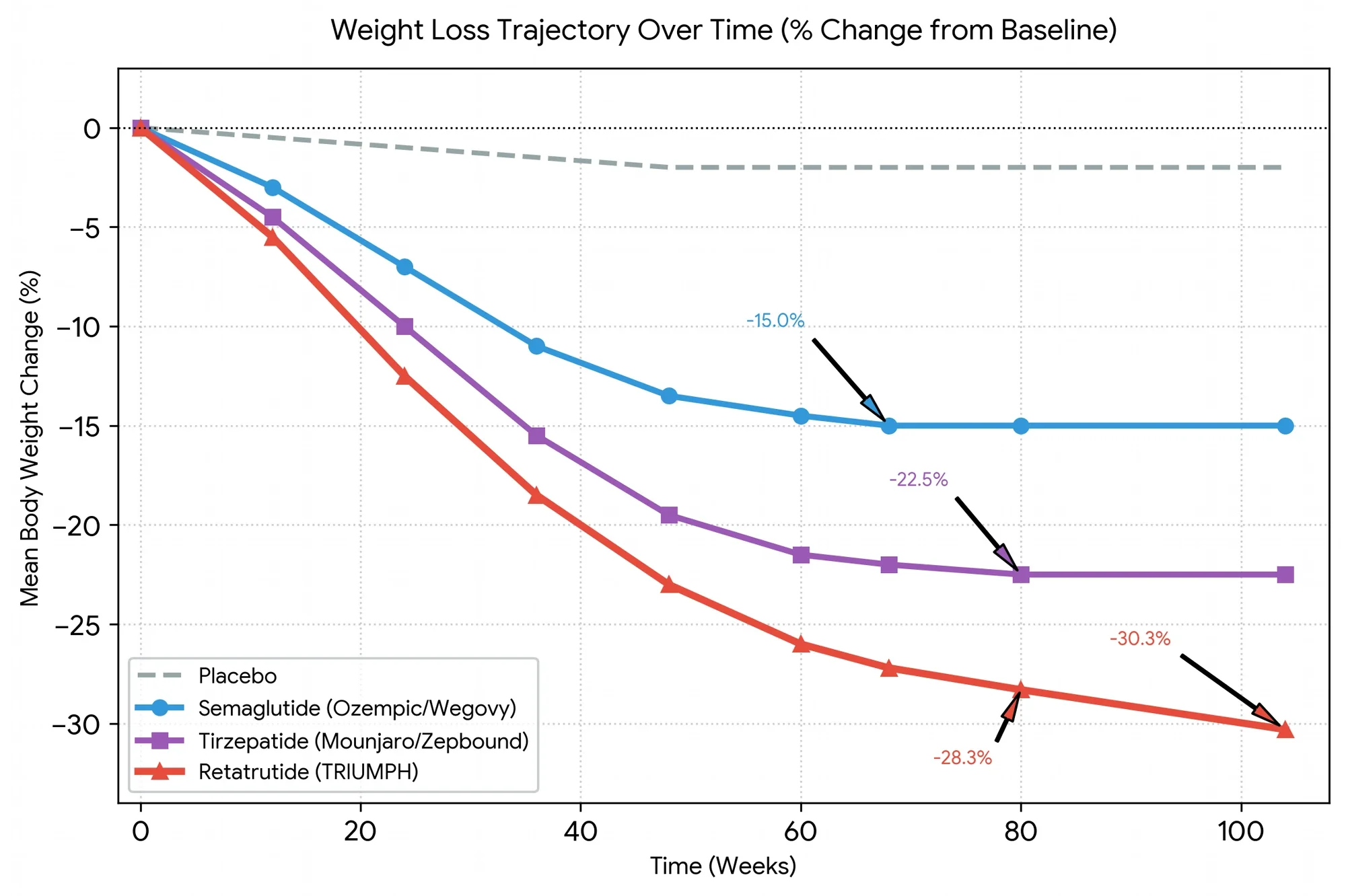
| Treat published trial data as a benchmark, not a forecast | Lilly reported an average 28.3% weight loss at 12 mg over 80 weeks in TRIUMPH-1. Your in vitro readouts will not map onto those figures directly. |
| Keep the chain of custody unbroken | Log every handoff between courier, receiving bench and storage, including Canadian Xpresspost transit, so no step in the record depends on memory. |
What the Published Retatrutide Data Actually Shows
Before you build a timeline, you need to know what the public record supports. Retatrutide is a novel agonist that acts on GLP-1, GIP and glucagon receptors, and its clinical work has centred on obesity treatment. A 2025 systematic review and meta-analysis of randomized controlled trials, published in Proceedings (Baylor University Medical Center), pooled the trial evidence on its efficacy and safety.

The headline figure most people cite comes from Lilly's pivotal Phase 3 program. In TRIUMPH-1, participants on 12 mg retatrutide lost an average of 70.3 lbs (28.3%) over 80 weeks, and 45.3% of participants reached a weight reduction of at least 30%. A UCHealth summary of the research describes the average loss as rivaling results seen with weight-loss surgery.
The number in a press release is the endpoint of a clinical program, not a deadline for your bench. Build your timeline around the steps your lab controls.
Read those figures carefully. They describe human participants in a clinical setting, followed for a long period under a protocol with its own dosing, monitoring and endpoints. They do not describe how a compound behaves in your assay, and they cannot tell you how fast your own readouts will mature.
What the public data does give you is a set of defensible reference points: the length of the program, the endpoints researchers track, and the kind of safety monitoring the field expects. Use these to justify your study design, then document every place where your own work diverges from them.
Mapping a Realistic Retatrutide Timeline
Weeks 1 to 2: Receipt and Verification
The clock starts when the package arrives, not when the project was approved. Open the shipment, match the lot number on each vial against the certificate of analysis, and confirm the lyophilized material looks as the documentation describes. Your receiving log is the record that matters inside your own building, even when the supplier ships with full Chain of Custody paperwork.
If the lot does not match, stop. A two-day delay at intake costs far less than a week of work on stock you cannot trace.
Weeks 2 to 4: Reconstitution and Baseline Logging
Reconstitution is where most timelines quietly slip. Record the bacteriostatic water lot, the volume added, the time, the operator, and the resulting concentration calculation. Take a baseline aliquot and label it so every later measurement can be compared against a known starting point.
In practice, a lab that logs baseline values on day one can explain a drift in week six. A lab that skipped that step is left guessing whether the drift came from the compound, the diluent or the freezer.
Months 2 to 4: Assay Readiness and Interim Checkpoints
Set interim checkpoints tied to assay readiness rather than calendar dates. A checkpoint might be a passing calibration run, a completed stability panel, or a signed control sheet. When a checkpoint slips, the timeline moves with it, and the change goes into the log with a reason attached.
Pro tip: Keep the timeline in a shared document with one column for the planned date, one for the actual date, and a short reason for every gap. Co-investigators and reviewers read the gaps first.
Documentation That Holds Up Under Review
Certificate of Analysis Checks
A certificate of analysis is only useful if you read it line by line. Check the stated purity, the analytical method, the test date and the lot number. Pepura Labs offers retatrutide lots at 99% purity or higher, but confirm the exact figure on the certificate for your specific lot rather than relying on a product listing.
Chain of Custody Records
Chain of custody is a sequence of recorded transfers, not a single document. From the moment a lot leaves the supplier, every transfer should show who took possession, when, and under what storage conditions. Gaps in that sequence are what reviewers flag first, even when the compound itself is sound.
Batch Traceability Across Your Own Records
Link each experiment to a lot number, not only to the compound name. If three studies use retatrutide from two lots, your results need to state which lot produced which data. Batch traceability is what lets you separate a lot effect from an assay effect when a result looks wrong.
Keep each certificate as a PDF in the same folder as its experiment file, with the lot number and download date in the file name. It sounds trivial until you need it the morning a submission is due. You can review the Pepura Labs retatrutide range and match lot details against your own records.
Reconstitution, Storage and Stability Checkpoints
Stability is the variable labs most often underestimate. Retatrutide is supplied as a lyophilized peptide, and its behaviour after reconstitution depends on the diluent, temperature, elapsed time and how many times the stock is opened. None of these conditions is exotic, but each one needs a number in your record.

Bacteriostatic Water as the Diluent
Bacteriostatic water is the diluent most labs choose when a stock will be sampled more than once. Record its lot, store it according to its own label, and log every time a diluent vial moves between benches. A mismatch between diluent lots is an easy variable to miss, and it can look exactly like a compound problem.
Freeze-Thaw Cycles and Aliquoting
Divide reconstituted stock into single-use aliquots as soon as your protocol allows. Each freeze-thaw cycle is an uncontrolled event, and a log entry that reads "thawed twice" is far more useful than one that reads "stored in freezer."
Temperature Logs That Match the Timeline
Pull the storage unit's temperature records and attach them to the study file for the full period. If a freezer alarm sounds on day 40, you need to know whether the stock was affected before you use it on day 41, not after the data has been generated.
Comparing Three Ways to Track Results
Labs usually settle on one of three approaches to track retatrutide timeline results. Each has a clear use case, and each fails in a predictable way. The table below compares them on the criteria that matter when a timeline has to be defended.
| Approach | Best Use | Where It Breaks Down |
|---|---|---|
| Milestone log in a shared spreadsheet | Small teams tracking receipt, preparation and checkpoint dates | Entries are easy to edit after the fact, so version history and timestamps must be enforced |
| Electronic lab notebook with lot-linked entries | Multi-lot studies where each data point must trace back to a certificate of analysis | Requires training, and the record is only as strong as the habits of the people entering data |
| Paper bench binder with signed pages | Labs with strict rules on physical records and limited software access | Hard to search across studies, and scanned copies can drift from the originals |
In our experience, the strongest setup pairs a lot-linked electronic record with signed bench sheets for reconstitution and storage events. Use the spreadsheet for planning, not as the official record. Whichever method you choose, decide it before the first vial is opened so the record does not change shape halfway through.
Common Documentation Mistakes That Delay Results
Most documentation problems are not dramatic. They are small omissions that compound over a study, and they tend to surface only when someone asks for the file. The three mistakes below show up most often in lab reviews we see.
Logging the Compound but Not the Diluent
Many labs record the retatrutide lot carefully and then write "BW" or "diluent" with no lot number. When results drift, the diluent is the first thing a reviewer will ask about, and the record has no answer. Treat the diluent with the same discipline as the compound.
Treating the Certificate as a One-Time Download
A certificate saved on receiving day is not the same as a certificate you can produce at review time. Check that the file still matches its lot after any folder reorganization, and keep a second copy in your archive system.
Backdating Entries After a Delay
Late entries are normal. Backdated entries are not. Write the actual time of entry, mark the record as late, and explain the gap in a sentence. A transparent late entry costs you very little, while a suspicious one can put the whole dataset in doubt.
Documentation is the timeline. Every week without a complete record is a week your results cannot yet fully support.
Pro tip: Hold a weekly 15-minute records review in which someone other than the bench operator reads every entry from the past seven days. Most gaps surface in that review, long before an audit does.
Frequently Asked Questions
How long do retatrutide timeline results usually take to appear in a lab?
No single number applies to every lab, because the timeline depends on your study design, assay and documentation workflow. The published TRIUMPH-1 program ran for 80 weeks in human participants, but in vitro work follows your own milestones. Plan receipt, verification, reconstitution and assay readiness as separate stages, and attach a date to each.
What should a certificate of analysis include before a lab accepts a retatrutide lot?
Check the lot number, the stated purity, the analytical method, the test date and the issuing laboratory. Confirm that the lot number on the certificate matches the vial label. If any of those items is missing or does not match, hold the lot and contact the supplier before opening it.
Does a higher purity figure guarantee better timeline results?
No. Purity affects how cleanly your data reads, but timelines slip for reasons unrelated to purity, such as unlogged freezer excursions, mismatched diluent lots or assays that have not been validated. Treat purity as one input among several.
Can one retatrutide stock be used across multiple experiments?
Yes, provided your stability data supports it and every experiment records the lot, the aliquot used and the number of freeze-thaw cycles. Without that record, you cannot separate a stock effect from an experimental effect when results diverge.
What is the most common reason a lab has to repeat its documentation?
In our experience, it is a gap in the chain of custody between receiving and storage. Labs often log the arrival but not the internal transfer, and reviewers flag that gap first. Record every handoff, including who moved the vial and where it was stored.
Tell us which checkpoint has slipped the most in your own retatrutide work, and which record you wish you had started keeping sooner.
We would love your feedback and any insights you would share with others. What perspective would you add?