If you have ever held a TB-500 vial and wondered whether the powder inside matches your study protocol, you are asking the right question. TB-500 sits in an unusual spot in peptide research. The name is widely used, but much of the published work describes thymosin beta-4, a longer natural protein, not the shorter synthetic fragment sold under the TB-500 label. That gap makes the certificate of analysis the most important document in your file before winter studies begin. This guide walks through how to read a TB-500 COA line by line, which checks actually confirm identity and purity, and where a clean-looking report can still hide a problem.
Table of Contents
- Quick Takeaways
- What TB-500 Actually Is
- Why Identity Comes First
- Reading a COA Line by Line
- Verifying Purity Before Use
- Comparing Verification Approaches
- Winter Storage and Shipping
- Pre-Study Verification Checklist
- Frequently Asked Questions
- References
Quick Takeaways
Key Insight | Explanation |
|---|---|
Identity comes before purity | A high purity percentage means little if the main peak belongs to the wrong molecule. Confirm the measured mass first, then read the purity figure. |
TB-500 is a fragment, not thymosin beta-4 | Much of the published evidence describes the full 43-amino-acid protein, so match your study design to the exact material you are buying. |
Purity is a share of detected peaks | An HPLC purity value reflects the area of the main peak at a stated UV wavelength. It does not prove that nothing else is in the vial. |
Net peptide content is not purity | Lyophilized powder carries water and salt counterions. Calculate weight-based doses from the net content line, not the gross powder weight. |
The lot number must match everywhere | The vial label, invoice and COA should carry the same batch identifier, or you cannot trace the material back to its test results. |
Ask for the raw chromatogram | A summary table hides baseline noise, shoulder peaks and integration choices. The raw trace shows what the summary smooths over. |
Winter changes the handling plan | Plan receiving and freezer placement so packages do not sit in sub-zero conditions before the material reaches controlled storage. |
What TB-500 Actually Is
TB-500 is a synthetic peptide fragment modeled on thymosin beta-4, a naturally occurring protein of 43 amino acids found in nearly every human and animal cell. Researchers use the fragment because the work around thymosin beta-4 points to cell movement and tissue repair. Those are the properties most studies try to probe, and they are why the molecule matters in a research setting.
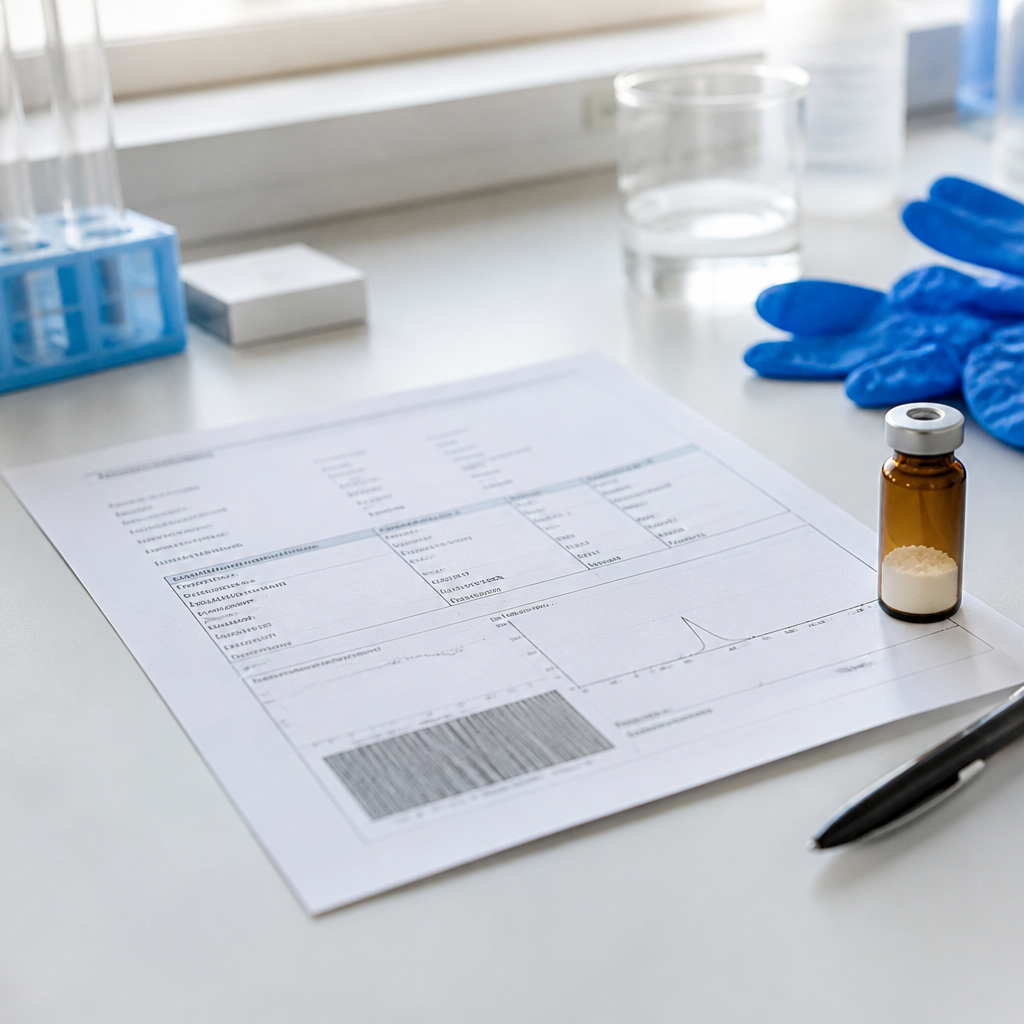
In practice, the first problem most buyers hit is a naming one. The label on a vial says TB-500, but a lot of the published literature describes the full thymosin beta-4 protein. If your study design cites one molecule and your vial contains the other, the data you collect will not mean what you think it means.
Fragment versus full thymosin beta-4
The two molecules share a lineage, but they are not interchangeable. Thymosin beta-4 is the full natural protein. TB-500 is manufactured to reproduce a region of it, so its sequence, length and behavior in solution can differ from the parent protein. A COA that reports only a purity number says nothing about which of these two molecules you have.
Before you order, write down the exact molecule your protocol requires, including whether it is the fragment or the full protein. Then confirm that the COA identifies that molecule by its measured mass, not just by its trade name. A mismatch caught at this stage costs a few minutes, while one discovered after a winter of data collection can cost the entire study.
Why actin binding drives the research
Most of the interest in this area comes from a single mechanism. Thymosin beta-4 binds actin, the protein that forms part of the cell's internal scaffolding, and that binding influences how cells move and reorganize. Research on TB-500 typically looks at cell migration, extracellular matrix work and wound healing models, all of which trace back to that interaction.
A label tells you what the seller intended to sell. Only the analytical data tells you what is actually in the vial.
Why Identity Comes First
Identity testing answers the question every other number depends on: is this the molecule you think it is? Purity only means something once identity is settled. A chromatogram can show one clean, sharp peak that belongs to the wrong compound, and the purity figure will still look excellent.
What mass spectrometry should confirm
Mass spectrometry measures the mass of the molecule as it leaves the column. A useful COA reports an observed mass alongside the expected mass for the sequence, and the two should agree within the tolerance the report states. If the document says only "conforms to structure" without a number, request the spectrum before you rely on it.
Look at how the mass was calculated. Peptides often appear as several charged species, and a good report explains which one was used. A vague report leaves you guessing whether the agreement is real or simply convenient.
Sequence labels that do not match the molecule
The most common identity problem buyers run into is a label that uses a trade name without a sequence or structure reference. Two sellers can market a product under the same name and deliver different material, so the name alone cannot anchor a study. Treat the vial label, the invoice and the COA as three separate claims that must agree on both the lot number and the molecule.
Pro tip: Copy the lot number from the vial label into your lab notebook before you open the COA, then check it against the document line by line. Many mismatches only surface because the notebook was filled in first.
Reading a COA Line by Line
A COA is a short document full of technical shorthand, and most of its value sits in a handful of lines. Read it in order: header, method, purity, identity, peptide content, then any contamination or safety testing. Jumping straight to the headline purity figure is the most common reading mistake.
The header and lot information
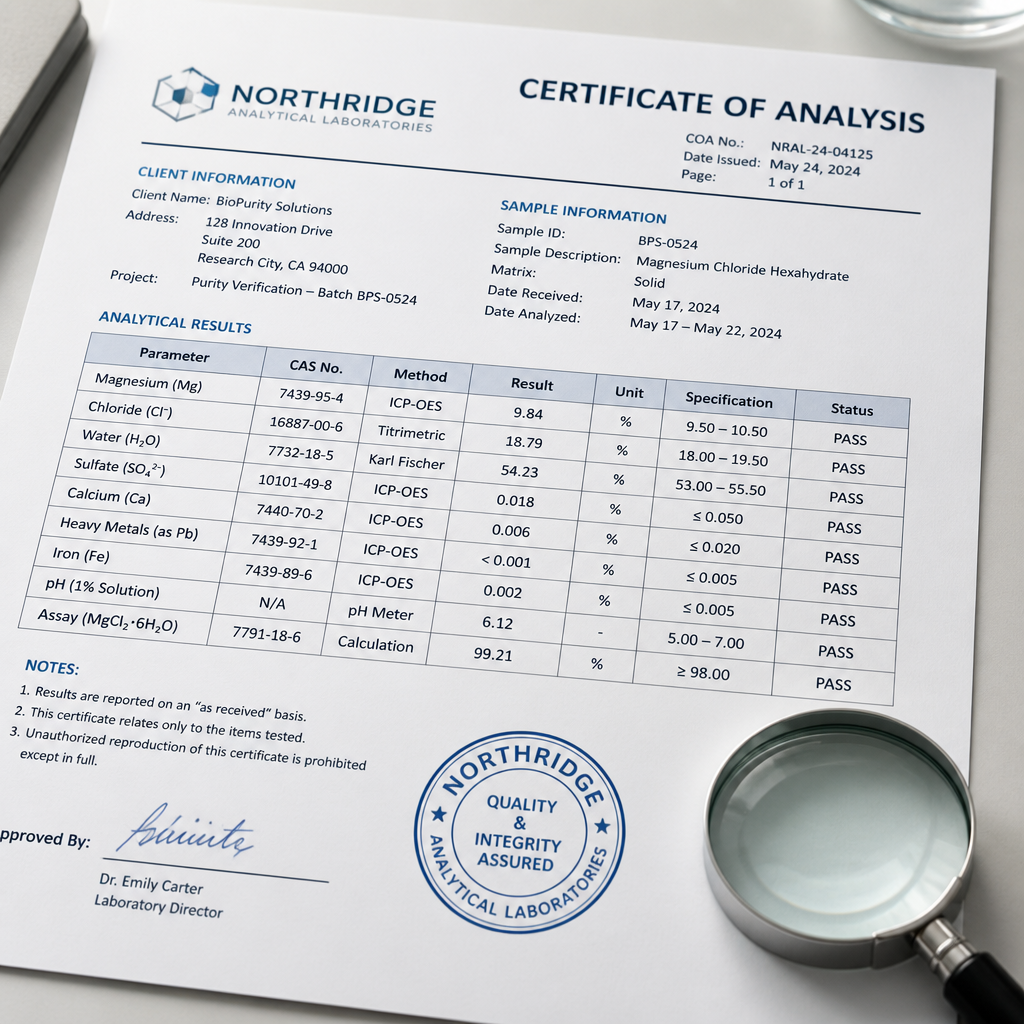
Start with the header. You need the product name, the lot or batch number, the date of analysis, the laboratory name and a contact or accreditation reference. If any of those are missing, the document is not traceable, and traceability is the whole point of a COA.
Next, check the fill quantity against what you ordered. Pepura Labs offers Retatrutide compounds in 10mg, 20mg, 40mg, 60mg and 84mg configurations, so the fill stated on the document should match the configuration on your order and label. A mismatch here is a documentation error worth raising before you reconstitute anything.
The HPLC purity line
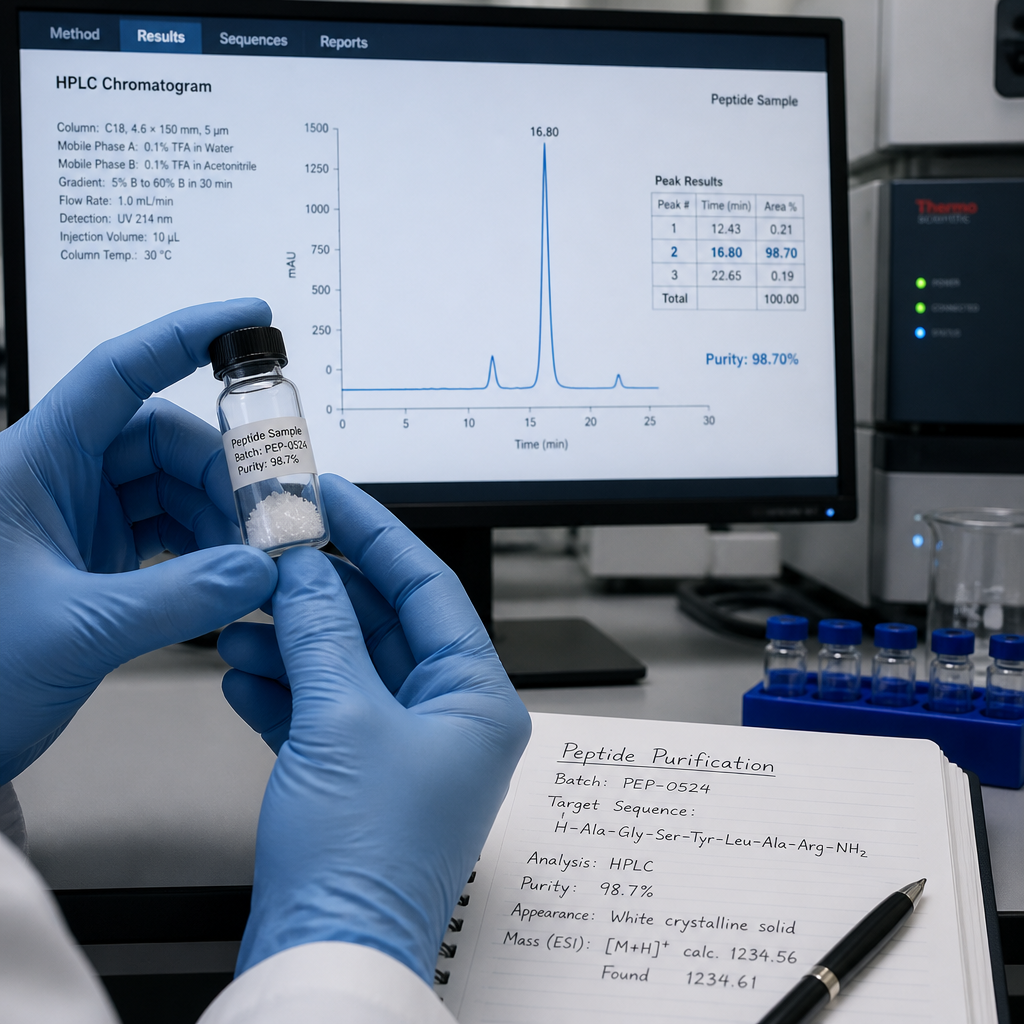
The HPLC purity value is the percentage of total peak area that belongs to the main peak at a stated UV wavelength. It is a relative measure, not a count of everything in the vial. Look for the column type, mobile phase gradient, flow rate and detection wavelength, because a purity number without its method is hard to reproduce.
A common mistake is treating 99% purity as proof that nothing else is present. Impurities that absorb weakly at the chosen wavelength, or that co-elute with the main peak, can sit below what the method detects. This is why purity and identity have to be read together.
Net peptide content and water
Net peptide content is the share of the powder's weight that is actually peptide. Lyophilized peptides carry water and salt counterions from synthesis and purification, so a vial can be highly pure by HPLC and still contain a meaningful fraction of non-peptide mass. If your protocol is weight-based, the net content line is the number that should drive your calculations.
Purity and net content are different claims. Mixing them up produces dosing errors that later look like biological variation.
Pro tip: Calculate working concentrations from net peptide content, not gross powder weight, and write that formula into the protocol itself. This one change removes a common source of unexplained variability.
Verifying Purity Before Use
Reading a COA tells you what the lab reported. Verifying purity means checking whether the underlying data supports the claim. Most of that work happens in the chromatogram, the trace the instrument produced before anyone wrote the summary table.

Reviewing the chromatogram yourself
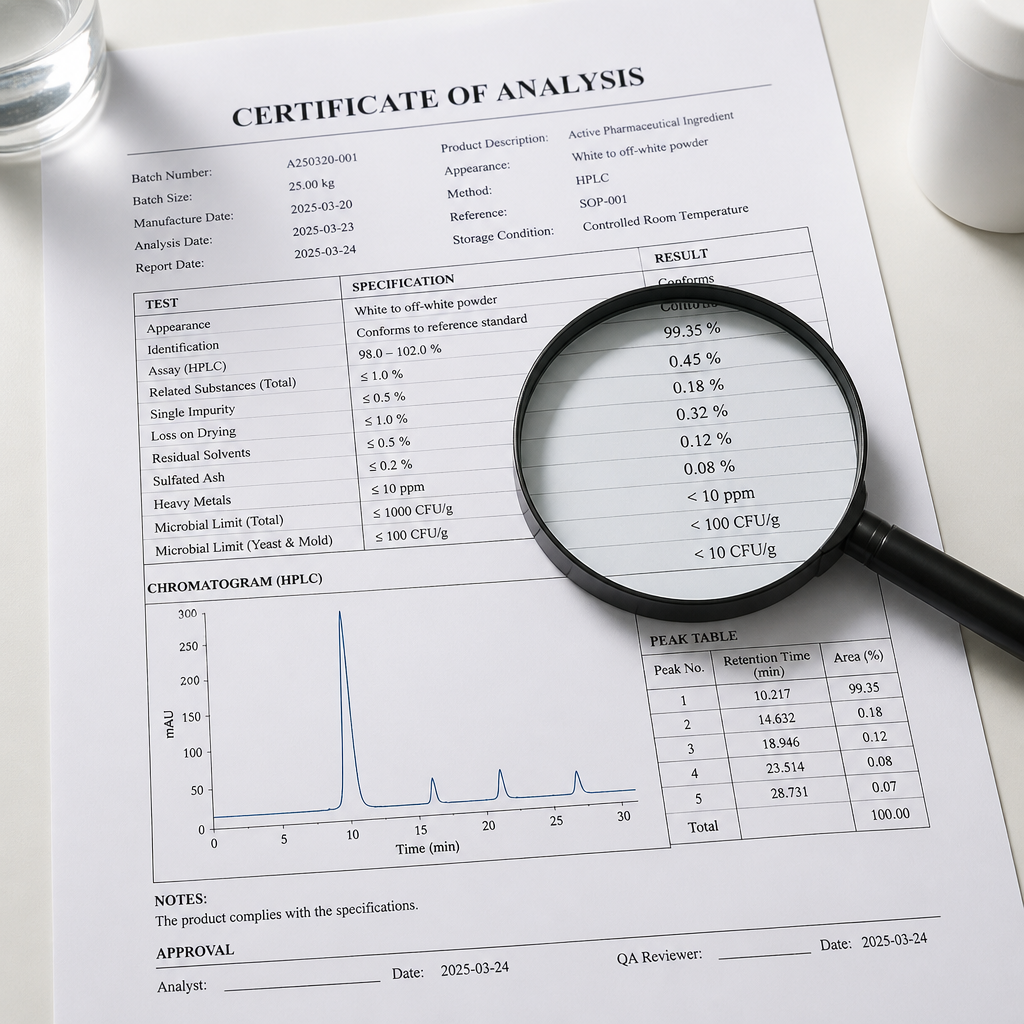
Ask for the raw HPLC trace and look at the baseline first. A noisy or drifting baseline makes small peaks hard to judge, and integration choices can inflate or hide impurities. Next, check the main peak shape. Fronting, tailing or a shoulder can signal co-eluting material even when the percentage looks clean.
Look for peaks you cannot account for. A good lab explains every peak above its reporting threshold and says whether any are related substances, residual solvents or salts. If the report lists one purity number and nothing else, you have a question to send back.
Red flags in the trace
Several patterns should slow you down: a main peak much broader than the others in the same run, integration lines drawn through what looks like a separate compound, and a method that changes between lots without explanation. Each one is a reason to request clarification rather than an automatic rejection, but none should be ignored.
Compare the trace against a reference standard if the lab provides one. Retention time alone is not identity, but a retention time that drifts between your lot and an earlier lot is a useful early warning. The checks in this section matter for any lot, ours included, and they are the ones we would want a buyer to run before committing a study to a batch.
Comparing Verification Approaches
Not every verification route gives the same confidence. Three approaches come up most often in Canadian research labs, and each answers a different question. The table below compares what each one confirms and where it falls short.
Verification Approach | What It Confirms | Where It Falls Short |
|---|---|---|
Summary COA from the seller | Claimed purity and sometimes a mass | No raw data, unclear method, and hard to tie to a specific vial |
Independent lab report with raw data | Identity by mass spectrometry, purity by HPLC, stated method and chain of custody | Represents one sampled portion and depends on the lab's integration and method choices |
Retained-sample testing on receipt | Your own check on the exact vial you plan to use | Needs instrument access, reference standards and trained staff |
The strongest file combines the second and third rows. A summary COA is a starting point, and a lab report without raw data still asks you to trust someone else's integration choices. Smaller labs without mass spectrometry can send a retained aliquot to an outside lab for identity confirmation, which is usually a small expense next to a failed study.
Whichever route you choose, write down which evidence supports each claim in your study file. Reviewers and collaborators will ask where the identity data came from, and "the vendor said so" is not an answer that holds up.
Winter Storage and Shipping
Winter is the stage where a good COA can still lose value. Lyophilized material that is shipped, delivered and stored in cold weather goes through more handling steps than most researchers plan for, and each step is a chance for a lot to change or become hard to trace.
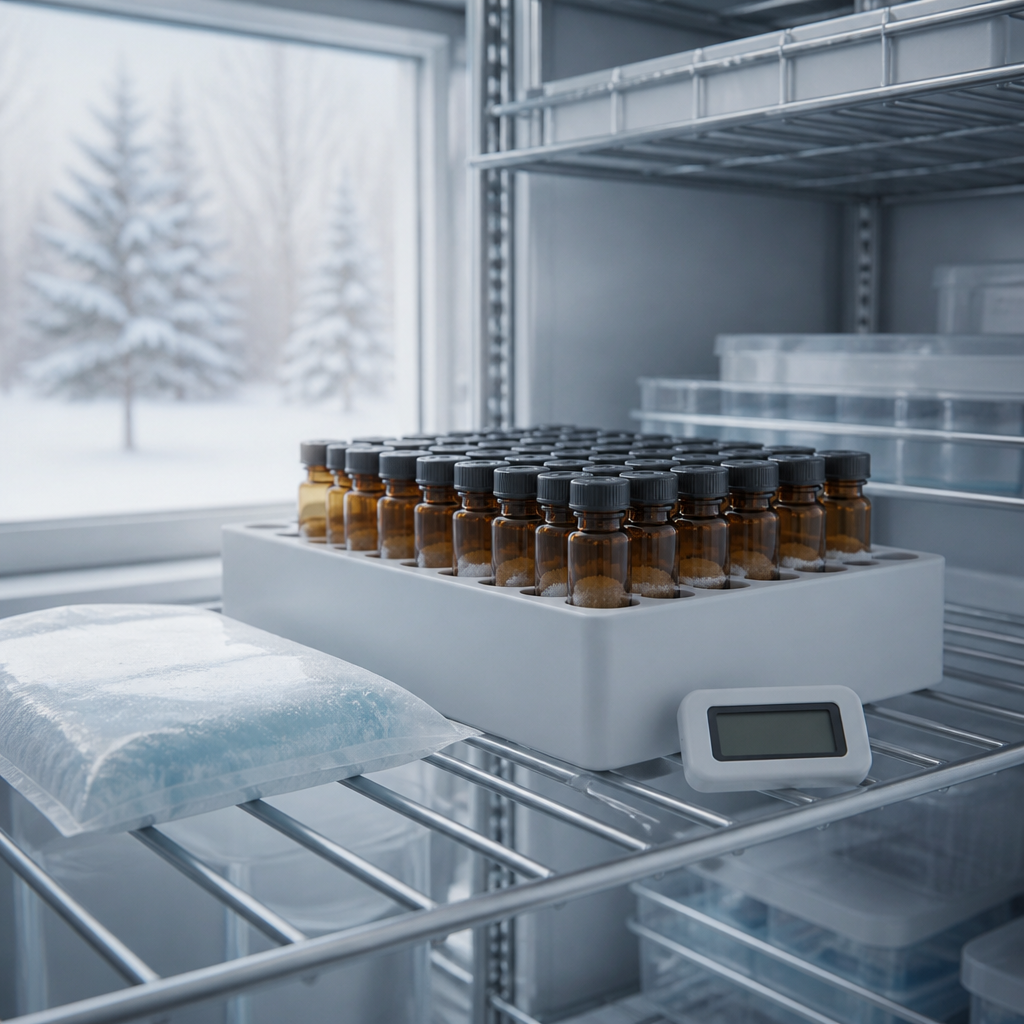
Cold weather transit and receiving
Packages can sit on a porch or in a depot during a cold snap, and the time between delivery and the freezer is the part most people never record. Inspect the package on arrival, note its condition, and move the vial into controlled storage promptly. If a shipment shows signs of temperature exposure, document it with photos and the tracking record before you decide what to do with the lot.
Pepura Labs ships Retatrutide compounds across Canada by Xpresspost, which shortens transit time. Speed does not replace a receiving check, though. A fast delivery that arrives in poor condition is still a problem for your study.
Reconstitution and the diluent record
Reconstitution adds a second material to the experiment. If your protocol uses bacteriostatic water, record its lot number and expiry alongside the peptide lot, and keep the diluent under the same traceability you apply to the peptide. Many unexplained results trace back to a diluent that nobody logged.
Reconstitute only what the session needs, and avoid repeated freeze-thaw cycles on the same aliquot. Preparing aliquots on the day of reconstitution is a practical habit that protects material across a long winter run.
Pro tip: Keep a cold chain log that records the delivery time, the time the vial entered the freezer and the name of the person who handled it. When a result looks odd in February, that log is often the fastest way to rule storage in or out as the cause.
Pre-Study Verification Checklist
A verification process only works if it is written down and applied before any material reaches a protocol. The list below is the one we would use for a winter study, in order. Each item should be signed off before the first dose or draw.
Documents to file before the first draw
Vial label with product name, lot number and fill quantity, photographed on receipt
Full COA showing method, HPLC trace, mass spectrum and net peptide content
Invoice and shipping record matched to the same lot number
Diluent lot and expiry, if reconstitution is part of the protocol
Cold chain log from delivery through storage
Decisions to make before the study starts
Decide in advance what result would cause you to reject a lot. A purity value below your acceptance threshold, a measured mass that does not match the expected value, or an unexplained peak above your reporting limit should each have a written response. Deciding after the data arrives is how labs end up justifying bad material.
Set a retained sample policy as well. Keep a labeled aliquot from each lot under proper storage so that, if a result is questioned later, the same material can go for independent testing. Without it, you have nothing to compare against except paperwork.
Frequently Asked Questions
Is TB-500 the same as thymosin beta-4?
No. TB-500 is a synthetic fragment modeled on thymosin beta-4, a 43-amino-acid natural protein, and the two are distinct compounds. Check the identity data on the COA to confirm which molecule your vial contains.
What is the most important line on a TB-500 COA?
The identity confirmation by mass spectrometry matters most, because a purity figure only means something when the molecule itself has been confirmed.
Does 99% purity guarantee the vial is clean?
No. HPLC purity is the relative area of the main peak at a stated wavelength, so impurities that co-elute or absorb weakly may not appear. Read the method, the trace and the impurity listing together.
How is net peptide content different from purity?
Purity describes the share of detected material that is the target peptide. Net peptide content describes how much of the powder's weight is actual peptide after water and counterions are accounted for. Use net content for any weight-based calculation.
How should I store lyophilized material through a Canadian winter?
Move it into controlled freezer storage as soon as it arrives, log the cold chain from delivery onward, and aliquot to avoid repeated freeze-thaw cycles. Document any temperature exposure during transit before you decide whether the lot is usable.
What is the most useful check you have added to your own COA review process, and what did it catch that the summary missed?
References
Overview of what TB-500 is, how it relates to thymosin beta-4, and why identity matters
Scientific research project on in vitro and ex vivo TB-500 metabolism